Alarm Queue Depth in Commercial Monitoring Centers
Ten years of camera growth left operators drowning in false alarms.

A commercial buyer who signs a monitoring contract is usually paying for the promise of real-time surveillance: a camera sees something wrong, a person looks at it, someone acts. What that buyer actually receives, in most legacy monitoring centers, is a backlog. Alarm queue depth, the number of unresolved events sitting in an operator's review pipeline at any given moment, gets treated as a staffing dial to turn up or down. That framing is backwards. Queue depth is a readout of how much unresolved noise has accumulated, not how busy operators are. It is a readout of whether the surveillance architecture behind them still works. When the number climbs, the honest question is not "how fast can operators clear this?" but "what real event is sitting behind everything already in front of it?" That second question is the one this piece is built to answer.
How camera proliferation outpaced operator capacity
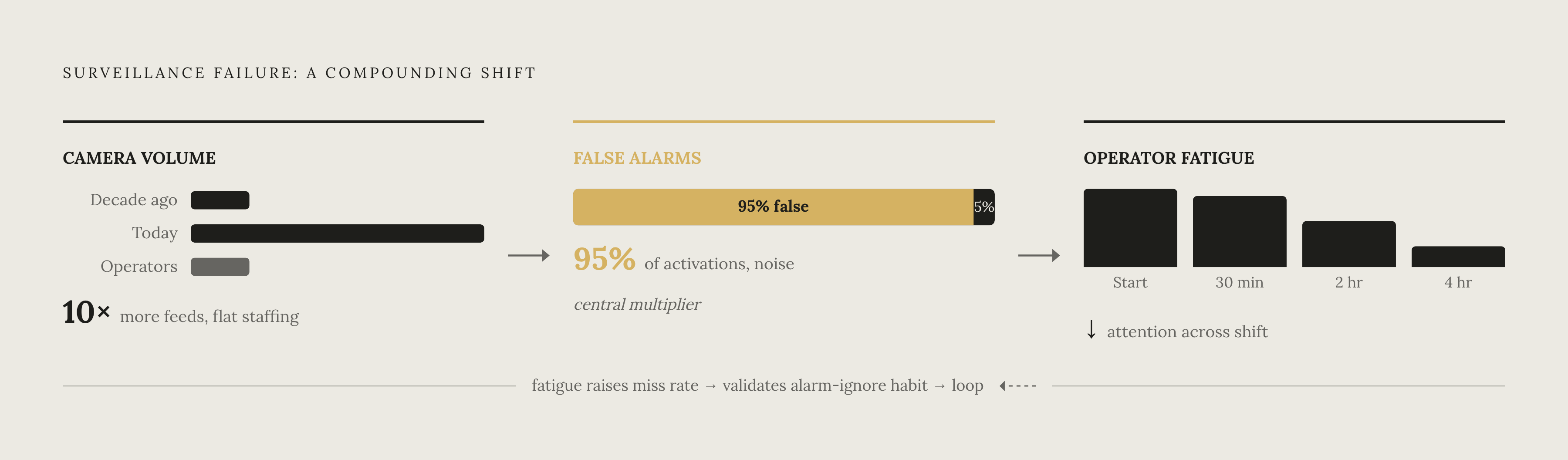
The queue did not appear because operators got slower or lazier. It appeared because the number of cameras feeding a typical monitoring center grew roughly tenfold over the past decade, while the number of people watching for real threats stayed flat, often on the same interfaces and the same platform architecture built around 2012. Headcount didn't grow. Workflows weren't redesigned to absorb the increased input. The math doesn't work, and it was never going to.
That gap is the product of a stack of specific design failures rather than one generic overload. Alarm prioritization schemes built for a lower-volume era don't rank events well when volume spikes. Platforms that don't talk to each other force operators to manually cross-reference data that should already be merged. Situational awareness protocols written for a smaller camera footprint leave operators guessing about context they should have been handed automatically. None of these are failures of the people working the queue. Each is a structural decision, made or left unmade, that determined how much of the incoming flood would reach a human unfiltered.
This has direct consequences for the buyers actually expanding their footprints. This is the compounding failure: high volume fills the queue, high noise degrades trust in the queue, and fatigue degrades the human capacity to work through what remains, three forces that reinforce each other over a shift. It adds more input to a pipe that was already full.
How false-alarm volume overwhelms the queue
Volume alone would be a hard problem. The overwhelming majority of what fills the queue isn't a threat, which is what makes it close to unworkable. Roughly 95% of alarm system activations turn out to be false alarms. The events operators are actually trained and paid to catch make up a small sliver of everything they have to wade through. An operator working the queue in real time is spending most of their attention on noise, by definition, before they ever get to signal.
Every minute spent dismissing a false alarm is a minute not spent on the alarm sitting three positions behind it that might be real. At a 95% noise rate, that tradeoff happens constantly. It's the default condition of the job. The downstream cost of that noise doesn't stay contained inside the monitoring center, either. The Security Industry Alarm Coalition reports that police respond to tens of millions of false alarms every year, at a cost running into the billions of dollars, a burden that has made some dispatch agencies slower and more skeptical toward monitoring-center calls generally. Noise inside the queue degrades trust outside it.
The sources of that noise are specific and repeatable. They're specific, repeatable, and tied to the physical realities of a given site: headlights sweeping across a detection zone, rain or insects triggering infrared sensors, a flag moving in wind, a scheduled delivery truck, a cleaning crew arriving after hours, an employee working late with legitimate reason to be there. Every one of these triggers is explainable once someone knows the site. None of them should require a human to manually rule out threat every single time they recur.
The obvious response, filter harder at the sensor level before anything reaches a human, doesn't hold up on its own. A filter tuned aggressively enough to suppress headlights and cleaning crews without knowing a site's actual delivery schedule, staffing patterns, or zone layout will suppress real intrusions right alongside them. Noise reduction that isn't grounded in what a specific site actually looks like just moves the failure from "too many alarms" to "the wrong alarms got dismissed. That distinction matters enough to warrant its own section further down. A queue that is 95% noise is untrustworthy, and untrustworthy queues change how the humans working them behave.
What operator fatigue does to the queue
Even a queue of manageable size runs into a hard ceiling the moment a human has to work it for an extended shift, because attention itself degrades on a predictable timeline. Operator attention starts slipping in a meaningful way within the first 30 minutes of a shift, drops further within the first two hours, and shows significant degradation by the four-hour mark, on shifts that routinely run well past that. This is a physiological limit, not a discipline problem or a training gap, and no amount of additional training extends it. A well-trained operator and an undertrained one hit the same attention curve at roughly the same clock hours.
The operator reviewing alarms at hour seven of a shift is making decisions with a meaningfully different capacity than the one who sat down at hour one, and the queue has no way of knowing that. A real threat arriving at hour seven gets the same degraded reviewer as a false alarm would. Fatigued operators tend to start filtering by pattern rather than by evidence: an alarm that resembles previous false positives gets deprioritized reflexively, even when the current instance is different. That's precisely the shortcut that lets a genuinely novel threat slip through unexamined.
The three failures reinforce each other across a shift. High camera volume fills the queue faster than any team can empty it. A 95% false-alarm rate erodes confidence in what the queue actually contains. Fatigue then degrades the operator's capacity to work through whatever noise and signal remain, at the exact hours when volume and noise have already done the most damage. Volume mismatch, noise dominance, and a human attention ceiling: three separate causes, compounding on the same shift, on the same queue. No hiring plan fixes all three at once, because volume, noise, and fatigue reinforce each other across a shift rather than being separate staffing problems.
What response-time SLAs measure
That metric most buyers actually negotiate on misses all of this. Monitoring center contracts are typically built around service-level agreements that measure how quickly an operator acknowledges an alarm signal, not how quickly a real threat gets verified and acted on, and that gap hides the true cost of a deep queue from the buyer paying for coverage. The UL 827 standard, which governs UL-listed central stations, requires operators to respond to a fire alarm signal within 90 seconds of receipt, with longer windows allowed for burglary signals. But "respond" in that standard means the signal was acknowledged; no one verified what was actually happening or dispatched help.
Acknowledgment and verification are two different events, and conflating them is where buyers get burned. A monitoring center can hit a 90-second acknowledgment SLA on every single alarm while a real intrusion sits unverified for many minutes behind a backlog of dismissed noise. The SLA number looks clean. The actual response time to the threat that mattered does not.
Buyers who negotiate primarily on camera count or on a headline acknowledgment number are pricing the inputs to the system instead of the outcome that actually matters: how long it takes a verified threat to reach someone capable of acting on it.
Some of the industry's more recent work targets that last leg directly. The ASAP-to-PSAP protocol, a partnership between APCO International and The Monitoring Association, delivers alarm event data digitally straight into a 911 dispatch center's computer-aided dispatch system over the Nlets law-enforcement network, cutting out the verbal handoff between a monitoring operator and a 911 telecommunicator. That single change produces an average dispatch acceleration of roughly two minutes per qualifying call. Two minutes sounds small until it's measured against a queue where a threat might otherwise sit for twenty minutes or more waiting for a human to even look at it.
Site-specific protocol coverage as a precondition for accurate alarm decisions
Shrinking the queue without giving the reviewing system knowledge of the site doesn't solve the underlying problem. It just relocates the failure from "too many alarms" to "fast decisions made without the facts needed to make them well." The false-alarm sources named earlier, deliveries, late-working employees, cleaning crews, site-specific lighting quirks, can only be correctly dismissed as non-threats if whatever is reviewing them, human or automated, actually knows that site's delivery schedule, its authorized personnel list, and how its zones are configured.
A protocol document specifying which zones are armed on which schedule, who sits on the escalation list, and what counts as an authorized late arrival functions as the decision logic that makes accurate triage possible. Without that context, every alarm, whether from a legitimate intrusion or a scheduled midnight delivery, looks identical to the system reviewing it.
The payoff for getting this right is measurable. Protocol-driven video verification essentially eliminated false alarms at MOD Pizza locations, with the franchise operator WKS reporting zero false alarm fees across every pilot site. That result didn't come from suppressing alarms harder. It came from giving the review process enough site knowledge to tell delivery trucks from break-ins.
The industry's standards bodies are formalizing the same logic. ANSI/TMA-AVS-01-2024 replaces the old binary model, intrusion or no intrusion, with a five-tier classification framework running from Level 0 (canceled, no threat) to Level 4 (confirmed human presence with an apparent threat to life), with each tier reflecting how much evidence the monitoring center actually had at the moment of dispatch. A five-tier system only works if the underlying review process has the site context to place an event correctly within it.
None of this eliminates the need for a person. Events that resist confident classification even under a well-built protocol still need a human who can watch how someone is behaving, pull up a second camera angle, and compare what's happening against what the site's instructions say should be happening, judgment calls no static threshold can make on its own. Site context is what makes that judgment fast and accurate rather than slow and speculative.
How AI agents reduce queue depth
The fix that follows from all of this is removing noise from the queue before it reaches a person, not adding more operators working longer shifts. It's removing noise from the queue before it ever reaches a person, while keeping a trained human in place for the events that actually need one. Early video analytics only flagged motion, and that generated much of the noise described earlier. The current generation of analytics reasons about context instead: correlating video against access control logs, time-of-day behavioral patterns, and site-specific schedules to confirm or clear an alarm before a human ever sees it.
Systems built for corporate campuses and data centers already run on this principle. Ambient.ai correlates video and physical access control data in real time to confirm or clear every alarm, with a stated goal of eliminating the large majority of false alerts before they reach a human reviewer. The effect on operator capacity is direct: with AI handling first-pass classification, a single operator can reasonably monitor hundreds of cameras instead of dozens, because the job shifts from constant vigilance across every feed to reviewing the alerts the system has already flagged as worth attention.
The broader industry is moving the same direction at the infrastructure level. Central stations are increasingly built to synthesize multiple data streams at once, video, alarm signals, geolocation, environmental sensors, rather than handling each channel one at a time in sequence. That shift to parallel reasoning across data streams is what makes a lower queue depth durable rather than a temporary improvement that erodes the moment volume climbs again.
The standard objection, that an AI layer will miss something a trained human would catch, gets answered by how the layers are actually divided. AI agents handle the classification of routine, clearly authorized activity. Events that remain ambiguous escalate to a human operator, who can pull a second camera angle and check against site instructions the way a static filter never could. Nobody is removed from the response. When a person does step in, the event in front of them has already been confirmed as worth their time, and they reach it in well under the 90-second acknowledgment window instead of twenty minutes or more into a backlog.
Queue depth across commercial, multifamily, and industrial sites
Queue depth doesn't behave the same way across every kind of property, because the sources of noise, the patterns of legitimate activity, and the stakes of a missed real event all shift by site type. Any monitoring approach that treats a retail back dock the same as an apartment courtyard or a warehouse yard is going to misclassify something important at one of these site types.
Commercial and retail sites carry a distinct risk profile around loading and receiving areas. Back docks are frequent targets for after-hours break-ins, unauthorized unloading, and staged organized retail crime, and these environments are difficult for generic analytics to read correctly because legitimate delivery activity and illegitimate activity can look almost identical on a motion sensor. A system that doesn't know the schedule treats both the same way, burying the real event in the queue or training operators to wave off that dock's alerts.
Multifamily properties introduce a different kind of noise: residents, guests, delivery services, and maintenance staff moving through shared spaces at all hours, none of it suspicious on its own, all of it capable of tripping a generic motion sensor. The protocol knowledge that matters here looks less like a delivery schedule and more like a running list of authorized access patterns tied to lease terms, guest policies, and staff shift hours. Without that context, perimeter sensors on a multifamily site will generate steady noise around the building's normal daily rhythm rather than around its actual security risks.
Industrial and yard environments raise the stakes differently again. Large outdoor footprints, heavy equipment, after-hours contractor access, and material theft risks mean that a missed real event can carry a far higher cost than a retail storefront break-in, while the environment itself, wide open yards, vehicle traffic, weather exposure, generates its own steady stream of false triggers. Each of these three environments needs the same underlying architecture, noise filtered out before it reaches a person, judgment preserved for what remains, but each needs it built around a different set of facts about how that specific kind of site actually operates day to day. Queue depth is the shared symptom. The cure only works when it's built around what makes each site's noise different from the next one's.