Total Cost Comparison of Guard Patrol vs. Remote Video Monitoring
Hidden costs of staffing guards dwarf the advertised hourly rate by millions over three years.

A property manager comparing two security proposals almost always looks at one line first: the hourly rate. A guard posted at $22 an hour looks cheaper than a monitoring contract billed at $1,200 a month, so the guard gets the nod before anyone runs the real math. That comparison is broken before the conversation even starts, because the posted wage excludes nearly every cost that determines what a guard actually costs the organization paying for one. This isn't a case of buyers being careless. Guard contracts are built to lead with the base rate, because the base rate is the number that wins the bid. What follows is the full cost picture on both sides of that comparison, built the same way a buyer should build it before signing anything.
The full employer burden loaded onto a security guard's cost
The wage on the proposal is only the floor. Before an agency adds its markup, that hourly figure is just labor cost. Once the agency margin gets layered on top, the effective billed rate for a single shift climbs well past what the initial number suggested, and that's before any of the costs that never make it onto the first page of a contract.
Those costs are real and they recur. Overtime and holiday pay raise the total the moment a guard works a double or covers a shift on a weekend. Supervisor coverage becomes a line item the day a guard calls out sick and someone has to fill the post. Recruitment, onboarding, and retraining are the biggest hidden cost of all, because turnover in the contract guard industry runs high enough that these expenses repeat constantly rather than happening once per hire. Every guard who leaves within a year means another round of hiring, vetting, and training, and that cycle is built into the economics of staffing a post with people rather than equipment.
Equipment and liability add more weight to the stack. Uniforms, radios, and in some cases patrol vehicles add real dollars per guard per year, and almost none of it appears in the contract proposal a buyer first reviews. Workers' compensation exposure and the liability cost of human error on post add further weight to the total. None of this makes a guard company dishonest. It only means the contract format was built around the wage, not around the employer's total cost of staffing a post with a person, and buyers who stop at the hourly rate are working from a number that was never meant to represent the full picture.
Remote video monitoring costs across property types and coverage tiers
Remote video monitoring is priced in tiers rather than at a single flat rate. It's structured in tiers, and the tier a property needs depends on how much activity the site generates and how much verification each alert requires. Guardian Integrated Security's 2026 pricing guide lays out commercial monitoring across four tiers, priced per camera per month. Standard service adds scheduled live checks and audio deterrence at a step up from that. AI-enhanced monitoring, which adds motion filtering and verified response before a human ever gets involved, costs more again. Continuous live coverage, where a human operator is watching a feed during specified hours, is the top of the range. Even at that top tier, the monthly cost per camera is nowhere close to what a single hour of guard labor costs, let alone what covering a full shift costs.
Per-site pricing follows the same logic. A small site with four to eight cameras, the kind of coverage a retail storefront or a small office needs, runs in the low hundreds of dollars per month. A large site with many cameras spread across a campus or multiple buildings runs in the low-to-mid thousands monthly. An enterprise account covering multiple locations moves into the thousands and scales with the number of sites and the complexity of coverage across them.
That monthly fee buys a single contract that includes AI-powered detection running around the clock, human operator verification when something needs a second look, live audio intervention when a warning needs to be issued in real time, incident reporting, and emergency dispatch. There's no overtime line, no cost for a sick-day gap, no supervisor pay to cover a missed shift. Which tier a given property actually needs, and how those tiers map to a site's specific risk profile and coverage hours, is a configuration question addressed later in this piece. For now, the point is that monitoring has a real, tiered cost structure just as detailed as a guard contract, and it's dramatically smaller at every tier.
The side-by-side cost gap over three years
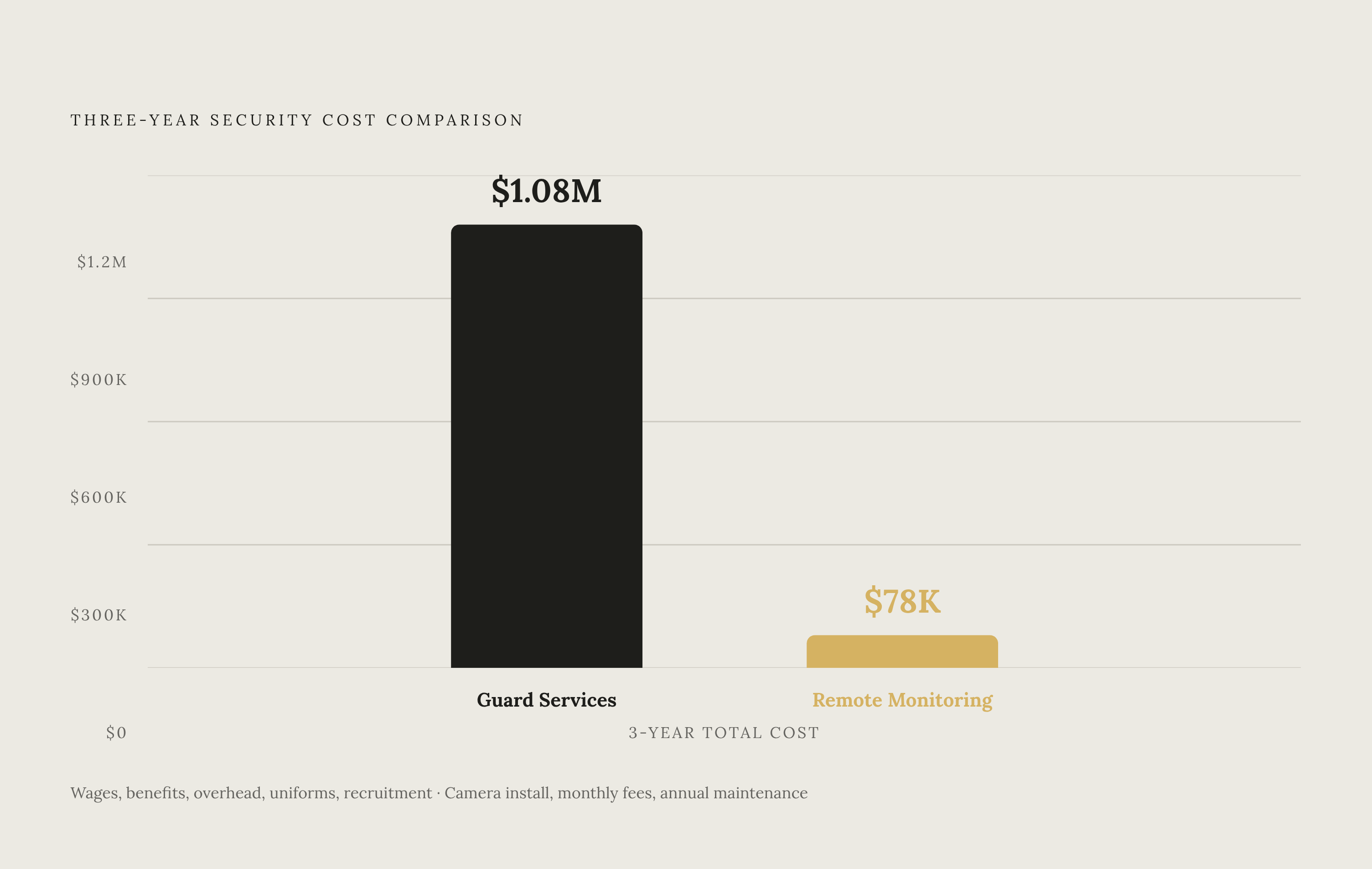
Putting the two fully loaded numbers next to each other shows the scale of the difference. A three-year total cost model puts guard services, wages, benefits, overhead, and management combined, well over a million dollars across that period. A comparable remote monitoring model, covering camera installation, monthly monitoring, and annual maintenance, totals a fraction of that figure over the same three years.
| Cost category | Guard services (3-year total) | Remote video monitoring (3-year total) | |---|---|---| | Labor / monitoring fees | Wages, benefits, overhead | Monthly monitoring fees | | Management | Supervisory and administrative overhead | Included in service, minimal added overhead | | Setup / equipment | Uniforms, equipment, recruitment cycles | One-time camera installation | | Ongoing maintenance | Recruitment, retraining, turnover-driven costs | Annual system maintenance | | Total over 3 years | Well over $1 million | A small fraction of the guard total |
The gap doesn't shrink as an organization grows. It widens. Adding a second or third site to an existing monitoring agreement costs a fraction of what adding a second or third guard post costs, since there's no additional labor to hire and no scheduling gap to fill. A guard company scaling to a new site has to recruit, train, and staff a new post from scratch. A monitoring provider scaling to a new site is largely adding cameras to an existing operational structure.
Insurance savings add a secondary financial benefit that the direct comparison above doesn't capture. Many commercial insurers offer reduced rates to properties running monitored camera systems, which adds return on investment that a guard-based security program simply has no equivalent for. None of this settles the question of which model is right for a given property, though. Physical presence is a real asset, and the next section takes that argument seriously before returning to the cost math.
What guards provide that a camera cannot
Physical presence is the strongest case for keeping a guard on post, and it deserves to be treated as a real advantage rather than dismissed. A guard can physically intervene when something happens. A guard standing at an entrance is a visible deterrent to someone considering an opportunistic crime in a way a camera and a speaker are not. A guard can make an access-control decision that requires human judgment at a door, and a guard can be present during a crisis in a way no speaker mounted on a wall can replicate.
That advantage holds most clearly in specific settings: venues that need active crowd management, posts where access decisions require discretion a rules engine can't replicate, and locations where police response times run long enough that someone needs to be on-site handling the situation until help arrives.
The argument runs into its limits fast outside those settings. A guard physically cannot watch multiple zones of a property at once. Valley Alarm notes that a single guard can effectively patrol roughly two to three acres at a time, while a monitoring center watches every camera across an entire site simultaneously, regardless of how large the property is. The patrol route itself is a structural blind spot: no matter how many guards are working a shift, the route they walk leaves certain areas unattended for stretches of time, and that gap is built into the patrol model itself rather than reflecting anything about the quality of the guards on duty.
Fatigue compounds the problem. Research cited in the underlying data shows that a person's ability to detect relevant activity on a monitored feed drops significantly after sustained periods of watching, and a guard on a long shift faces the identical limitation. No amount of additional staffing removes that human ceiling on vigilance.
The practical answer for properties that genuinely need both isn't choosing one model over the other in full. Guardian Integrated Security describes a hybrid structure, pairing remote monitoring with a single on-site guard scheduled for the specific hours when a property's risk is highest, as a way to get both deterrence and physical presence without paying for full-time guard coverage around the clock. That structure respects what a guard genuinely offers while avoiding the cost of staffing a post for a risk that may only materialize for a few hours of it.
Legacy monitoring's structural failure and the coverage gap it leaves
The cost problem with guards is only half the story. The legacy monitoring model, the traditional alarm-based approach that many properties still run on, was never built to handle the scale of modern camera deployments, and that failure creates its own coverage gap regardless of what a buyer is willing to spend.
Traditional alarm monitoring systems were designed for a facility running about eight cameras. Modern commercial sites run 80, 120, or 300 cameras generating constant activity, and the number of operators watching those feeds never grew to match the number of cameras being installed. Each alarm that fires requires a human operator to open the relevant camera feed, inspect it, interpret what's happening, categorize the event, decide on a response, document the decision, and escalate if needed. That's a manual triage process, not active monitoring, and at the scale modern camera counts demand, it becomes cognitively impossible for any team of operators to keep up.
High false alarm rates make the backlog worse. Research on analyst performance shows that precision and response speed both degrade meaningfully once operators face a high enough volume of nuisance alerts, and that degradation is a structural outcome of any detection system that generates more alerts than a person can reasonably evaluate one at a time. A real threat can end up waiting in a queue behind dozens of routine, meaningless alarms because the system architecture, not the operator's competence, put them in a position no amount of individual skill can fix.
The industry's current workarounds don't solve the underlying problem. Muting noisy cameras trades coverage for quiet. Offshoring operators trades quality for cost. Charging overage fees trades cost back onto the buyer. All three treat the symptom, leaving the queue itself, the actual bottleneck, untouched.
How smarter monitoring fixes the queue problem
AI video analytics doesn't remove the human operator from the loop. It changes what reaches that operator in the first place, and that's the change that actually fixes the queue problem instead of just working around it.
Traditional motion detection measures pixel change and fires an alert whenever that change crosses a threshold. A blowing tree branch and an intruder can trigger the identical alarm. AI-based detection works differently: it analyzes what's actually in the frame, identifies specific objects like people or vehicles, applies contextual rules about what matters at that location and time, and only sends an alert forward when something relevant is actually happening. That's a fundamental change in the volume and quality of what an operator ever has to look at.
The categories an AI layer can flag go well beyond simple motion: people, vehicles, movement patterns that don't fit the normal pattern for that site, perimeter activity, after-hours presence, safety hazards, and operational issues. The system has moved from flagging that something moved to reasoning about whether that movement means anything.
The measured effect on alarm volume is significant. One documented case involved a client cutting alarm volumes by hundreds of thousands per month after AI filtering was put in place, and separate analysis from 2024 found that businesses using this kind of filtering can replace multiple on-site guards with a small rotating remote team while holding coverage steady or improving it, because the operator's workload finally becomes something a person can actually manage.
Some platforms have gone a step further, deploying AI agents that issue live verbal warnings, referencing the intruder's specific appearance and behavior, before a human operator is even looped in. By the time an alert does reach a person, it's already been placed in a queue ordered by how relevant it is, not by when it happened to arrive. Response times reflect that shift: automated systems can trigger an alert and start a live intervention immediately, with a trained operator responding through a two-way speaker and contacting police in real time, in many cases before any actual damage occurs. Detection can happen within seconds, and operator viewing and intervention can begin in under a minute depending on the type of event.
What this changes for the operator's job matters as much as the speed. Operators stop doing manual triage across a flood of low-value noise and instead apply judgment to events that have already been verified as worth their attention. Operators apply judgment built on human reasoning rather than endurance, which lets the monitoring system deliver the coverage a large camera count demands without asking a person to sustain something no person could.
Site-specific configuration determines whether the cost savings are real
None of the cost and coverage advantages described above are automatic. AI-augmented monitoring only delivers them when detection zones, confidence thresholds, and response protocols are configured specifically for the property they're protecting. A warehouse loading dock, a retail parking lot, and a construction site at night all have different normal patterns of activity, and a system tuned to one of them using generic, out-of-the-box settings will misread the other two. Generic deployment brings back the exact problem this technology was built to solve: too many irrelevant alerts reaching a human, precision dropping, and the queue backing up again. The cost advantage documented throughout this comparison holds only where the underlying system has been configured against the specific site it's watching, not against a generic template applied across every property a provider serves.