False Positive Rates in Video Alarm Monitoring
Video alarm monitoring systems trigger false alerts over 94 percent of the time.
A false positive, in the context of security monitoring, is an alarm that reaches an operator or dispatcher and turns out to represent nothing at all: no intruder, no break-in, no event worth a response. Research compiled by the ASU Center for Problem-Oriented Policing for the DOJ COPS Office puts the false positive rate at nearly all police responses to burglar alarms, with individual cities including LAPD and Chicago reporting figures at the high end of that range. Out of every hundred alarm responses, between one and six involve an actual event, and the system is almost entirely noise by volume. That ratio did not appear last year, and it is not a calibration problem waiting on a software patch. It is the baseline condition the entire reactive-monitoring model has run on for decades, built into how alarms get generated, routed, and answered long before anyone thought to measure it this precisely. A statistician's false positive rate describes the error probability of a test in the abstract. This is not that. This is police rolling to addresses, operators reviewing footage, and dispatchers making real-time decisions, over and over, against a signal that is wrong almost every time it fires. Once the number is that lopsided, it stops functioning as a flaw in an otherwise sound system and starts functioning as the environment the system has to operate inside. Every argument that follows, about operator behavior, about contract language, about what AI filtering actually changes, rests on taking that number as a starting condition rather than a defect to be apologized for.
Why traditional sensors generate so much noise
The 94–98 percent figure is not a mystery once the underlying detection logic is laid out, because traditional sensors are not built to understand what they are seeing. Standard motion detection works by comparing pixel values between frames: if enough pixels change, the system fires an alert, with no concept of what caused the change. Wind moving foliage produces exactly the same kind of signal as a person moving toward a window. Blowing debris, shifting shadows from passing clouds or headlights, and flickering fluorescent lights all register the same way. So do insects building webs across the lens, rodents, wildlife, and pets wandering through a frame. Electrical interference from nearby power lines or radio equipment, sensor noise in low light, and poorly shielded cabling add a second layer of false triggers that have nothing to do with the physical scene at all. Then there is a category of activity that is real but entirely authorized: a manager disarming the system late, a vendor showing up during an off-shift, a resident propping a door open. A door contact sensor registers a crowbar forcing that door the same way it registers an employee who forgot to disarm it on the way out. Both produce the identical signal: door open. Scylla AI's own documentation describes the mechanism, noting that conventional motion-detection cameras trigger alerts "each time anything moves on the video frame, be it a ceiling fan, foliage, shadow change, or an animal". None of this is exotic or rare. A single flickering light fixture can throw off dozens of alerts in a few hours; the volume problem is driven by ordinary, everyday conditions rather than occasional edge cases. And because the sensor has no way to tell a threat from a shadow, every one of those signals has to be treated, at least initially, as though it might be real. The blindness at the sensor level does not stay contained at the sensor level. It gets pushed downstream, forcing caution at every step that follows, because nobody upstream did the work of telling the difference.
How a 94–98% noise rate breaks the monitoring queue
A monitoring queue is built to handle alarms that arrive at a manageable pace and carry roughly similar odds of being real. Neither condition holds once 94 to 98 percent of what enters that queue is false. The result is not an inconvenience for the people managing it; it is a structural failure in how threats get prioritized and reached. Operators working a high-volume queue have to context-switch constantly, jumping between unfamiliar sites, different camera layouts, and different alarm types, often within seconds of each other, and there is a hard ceiling on how fast a human being can do that without the quality of judgment collapsing. A 2026 market analysis of the professional monitoring industry calls the resulting condition "alarm fatigue," attributing falling detection rates to the fact that sustained vigilance is structurally impossible when the signal in front of you is almost never real. Faced with that load, operators adapt the only way they can: they develop shortcuts, skipping alarms, cutting review time short, defaulting to dismissal when a scene looks ambiguous. Those shortcuts are rational responses to an impossible volume of noise, and they are precisely the mechanism by which a genuine threat slips through unreviewed.
The queue delay caused by false alarms is visible directly in response times. When a real break-in enters a queue behind dozens of false alarms, it does not get bumped to the front because it happens to be real; it waits its turn like everything else, and that queue position, not the severity of the event, ends up determining how fast anyone responds. Dallas, one of the cities that experimented with changing how alarms get verified, saw response times for priority break-in calls stretch past an hour in the period before reform, a concrete illustration of what queue failure looks like once it compounds. Staffing instability makes the problem worse rather than better: the U.S. The U.S. security guard workforce turns over at roughly three-quarters of its staff annually. The seasoned judgment that helps an experienced operator spot a real threat faster is constantly being replaced by newer hands still learning the job. Adding more operators to the same queue does not fix the underlying ratio. It scales the labor cost linearly while leaving the proportion of real to false alarms untouched. A bigger team mostly means more people reviewing the same noise, not a faster path to the handful of alarms that matter.
Why legacy providers' workarounds don't fix the queue
Faced with a queue drowning in noise, legacy monitoring providers have settled on a handful of workarounds, and each one treats the symptom the vendor can see rather than the architecture generating it. Muting or masking a camera that fires too many false alerts is the most direct of these: it removes the noise from the queue, but it also removes the coverage. A muted camera cannot flag a real event any more than it can flag a false one, so the site has not gained a quieter system; it has lost a monitored one. Offshoring the labor that processes alarms lowers the cost per review but does nothing to change the ratio of real signal to noise that each reviewer has to wade through. The queue fills with exactly the same volume of false alarms, just reviewed at a lower hourly rate, and the throughput bottleneck that was slowing down real-threat response stays exactly where it was. Overage pricing takes a different approach entirely, turning the queue problem into a line item: clients pay more when alarm volume spikes, but a spike in alarm volume is precisely the condition under which coverage quality degrades most, so the billing model charges the customer more at the exact moment the system is working worst. Muting a noisy camera is close to pulling a fire alarm off the wall because it keeps going off: the building sounds quieter, but nothing about its safety has improved. What unites all three responses is that they manage the false positive rate as a cost problem to be contained rather than a detection problem to be solved. They optimize around a broken model instead of replacing it.
Verified response policy and the value of an unverified alarm signal
Police departments have had the clearest view of the false positive problem for longer than almost anyone else in the chain, and some have acted on it. Salt Lake City became the first major U.S. city to require verified response, in 2000, and saw alarm responses drop by 90 percent almost immediately after the policy took effect. Los Angeles moved in a similar direction after finding that the overwhelming majority of its annual alarm calls were false, a pattern that was costing the department millions of dollars in patrol time that could have gone toward calls with a real event behind them. That is a significant decision for a police department to make, in effect declining to treat an unverified alarm as worth the resources of a dispatched response.
The policy has not caught on broadly. Only a handful of U.S. law enforcement agencies have formally adopted verified response, and at least eleven that tried it, including Dallas, San Jose, and Madison, reversed course once public expectation that police answer every alarm regardless of its accuracy proved too strong to sustain. That fragility matters for how the industry should read the policy. Verified response cannot be counted on as the mechanism that eventually forces the monitoring industry to fix itself, because it keeps getting rolled back under political pressure. But its existence, however unevenly applied, still demonstrates that the agencies closest to the problem have quantified the cost of an unverified signal and judged it not worth answering in at least some jurisdictions. For a buyer evaluating a monitoring contract, that carries a direct implication: a service that delivers unverified alarms to police is exposed to the risk that the receiving department tightens its verification requirements at any point, while a service built around verified detection is not exposed to that same risk. Los Angeles backs the point with a direct financial penalty, charging a specific per-response fee for false alarms under its 2025 municipal fee schedule, which turns the false positive rate from an operational annoyance into a cost that appears on an invoice.
How SLA language hides the queue problem from buyers
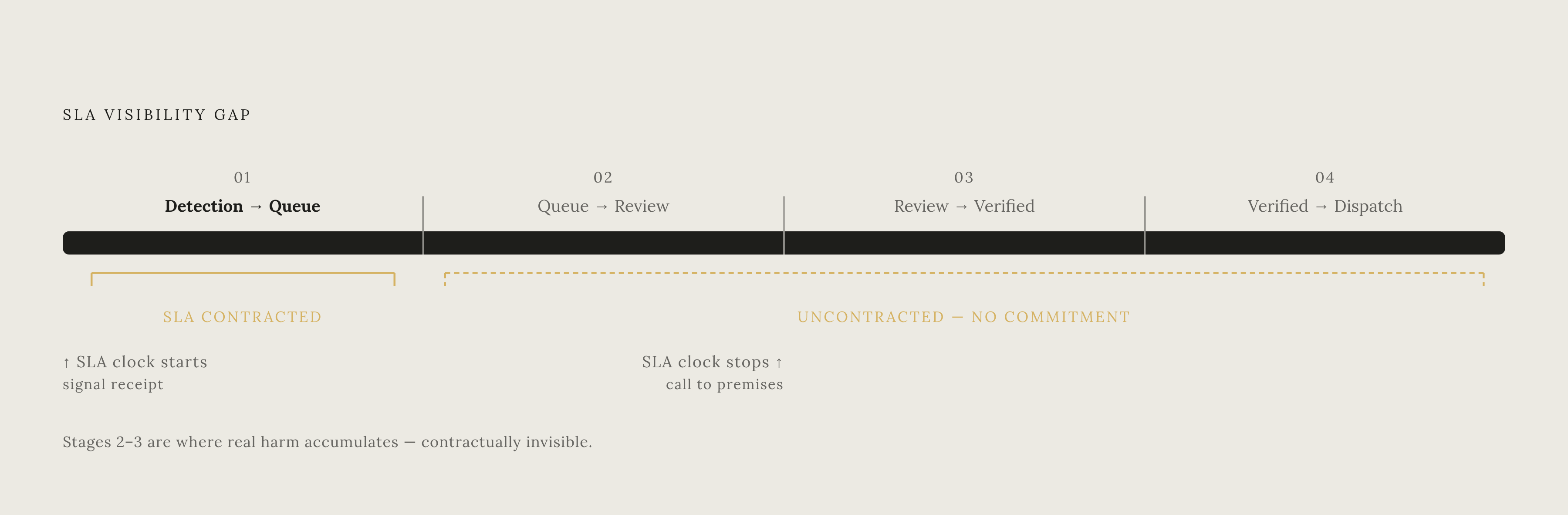
Most monitoring contracts define "response time" as the interval between when a signal is received and when a call goes out to the premises, and that definition leaves the part of the process where false positives actually do their damage completely uncommitted. The monitoring lifecycle runs through at least four distinct clocks: the time from detection to a signal entering the queue, the time the signal sits in the queue before anyone reviews it, the time it takes to verify once reviewed, and the time between verification and an actual response being dispatched. A contract that starts its clock at signal receipt and stops it at the call-to-premises step is measuring only the first of those four intervals, and it is measuring the easiest one to keep short. One industry SLA guide warns that a response-time number can look impressive on paper while masking weak performance, because the figure says nothing about which stage of the incident it is actually timing.
The practical consequence is that a provider can hit every number in its contract while still failing the customer where it counts. A legacy SLA promising fast signal receipt is fully compatible with a queue that holds a genuine threat for many minutes before anyone looks at it, and the contract remains technically satisfied the entire time. A buyer evaluating a proposal should push past the headline response-time figure and ask for commitments at each stage: the maximum time from detection to an operator actually looking at video, and the maximum time from that first look to a verified decision, rather than accepting a vague promise that alarms get answered quickly. Publishing stage-level SLAs matters because each clock creates a verifiable obligation, and a vendor unwilling to publish stage-level commitments is implicitly protecting queue time from scrutiny.
How AI agents filter alarms by reasoning about scenes
The architectural fix changes the question the system asks of a frame. Traditional detection asks only whether pixels changed between one frame and the next. AI-based classification asks what object caused the change, how that object is moving, and whether the movement resembles a known threat pattern, which is a fundamentally different kind of question and produces a fundamentally different kind of output. Object recognition filters out non-human motion, such as wind-blown debris, animals, or a shift in lighting, before an alert is ever generated, keeping that signal out of the queue. Behavioral analysis adds a second layer of filtering on top of that: a person walks with a steady, upright gait, a pet moves erratically and close to the ground, wind-blown debris drifts without any consistent pattern at all, and that difference in movement lets the system separate a real threat from background noise even when the shapes involved look similar at a glance. Scene-level reasoning extends the filtering further upstream still, flagging behavioral precursors like loitering near an entrance, repeated attempts to test access points, or unusual crowding near a restricted area, all of which a pixel-change system misses entirely because no motion threshold ever gets crossed until the person acts.
Scylla AI states a filtering accuracy of up to 99.95 percent, and the operational effect of that number is where the architecture argument lands. At a site generating tens of thousands of raw events in a given period, a system that filters well leaves a human review queue holding thousands of items, while one that filters almost perfectly leaves a queue holding a few hundred. That is a different relationship between the volume of raw signal and the number of things a person actually has to look at, a fundamentally larger improvement than an incremental gain over the legacy sensor model, and it is the only approach among those discussed here that changes the false positive rate at its source rather than managing the consequences of leaving it where it has always been.