Camera Muting Practices in Remote Monitoring
Muting alerts can quietly stop a camera from being watched at all.
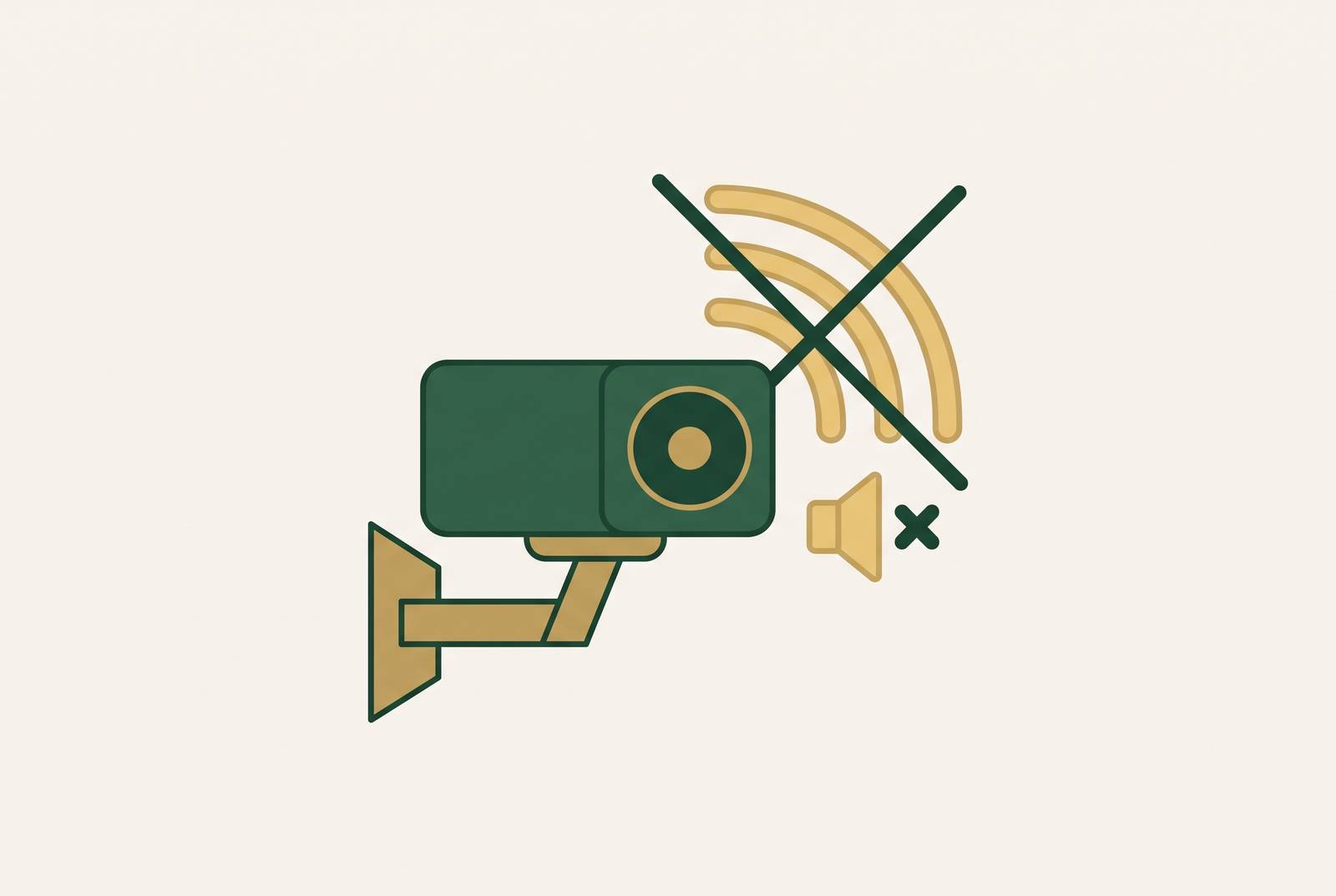
Camera muting is the practice of silencing alerts from a surveillance feed to cut down on false alarms, and it is widely treated as routine housekeeping in remote monitoring. It deserves a harder look: muting is often the exact moment a monitoring operation quietly stops watching a camera at all, and the reasons operators reach for it point to a deeper flaw in how legacy monitoring is built.
The alarm volume problem operators face
Remote monitoring centers run on a signal that is unreliable almost by design. Research on burglar alarm response, cited by the ASU Center for Problem-Oriented Policing, has found that most police responses to burglar alarms turn out to be false. The signal an operator receives is wrong nearly every time, a baseline condition of the entire industry built into how motion-based detection works in the real world, with wind, headlights, animals, shadows, and ordinary foot traffic all capable of tripping a sensor meant to catch an intruder.
Against that backdrop, think about what a single human operator is actually asked to do. Monitoring centers typically assign each operator a set number of camera feeds to watch, because there is a ceiling on how much a person can reasonably track at once. That ceiling does not move when alarm volume spikes. A busy night, a storm front, a construction crew working late on an adjacent property, any of these can flood an operator's queue with alerts that look urgent and resolve as nothing. When that queue backs up, the operator needs a way to bring it back under control, and fast. Muting is the fastest lever available: suppress the camera or zone producing the most noise, and the queue shortens immediately. None of this makes the operator careless. The operator is rational, because they work inside a system that gives them too many false signals and too little room to sort them.
Camera muting in practice
Camera muting is a stack of separate controls, each capable of removing coverage in exchange for fewer alerts, and each with its own way of quietly narrowing what the system actually watches.
The most basic layer is the sensitivity threshold: a setting that determines how much motion has to register before anything fires. If you raise the threshold, small or distant movement stops triggering alerts, and so does whatever genuine activity happens to look small or distant. The second layer is the detection zone: you draw a geographic exclusion directly onto the camera's field of view. A street at the edge of the frame, a tree line that sways in the wind, a loading dock in constant use, any of these can be boxed out so the system ignores everything inside the boundary, no matter what happens there. The third layer is object classification: filtering alerts by category so that only certain kinds of movement, a person but not a vehicle, a vehicle but not an animal, ever produce a notification.
Layered on top of these three is time-based rule composition, which pairs classification with a schedule. A vehicle alert might be set to fire only between certain hours; pedestrian alerts might be suppressed entirely during business hours when foot traffic is constant and expected. The bluntest form of all is outright suppression: a camera or zone muted with no time limit and no classification logic attached. The camera keeps recording, but no alert will ever leave it, for any reason, until someone manually reverses the setting. Used with care and reviewed regularly, each of these controls does what it is meant to do: strip genuine noise out of the alert stream. Used without that discipline, each one is a different way of quietly cutting coverage the operator may not even remember is gone.
The moment muting crosses from noise reduction into coverage abandonment
The line between legitimate filtering and real coverage loss gets crossed at a specific, identifiable point: when a muting rule runs with no time limit, no documentation, and no way for anyone to notice that it has suppressed a genuine threat right along with the noise it was built to cut.
The most common version of this failure is deceptively simple. A rule gets built for daytime conditions, when a loading dock is busy or a parking lot sees constant authorized traffic, but it keeps running at 2 a.m., when the same motion means something completely different. Business hours and off-hours are not the same security environment, but an unreviewed muting rule treats them identically, so it applies a daytime logic to a nighttime threat. A second version of the failure appears in rules that outlive the condition that justified them. A camera gets muted because of wind-triggered foliage or a noisy street, and it stays muted for weeks after the wind dies down or the street quiets, because nothing in the system prompts anyone to check whether the original reason still applies. A third version occurs in classification settings that were scoped correctly for one shift and left in place for the next: vehicles excluded from alerts in a loading area during the day, for good reason, carry that same exclusion into the night, when an unauthorized vehicle in that exact zone is precisely the event the camera exists to catch.
What makes this failure mode so hard to catch from inside the monitoring center is a basic asymmetry. A muted feed produces silence whether nothing is happening or something very serious is happening. The operator gets the identical signal, which is to say no signal at all, in both cases. The monitoring operation has stopped watching that camera, and nothing in the interface tells anyone that has happened.
Muted feeds and legacy queue risk
Muting and queue backlog are not two separate problems sitting side by side. Muting and queue backlog feed each other, and together they undermine the coverage claims a monitoring center makes even for the cameras nobody has muted.
When the noisiest cameras get silenced, the pressure that was driving an operator's overloaded queue moves rather than vanishing. It lands on whatever feeds remain active, which now carry a larger share of the operator's total attention than before. The cameras most likely to get muted in the first place, because they generate the most motion and the most false alerts, also tend to be the cameras covering the busiest, highest-value parts of a site: loading areas, perimeter gates, parking lots, exactly the locations where an after-hours intruder is most likely to show up. An operator handling more volume across fewer active feeds is working with less of the picture the site was actually designed to give them, at precisely the moments that picture matters most.
Silent equipment failure makes the compounding worse. A camera that has gone dark from a power outage, network congestion, or a blocked lens does not generate an alert saying so. It simply disappears from the operator's queue, indistinguishable at a glance from a camera that has nothing to report, and that gap can run for hours before anyone notices. Putting the two failures together, muted feeds and silently offline feeds, means a site's camera count stops meaning anything useful. Nobody watching the monitoring center's dashboard can say, with any confidence, what fraction of those cameras are actually being reviewed in real time.
What the coverage gap costs in real security terms
A muted or silently offline camera does not just miss a single event. It removes the verified response at the center of professional monitoring: a person confirming in real time that something was actually happening.
Deterrence depends on a threat actor believing someone is watching. A camera that is physically present but not actually monitored keeps its visual deterrent value only until someone tests it and learns that nothing happens in response, at which point the camera becomes a piece of scenery. Verified response needs a feed that is live and actually being reviewed, and it is what lets a monitoring center dispatch police or security with confidence because a human being has confirmed the event. A muted camera cannot contribute to that confirmation no matter how good the footage later turns out to be. The recording survives, so there is still an evidentiary record after the fact, but the window for doing anything about the event in the moment closes the instant the alert never reaches a human. By the time anyone pulls the footage, the incident is already over, resolved one way or another.
Think about where this plays out. Truck yards, retail parking lots, employee parking areas, multifamily residential perimeters: these are sites where after-hours activity is both the most likely time for muting rules to be running unreviewed and the most likely window for theft or intrusion to occur. The owner of that site is paying for monitoring coverage that, in practice, is not being delivered during the hours it matters most, and the monitoring center's own reporting usually gives no reliable way to see that gap.
Muting is a symptom of the queue architecture, not a solution to it
Muting is what any human-staffed alert queue eventually does once alarm volume outpaces what people can realistically review. It functions as a pressure valve rather than a genuine control, and as long as the underlying queue design stays the same, operators will keep reaching for it no matter how many policies get written to prevent it.
The traditional monitoring-center model assumes a roughly fixed relationship between the number of cameras on a site and the number of operators needed to watch them. As camera counts grow, that model leaves only a few paths forward: add more staff, mute more feeds, or let the backlog grow, and all three are really the same constraint showing up in different clothing. Adding offshore staff or charging overage fees can cover the cost of running an overloaded queue. It does nothing to shrink the queue itself. The actual source of the overflow is structural: every alarm, whether it turns out to be a real intrusion or a plastic bag blown across a parking lot, enters the same queue and competes for the same finite block of a human operator's attention, regardless of how likely it is to be genuine.
Any system that requires a human being to be the first person to look at every single alarm will eventually produce muting under enough load, because the only alternative inside that design is a queue that never clears. Better documentation, stricter time limits on suppression rules, more frequent audits: all of these can slow the damage, but none of them touch the actual cause. The fix has to remove humans from the position of first reviewer entirely, so that what reaches a person is already a short list of events someone, or something, has confirmed is worth their time.
AI-first monitoring and the elimination of muting
The structural alternative follows directly from the diagnosis above. When AI agents take over first review, filtering out environmental noise, recognizing routine and authorized activity, and escalating only events that clear a real bar for concern, the human queue shrinks enough that muting stops being a tool operators need to survive their shift.
The architectural shift is specific. Instead of applying a single generic motion threshold to every camera, an AI system reviews every alarm the instant it fires and checks it against context specific to that site: scheduled deliveries, authorized personnel, the rules attached to a particular zone, the time of day. A recurring delivery truck, a vehicle type the system has learned is authorized, a pedestrian pattern that repeats the same way every afternoon: all of these get resolved automatically, and none of them ever reach a human queue. What reaches a person is a filtered set of events that are both verified and genuinely out of the ordinary, so an operator's attention goes toward judgment calls instead of getting burned up sorting through volume. Monitoring centers that have adopted this kind of AI-assisted filtering report sharp drops in the number of alerts reaching each site's human review, so existing staff can manage far more accounts without hitting the fatigue that pushes people toward muting.
Muting logic does not disappear entirely under this model. Detection zones and time-based classification rules still have a place. What changes is that those rules become deliberate, documented configuration choices made with full visibility, not emergency measures reached for under pressure. But none of this works without protocols built for the specific site. What counts as ordinary activity at a truck yard at two in the morning looks nothing like what counts as ordinary at a retail parking lot at ten at night, and an AI system that applies one generic standard everywhere reproduces the same flaw that made legacy motion detection unreliable. The filtering has to be built around the site it is protecting, applied as a setting specific to each property a monitoring center manages.
Verifying monitoring coverage before trusting the camera count
A buyer evaluating a monitoring contract needs a clearer picture of what proportion of those cameras are actively reviewed, under what rules, and how fast a real event moves from detection to response, since those numbers show whether the investment delivers anything beyond a recording archive. A buyer should ask which cameras or zones are currently suppressed and what documented reason justifies each one, since an undocumented suppression rule is indistinguishable from a blind spot nobody is tracking. It is worth asking whether any suppression rules carry a time limit and when each one was last reviewed, because a rule with no expiration date and no review history is exactly the pattern that turns noise reduction into abandonment. A buyer should also ask how the monitoring center measures its first-review time, and specifically whether that clock starts when the alarm fires or only once it reaches the front of a queue, since those two numbers can tell very different stories about the same contract. A center's real performance is visible at peak load, not on a quiet Tuesday afternoon, so it helps to ask what happens to that queue during a volume spike. Finally, a buyer should ask what site-specific protocols govern which activity counts as authorized versus suspicious, and how often those protocols get updated as the site changes.
The gap between acknowledgment time and verified response time deserves particular attention, since a center that acknowledges an alarm within seconds but takes several more minutes to actually verify it has not solved the underlying speed problem. Silent camera failures, feeds that have gone dark from a power issue, a network problem, or a misconfiguration, should show up directly in a monitoring center's own reporting; if they do not, there is no way for a site owner to tell a quiet camera apart from a blind one. An AI-first model, where software reviews every alarm first and a human responds only once something has been verified, is one concrete answer to that test, and it is the kind of architecture buyers should be measuring every proposal against.