What a 20-Minute Alarm Response Time Actually Costs a Business
Delayed alarm responses let thieves finish and rack up false-alarm costs for police.

A business that pays for monitoring assumes someone is watching the cameras when it matters. What actually happens on a busy alarm night looks different: a sensor trips, the signal lands in a queue at a monitoring center, and an operator works through that queue until the alarm reaches the top. The gap between those two moments, the trip and the review, commonly runs 20 to 35 minutes before police even arrive on scene. That window is long enough for a theft to finish, long enough for the call to lose priority in a police dispatch system, and long enough to produce a false sense of security that the business never notices until it needs the footage. Those are three separate costs, not one, and each compounds the others. The rest of this piece traces where each cost originates and what changes when the architecture behind the response addresses it.
The Queue That Makes 20 Minutes Inevitable in Legacy Monitoring
The delay is a design flaw: every alarm signal that reaches a human operator looks the same, whether it came from an HVAC draft or a door forced open at 2 a.m. A motion sensor firing because warm air moved across a room produces an identical alert to one firing because someone just climbed through a window. The operator has no way to tell the difference until they pull up the footage and look.
Commercial properties generate false triggers constantly, and for mundane reasons. HVAC airflow sets off motion detectors. Employees walk in before they disarm the system. Animals wander through a yard, contractors show up on a Saturday, a power fluctuation resets a panel and sends a signal nobody asked for. Each of these produces an alarm that sits in the same stream as a genuine break-in, waiting its turn.
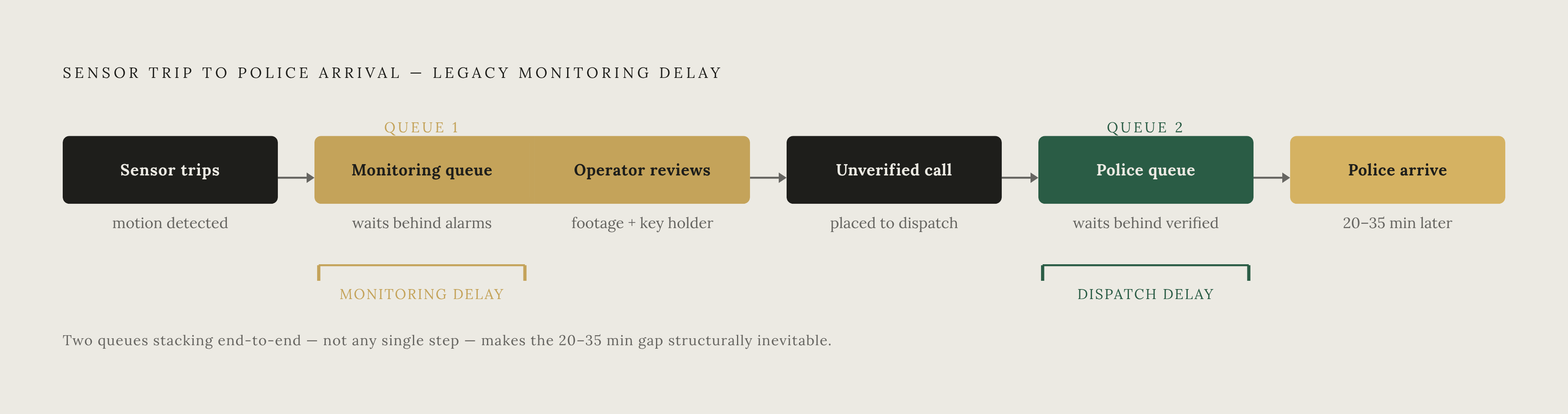
The call chain that follows makes the delay worse. A sensor trips. The event lands in the operator's queue behind whatever else fired that night. The operator works through the queue, tries to reach a key holder, waits for that person to decide what's happening, and only then does police get called, as an unverified report. That unverified call enters a lower-priority slot in a police dispatch queue that already has its own backlog. Every step adds time, and none of the steps happen in parallel.
The overwhelming majority of commercial alarm activations turn out to be false because the system has no mechanism to sort authorized activity from an actual threat before a person reviews it manually. Human attention is the bottleneck, and that bottleneck is the defining limit of how legacy monitoring is built, the reason a real threat and a false one wait in the same line.
A Real Threat During Those 20 Minutes
A typical commercial burglary takes only minutes from entry to exit. That arithmetic alone explains why a legacy monitoring center, working through its queue, finishes its dispatch process after the crime is already over. A business running traditional monitoring, in most cases, documents a theft.
The outcome that follows is predictable. Police arrive to a scene, not a threat in progress, so their role shifts from intervention to report-writing. Burglary clearance rates sit among the lowest of any major property crime category the FBI tracks. Most of these reports close with no arrest and no recovery. An insurance claim follows the report, but a claim doesn't replace stolen inventory on a shelf the next morning, doesn't cover the cost of a damaged point of entry, and doesn't account for a day of lost operations while a business sorts out what's missing.
The 20-minute gap carries a second, quieter cost. During that window, operators working through a backlog of alarms are not watching the one camera that matters. The footage exists. Nobody was looking at it while the event happened. The recording becomes evidence after the fact instead of the basis for a response while there was still something to respond to.
How unverified alarms cost businesses money before a crime even happens
The cost of a false alarm is a recurring financial liability that a business pays whether or not anything happens on site.
Most U.S. cities require a permit for a commercially monitored alarm system, and that permit typically gets renewed every year. Once a business exhausts its free-dispatch allowance, cities start billing for every police response to an alarm. Los Angeles charges a set fee for the first chargeable false alarm at a permitted business, with the fee increasing for each subsequent dispatch in the same period. Some jurisdictions go further and suspend police dispatch altogether for properties that keep generating unverified alarms. At that point, the business is paying full monitoring fees for a system that no longer brings police.
The pattern scales up to the level of entire cities. The cumulative cost of chasing unverified alarms runs into the billions of dollars nationally in police time, and Los Angeles alone has estimated roughly $11 million in lost patrol time tied to false alarms. That's a burden police departments are increasingly unwilling to absorb, and it's the direct reason verification requirements keep getting tighter. The next section covers how that pressure has changed dispatch policy itself.
How police departments have responded to unverified alarm volume by deprioritizing it
Treating this as a failure on the part of police departments misses the point. Departments are responding rationally to a volume problem that originates somewhere else: the monitoring architecture that lets false signals reach dispatch.
Los Angeles found that the vast majority of its annual alarm calls turned out to be false, and in response, the city now requires verification after two false alarms at a given location within a rolling 12-month period. That's a policy shift aimed at the volume of bad signals coming in, not at punishing any single business for one bad night.
Some jurisdictions tried outright non-response policies for unverified alarms in years past. The practical result across U.S. law enforcement was never full elimination of response. It was response that got pushed back and deprioritized, and for a business waiting on the other end of that call, a deprioritized response produces the same outcome as no response at all: an officer who shows up late, if at all.
A traditional alarm call placed on a busy dispatch night doesn't just wait behind the monitoring center's internal queue. It then waits behind every verified call already ahead of it in the police queue. Those two delays stack, and the total time from the moment a sensor trips to the moment an officer arrives can run well past 20 minutes.
Why verification is the variable that changes all of the above
Every cost traced so far, the theft that completes before anyone responds, the false-alarm fees, the deprioritized police queue, comes back to the same missing step: nobody verified the alarm before it escalated. When a monitoring operator can hand a dispatcher real-time visual confirmation, the whole calculation changes. The number of people on site, whether anyone is carrying a weapon, a vehicle description, which door they used to get in: all of that information turns an unverified call into a call police can prioritize.
Having cameras on site was never the hard part. The hard part is whether anyone is actually looking at the feed the moment an alarm fires, and legacy monitoring centers can't guarantee that at peak volume, when dozens of alarms are stacked in the same queue.
Motion-based analytics flag that something moved, and that's the extent of what they do. A swaying tree, a raccoon, and a person forcing a door all produce the same flag. AI agents trained to review alarms as they fire can classify and contextualize instead of just flagging: they assess whether a person is following a known routine, loitering near a restricted area, or going through cabinets after hours. That distinction, purposeful movement versus a threat pattern, is the input a human operator actually needs to make a fast, correct call.
Services built around this model, Verdun among them, filter every alarm through AI agents before a human ever sees it, dismissing environmental noise and authorized activity so that only verified threats reach an operator. That doesn't replace the operator. It changes what reaches them. The AI layer handles volume; the human makes the response decision once the event is confirmed as something worth a decision. That division of labor, not substitution, is what resolves the common objection that AI can't be trusted to make security judgments on its own. It isn't being asked to.
How site-specific context makes verification meaningful rather than generic
Verification only works if the system knows what normal looks like at a given site, and normal varies enormously by property type. A fence-line breach at a construction site, a door opening after hours at a multifamily complex, and an unfamiliar vehicle pulling into a truck yard each carry a different baseline risk and call for different response logic. A generic motion alert can't account for any of that on its own.
Site-specific protocols handle distinctions that a one-size-fits-all system simply can't. At a retail location, they separate an employee who shows up early from someone who shouldn't be there. At a multifamily property, they filter out the routine comings and goings of residents so a genuine intrusion doesn't get lost in the noise. At an industrial site or a construction yard, any pedestrian movement after hours is presumptively unauthorized, since no one has a legitimate reason to be there. Object classification can also catch copper theft or vandalism in progress, before the damage adds up to a real loss.
Industrial and construction sites are particularly hard for generic analytics to handle. Low light, shifting weather, and a lot of ambient movement from wind, equipment, and vehicles make motion-only detection close to useless without a layer of context on top of it. Camera placement, lighting, and routine maintenance all affect how well verification works in practice, and a monitoring setup built around verified response accounts for those variables through operator training and protocol coverage alongside hardware.
The Total Cost of Slow Response
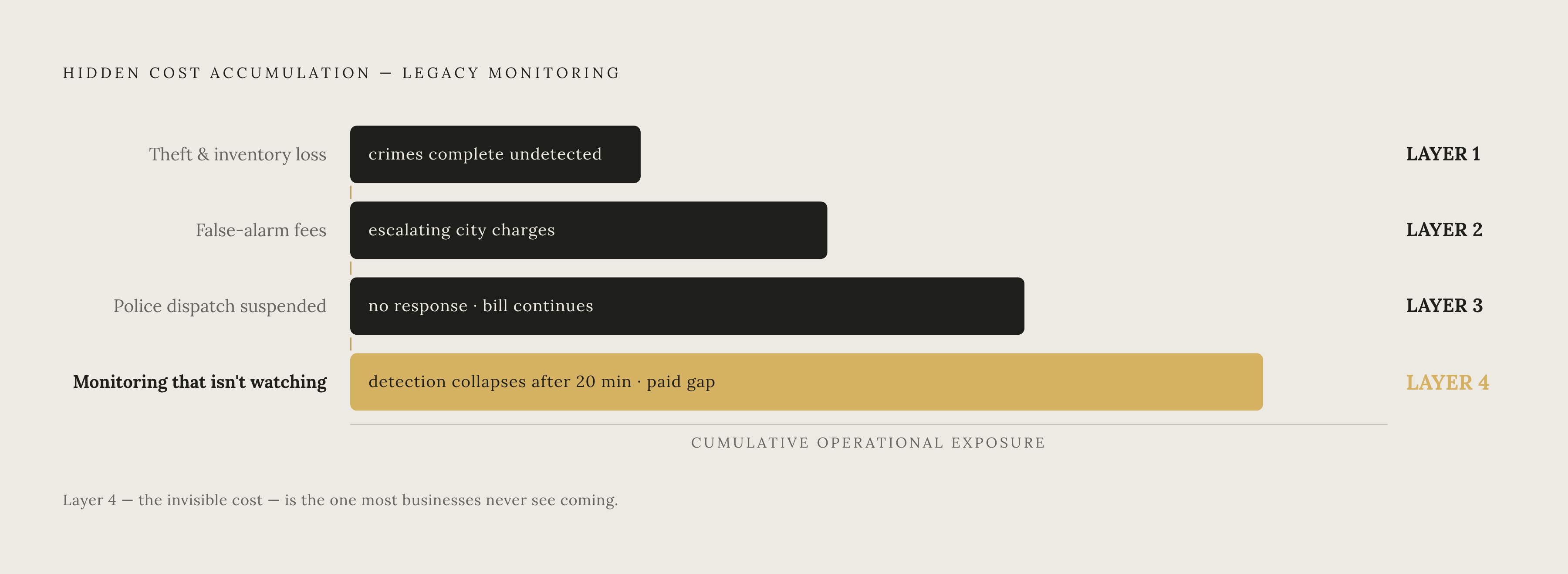
Put together, the cost of slow response isn't a single line item on an invoice. It accumulates across at least four categories that compound each other over time.
Theft and inventory loss sits at the center: crimes that complete inside the monitoring window, most of which police never clear and insurance never fully makes whole. False-alarm fees run alongside it, a recurring, city-imposed cost that climbs with alarm volume and escalates sharply for repeat offenders, charged whether or not anything criminal ever happened on site. Police dispatch suspension is the sharper version of that same risk: a property with a high false-alarm count can lose police response entirely, while the monthly monitoring bill keeps arriving regardless. And finally, there's the cost of paying for monitoring that isn't actually monitoring anything: a business covering the cost of 24/7 coverage with no guarantee that a human is watching the feed at the exact moment an alarm fires.
That last category carries its own hidden cost. Operators scanning live feeds manually show a documented, sharp decline in detection effectiveness after just 20 minutes of continuous watching. A camera that's nominally monitored may not actually surface a threat until it's already over. The business is paying for a layer of security that exists on paper but not in practice at the moment it's needed.
The economics shift once AI handles the first pass. When an operator's attention goes only to verified exceptions instead of a flood of undifferentiated alarms, both the speed of response and the cost per alarm change. Fewer wasted reviews mean faster attention to the alarms that actually matter.
What a monitoring architecture looks like when it is built around verified response rather than alarm volume
A monitoring setup built around verified response separates three functions that legacy monitoring centers collapse into one person's job. Continuous attention comes first: AI agents review every alarm as it fires, checking it against the protocol built for that specific site. Filtered escalation comes next: only verified threats make it to a human, which removes the queue that makes a 20-minute delay all but guaranteed. Trained human response comes last: the operator who receives an escalated event already has the context needed to make a fast, informed call, whether that's a talk-down, a dispatch, or a notification to the property owner.
Because legacy systems treat every signal the same until a person manually reviews it, false positives generate costs that stack on top of each other: dispatch fees, permit violations, wasted operator time, all compounding across a busy monitoring center on a single bad night. Filtering routine activity out before it ever reaches dispatch, by reviewing video context against site-specific authorization, removes that entire cost category and still lets genuine threats through immediately.
Verdun's approach to this problem puts AI agents at the front of that chain, triaging every alarm and dismissing environmental noise and authorized activity before anything reaches a human, and trained operators at the back of it, responding to what's actually been verified as a threat. Neither layer is asked to do the other's job. The AI handles volume; the person handles judgment.
For any business evaluating a monitoring provider, commercial, multifamily, or industrial, the monthly invoice is the wrong place to start. The question that actually determines what's being paid for is how long a verified threat waits before a trained human sees it. That number, not the price per camera or the number of cameras installed, is what decides whether the system in place is actually watching, or just recording.