Parking Lot Security Cameras: Placement, Coverage and Who Watches Them
A camera on a pole records what happens in a lot. Whether it stops anything depends on where it points, what it can see at night, and who is looking when it fires.
Parking lots are some of the hardest places on a commercial property to cover. They are large, open, poorly lit after hours and full of legitimate movement: employees arriving for a shift, customers leaving late, delivery vans, headlights sweeping across the asphalt. They are also where vehicle break-ins, catalytic converter theft, vandalism, dumping and confrontations near the building tend to happen when nobody is around.
This guide is for owners and operators of retail stores, offices, employee lots, multifamily properties and yards who are planning or replacing cameras on a lot. It covers what the cameras need to do, where they go, which type suits which job, and the decision most buyers leave until last: what happens when a camera sees something at 2 a.m.
Decide what each camera is for before choosing hardware
Most disappointing parking lot systems were bought by camera count. A better starting point is the job each view has to do, because one camera rarely does more than one of them well.
- Overview. Shows what is happening across a whole area: how many people, where they went, which way a vehicle drove. Good for situational awareness and for an operator deciding whether activity is normal, but usually too wide to identify a face or read a plate.
- Identification. A narrow view at a chokepoint, such as a pedestrian door or a vehicle entrance, framed tightly enough to recognise a person or a vehicle. This is the footage police and insurers ask for.
- License plate capture. A dedicated, tightly framed view of the lane where vehicles enter and exit, set up for the angle and speed of traffic. General-purpose cameras rarely read plates reliably, especially at night.
- Deterrence. Visible cameras, lighting and signage tell someone the lot is watched. Deterrence works best when something actually happens in response, such as a light, an audio warning or a call.
Where parking lot cameras go
Walk the lot at night before deciding on positions, and note where vehicles and people come in, where they linger and where the light runs out. Typical priorities are:
- Vehicle entrances and exits. Every vehicle passes through them, which makes them the most efficient place for plate capture and vehicle identification.
- Pedestrian paths to the building. Doors, walkways and the stretch between the lot and the entrance, where staff walk to their cars after closing.
- The far edges and corners. The rows furthest from the building, fence lines and areas behind landscaping are where vehicles sit unattended longest and where intruders expect not to be seen.
- Pay stations, kiosks, dumpsters and loading areas. Fixed equipment and service areas attract tampering, dumping and after-hours access.
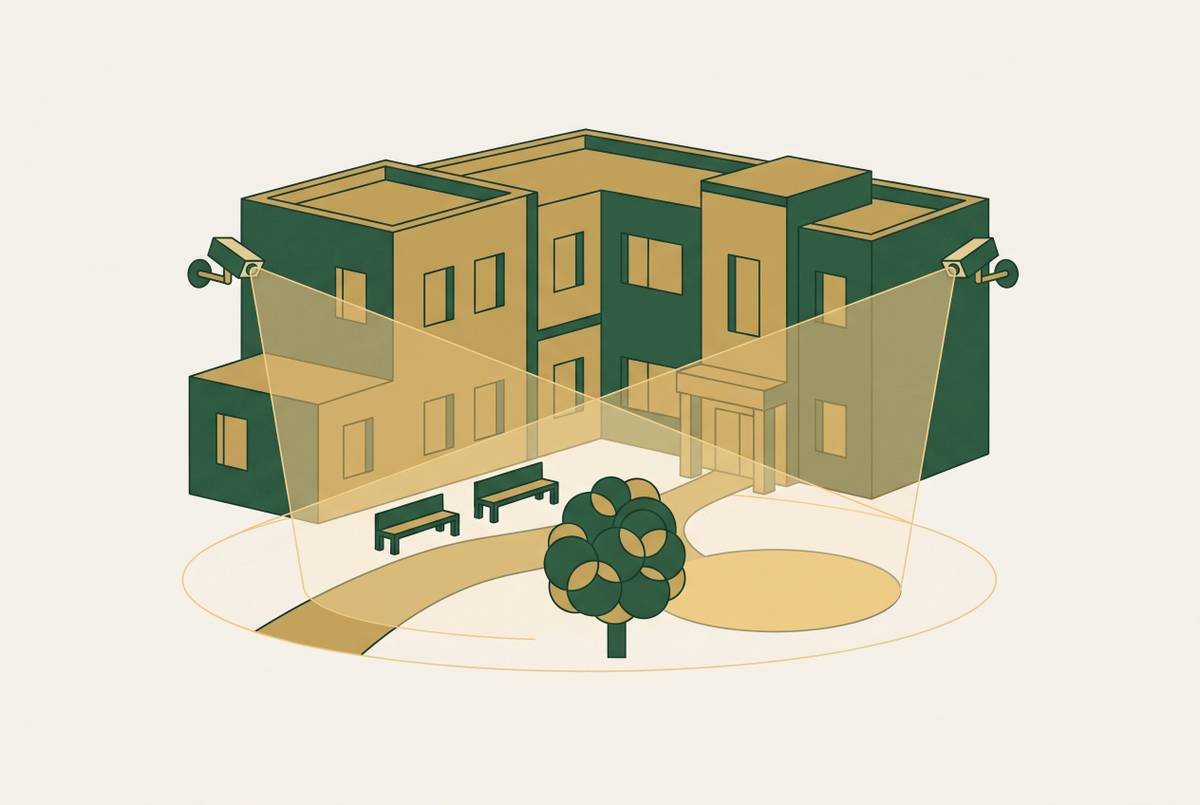
- Overlapping views. Position cameras so each one can see the pole or wall another is mounted on. An intruder who disables one camera is still recorded doing it.
Which camera type does which job
- Fixed bullet and turret cameras suit chokepoints and identification views. They always look at the same place, which makes them predictable to configure and to monitor.
- Multi-sensor and panoramic cameras cover a wide area from one mounting point and suit overview positions on tall poles or rooftops.
- PTZ (pan-tilt-zoom) cameras can follow activity and zoom in, but only see where they are pointed. Pair them with fixed cameras rather than relying on them for continuous coverage.
- License plate recognition (LPR) cameras are purpose-built for plates, with settings for fast shutter speeds and infrared at night. They belong at entrances, not across the middle of the lot.
- Thermal cameras detect people and vehicles by heat in complete darkness and through glare, and suit unlit perimeters. They do not capture identifying detail, so they are paired with visible-light cameras.
Resolution, field of view, infrared range and low-light performance vary by model. Check the manufacturer's datasheet for each position, and ask your installer to show sample night footage from a similar lot rather than daytime marketing images.
Light, weather, power and network
Outdoor lots punish equipment that works fine indoors. Plan for these before the first pole goes up:
- Lighting. Cameras see what the lot's lighting lets them see. Even lighting improves image quality and deterrence at once; patchy lighting leaves dark pockets that infrared alone may not reach.
- Headlight glare. Cameras facing traffic can be blinded by headlights. Wide dynamic range (WDR) helps, and so does angling cameras so oncoming headlights do not shine straight into the lens.
- Weather and vandalism. Look for housings rated for outdoor use (an IP66 or IP67 ingress rating) and impact-resistant domes (IK10) where cameras are within reach.
- Pole movement. Tall poles sway in wind, and a swaying camera makes the whole scene look like it is moving. Use rigid poles and mounts for cameras that trigger alerts.
- Power and connectivity. Lots often have no network cabling to the far rows. Options include trenching cable or fibre, wireless bridges between poles, and solar or cellular camera units for lots with no infrastructure at all. Ask installers to price each.
Recording is not the same as watching
A recorder full of footage tells you what happened after someone notices the damage. It cannot stop a break-in in progress. For lots that are empty overnight, the bigger decision is who responds when a camera detects something, and how fast.
The common options are: reviewing footage only after an incident; sending motion alerts to a manager's phone; guard patrols that pass through on a schedule; and remote video monitoring, where operators watch alerts live and can issue an audio warning through on-site speakers or call police with a description of what they are seeing.
Read more: Total cost comparison of guard patrol vs. remote video monitoring
Why parking lots flood monitoring with false alarms
Lots are noisy scenes. Headlights sweep across walls, rain and insects catch the infrared light, shadows move as clouds pass, trees sway, and authorised people come and go at all hours. A camera that alerts on motion cannot tell any of that apart from an intruder, so it sends all of it to whoever is watching.
The result is a familiar pattern: alerts pile up, real events wait behind false ones, and someone eventually mutes the noisiest cameras, which are often the ones covering the lot. Before signing up, ask how a provider separates a person trying car doors from a customer walking to their car, and what they do with a camera that alerts too often.
Read more: Environmental noise filtering in outdoor commercial camera systems
Give the monitoring the site's context
The same movement means different things at different times. A person in an employee lot at shift change is expected; the same person at 3 a.m., walking between parked cars, is not. Whoever monitors the lot should know its schedule, who is allowed there and when, where deliveries arrive, and what should happen for each kind of event: a warning over the speaker, a call to a keyholder, or a call to police.
Read more: Site context inputs that enable AI alarm verification
Questions to ask a camera or monitoring provider
- What happens when a camera detects someone after hours? Ask them to walk through a real event from detection to response, step by step.
- How quickly do you respond, measured how? Ask for their own measured response times and how they are calculated, not a target.
- How do you handle cameras that alert too often? If the answer is muting or reducing sensitivity, ask what coverage is lost while it is in place.
- Who reviews the alerts? Where operators are located, how they are trained, and how many cameras each one is responsible for.
- How is the service priced? Per camera, per site or per hour, and whether there are fees when alert volume exceeds a limit. Get every fee in writing with the quote.
- How long is footage kept, and how do I get a clip for police or an insurer? Retention periods and export steps vary by system and contract.
Read more: Overage pricing models in commercial video monitoring contracts
Cost: where to get real numbers
Costs depend on how many positions the lot needs, whether poles, trenching or lighting are required, the cameras chosen and whether the footage is monitored live. Published price lists rarely reflect a specific lot. Get itemised quotes from at least two installers after a site walk, and ask monitoring providers for their pricing terms in writing, including any per-alert or overage fees.
Privacy, signage and the law
Rules on video surveillance, audio recording, signage and footage retention vary by state and city, and audio recording in particular is often subject to consent laws. Avoid aiming cameras into neighbouring homes or other places where people expect privacy. Post clear signage, and check requirements with your local authority or legal counsel before installation.
Frequently asked questions
How many cameras does a parking lot need?
It depends on the lot's size and shape, its entrances, its lighting and what each view needs to do. Map entrances, pedestrian paths, far corners and service areas first, then count the positions needed to cover them with some overlap. An installer's site walk is the reliable way to get a number.
Can parking lot cameras read license plates at night?
Usually only dedicated license plate cameras can. They are mounted at entrances and exits, framed tightly on the lane, and use fast shutter speeds with infrared illumination. Wide overview cameras in the middle of a lot rarely capture readable plates after dark.
Do security cameras stop parking lot crime?
Visible cameras and good lighting can discourage some offenders, but a camera nobody is watching only records what happened. Live monitoring with an audio warning or a police call is what lets a camera interrupt an incident while it is happening.
Should parking lot cameras be monitored live?
For lots that are empty or lightly used overnight, live monitoring is the only way footage leads to a response before the damage is done. Compare the provider's response process, false-alarm handling and pricing terms against the cost of patrols or doing without.