Site Context Inputs That Enable AI Alarm Verification
Context data like schedules and access logs transform AI detections into verified threats.

AI alarm verification depends on site context. Schedules, access records, spatial rules, and operational protocols provide the evidence that separates a verified threat from a faster false alarm. The practical requirement is a monitoring system that reasons against the site’s current operating conditions and turns that reasoning into an actionable response.
Why AI alarm verification fails without site context
Adding AI to an existing camera stack does not automatically improve alarm quality. A model can identify a person more quickly without establishing whether that person belongs there. The structural weakness of legacy monitoring is not simply slow review, but the lack of context in the signal being reviewed. A sensor trip says nothing about who caused it, whether their presence is authorized, or what they were doing.
Traditional alarms have a 99% false-alarm rate because context is missing at detection, as well as because people are slow to respond. That weakness also creates a queue problem. A verified threat can wait behind dozens of signals that lack context while operators work out what happened in each case. A model that takes the place of those operators still lacks that information.
For example, a vision model with no knowledge of authorized activity, operating hours, or restricted zones cannot distinguish a maintenance worker from an intruder. It can label the visible object, but it lacks the evidence needed to judge the event. Faster processing therefore risks producing AI-assisted false-alarm generation. The useful output is that an unauthorized person is in a restricted zone at an unauthorized time.
How AI agents reason about alarms rather than just flag them
Verification begins when a detection is compared with a representation of normal activity for that site at that time. Classical motion-based analytics flag a departure from a pixel baseline. An AI agent performing verification instead evaluates whether the event fits the site’s operating conditions and the person’s authorization.
Object detection and tracking provide the structured observations that support that comparison. YOLO-family models and object trackers illustrate this part of the architecture, producing metadata including person, vehicle, bounding box, confidence, timestamp, and camera ID. Yet a bounding box labeled “person” at 2 a.m. remains ambiguous. The metadata establishes what the system detected.
A vision-language or agentic reasoning layer cross-references that event against access logs, schedules, and zone rules. Those inputs can refine “motion detected” into a classification such as “unauthorized person in restricted zone”. When the comparison finds no authorized explanation, the agent can escalate a pre-verified, pre-contextualized alert to a trained operator. The operator then acts on a threat description rather than first reconstructing the site’s normal activity.
That division of work does not make agentic systems infallible. Lin and Zhang’s chapter on agentic AI reliability lists goal misalignment, flawed planning, and breakdowns in human-AI collaboration as ways these systems can fail. Well-defined, regularly updated site context reduces these risks but does not eliminate them. Its role is to ground the model’s reasoning in explicit operating facts, while preserving the human role in responding to verified threats.
Schedules and access data as the baseline for authorized activity
The first operating fact is whether anyone should be present at the time of detection. That answer changes with shifts, contractor visits, and holiday closures, so an installation-time schedule is only a starting point. Business hours, shift patterns, maintenance windows, and after-hours exceptions set the times when people are allowed to be there. The context layer must track those conditions as they change.
A person crossing a loading dock at 10 a.m. may be entirely routine. The same activity at 2 a.m. becomes a candidate for escalation if the schedule contains no authorized activity at that hour. Without that temporal baseline, the camera supplies a true observation but no useful judgment about authorization.
Access control records make the baseline more specific by identifying which people, credentials, or vehicles are permitted in which zones at which times. If no credentialed entry precedes a camera detection in a secured area, the agent has a cross-stream signal of unauthorized presence. If a credentialed entry matches the detection and the relevant permissions, the agent can dismiss the event without human review, reducing false alarms through an authorized explanation.
The quality of this comparison depends on the records reflecting current operations. Stale information can cause authorized activity to be escalated or unauthorized activity to be dismissed. A schedule and an access log are therefore decision inputs.
Spatial rules and zone definitions as the map the AI reasons against
Time and permission acquire meaning only in relation to a defined place. A camera’s field of view shows where activity is visible, but it does not establish the rules that govern that space. Zone-of-interest masks, dwell thresholds, and perimeter definitions encode those rules into the detection pipeline. Class filtering further distinguishes the kinds of objects relevant to an event.
A properly zoned parking structure separates the meaning of movement through its different spaces. Its rules allow the agent to evaluate presence against the zone involved. An unzoned structure leaves the model flagging movement across a broad field of view without the boundaries needed to interpret it. The contrast is between an image of a property and a usable map of its access conditions.
Duration also changes the meaning of presence within a zone. A delivery driver walking past a restricted door is not the same signal as someone standing at it for five minutes. A dwell threshold makes that distinction explicit instead of asking the model to infer the operator’s tolerance for lingering.
The map must also reflect the property’s risk topology. Commercial and industrial sites often have a primary perimeter and a small number of high-value interior zones, while multifamily properties have layered semi-public spaces including parking structures, lobbies, common corridors, and amenity areas. Truck yards and employee lots need vehicle-class rules as well as person-detection rules. An unrecognized vehicle stationary in a fire lane means something different from an employee’s car in a designated space. Poorly defined boundaries erase these distinctions, producing undifferentiated alerts that operators may eventually tune out.
Operational protocols as the decision logic the AI inherits
Once the agent has checked whether the person is allowed to be in that place at that time, it still needs a rule for what happens next. Operational protocols supply that rule. They distinguish events that require immediate human escalation from those that warrant a logged warning, an automated deterrent action, or dismissal without record.
For example, loitering in a retail parking lot at 11 p.m. might warrant a visible light deterrent before human escalation. The same detection in a pharmaceutical storage corridor might call for a person to review it at once and for the facility to go into lockdown. These are different judgments about risk tolerance, asset value, and operational priorities. The AI executes the protocol, but the site operator supplies the judgment embedded in it.
What the protocols cover also shapes the information that reaches the operator who responds. An alert describing an unauthorized person in chemical storage, no credentialed entry in the past several hours, and a camera disabled 30 minutes ago gives the operator a basis for action. With a generic motion alert, the operator has to work out those details before responding. Encoding the relevant decision logic upstream changes the alert from a request for investigation into a contextualized escalation.
Platforms that let operators define which event types trigger alerts and which are logged provide a means to implement this layer. AI-powered analysis, multi-sensor verification, and adaptive sensitivity settings can support that configuration. None of them supplies the operational judgment that configuration requires. For a system with reasoning capabilities to “just work”, it must operate against the response rules people have defined for the site, making protocol design a human responsibility within the technology.
Why site context must be maintained, not just installed
The responsibility for those rules continues after deployment because site operations do not remain fixed. Tenants change, contractors come and go, traffic patterns change with seasonal operations, and layouts create new areas of risk. Each change can separate the site’s actual conditions from the conditions represented in the AI’s knowledge base. That separation is context drift, and it can undermine an otherwise correctly functioning verification system.
A schedule inherited from a previous tenant may cause the new tenant’s early-morning staff to be escalated as a threat. The same outdated schedule may treat presence as normal during hours that are no longer occupied. Spatial drift causes a similar problem when construction changes a route into the site. A zone definition that once marked a restricted path may then generate alarms on the authorized employee entrance. In each case, the model is applying an obsolete account of the site.
The first configuration sets a baseline, but using the system brings out edge cases, seasonal changes, and environmental conditions that no one expected. To reduce false alarms, the system needs tuning after deployment as well as when it is first set up. However, tuning in response to visible noise is not enough. Wrong context can also cause the system to miss threats, so a quiet alert queue gives no assurance that the rules are still right.
There needs to be a clear process for updating schedules, access rules, zone definitions, and protocols whenever operations change. Context maintenance belongs to security operations. Treating it as an occasional technical task allows drift to accumulate until a missed incident or repeated false escalations exposes the gap. For buyers, accountability therefore rests with whoever maintains the operating truth the agent relies on. Human responsibility has not disappeared with AI, but moved upstream into context governance.
How complete site context connects to verified response and dispatch priority
The value of that governance extends beyond the monitoring center. A contextualized alarm can give law enforcement credible evidence that changes dispatch priority and, in some jurisdictions, is required for officers to respond at all. Speed within the system matters only if the alert gives people enough information to act. Verification connects the quality of the system’s inputs to the credibility of its output.
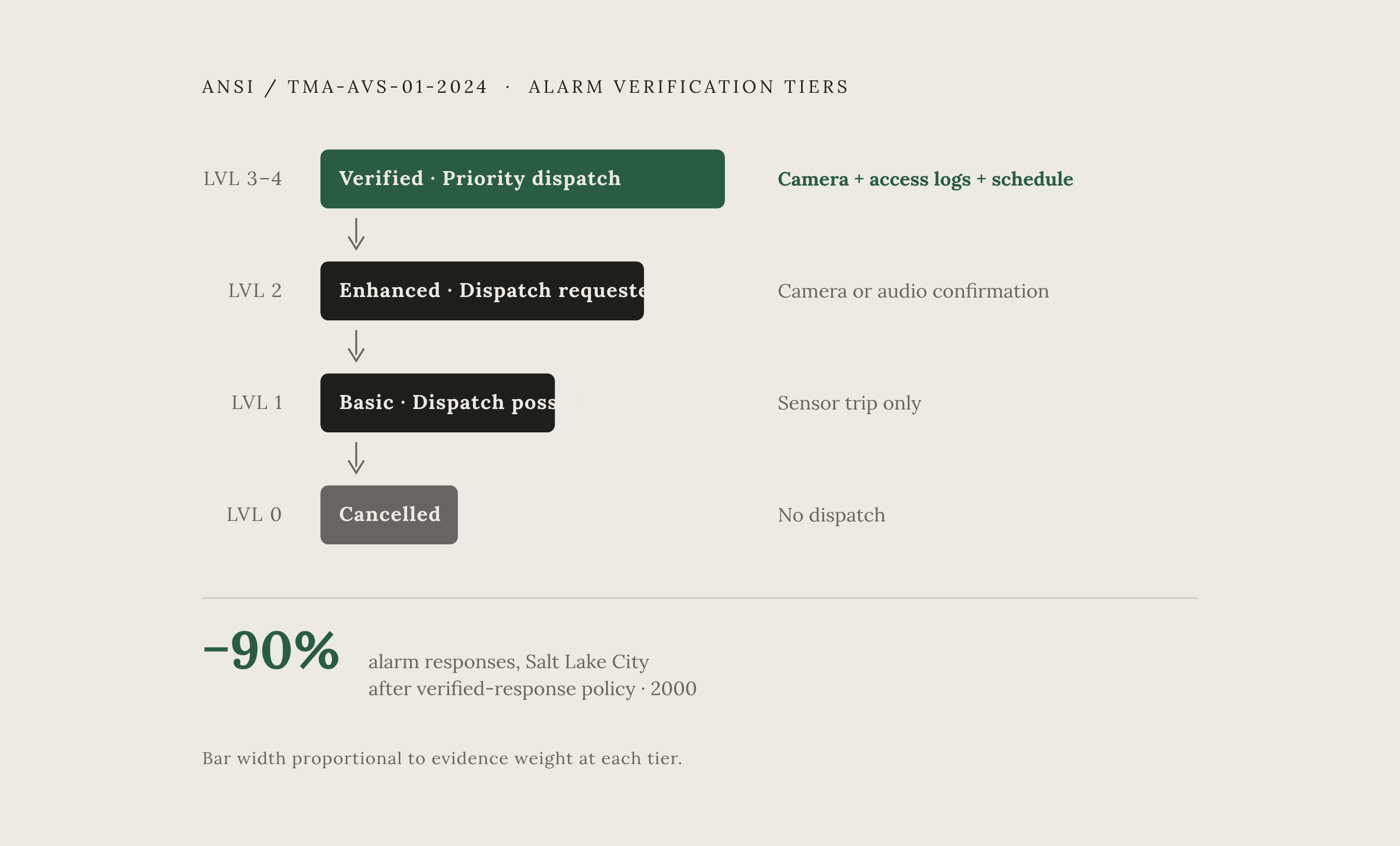
The Monitoring Association’s ANSI/TMA-AVS-01-2024 standard establishes a five-tier classification framework based on the evidence available at dispatch. It replaces a binary intrusion/no-intrusion signal with a more specific account of the alarm. A monitoring center with camera angles, access control data, and schedule information can support a Level 3 or Level 4 classification when the evidence warrants it. A sensor trip alone delivers Level 1, or Level 0 if the alarm is cancelled and no dispatch is requested. That classification informs how a Public Safety Answering Point prioritizes the alarm against citizen-originated emergency calls.
Verified-response policies give this distinction weight in practice, though only a small share of U.S. law enforcement agencies have formal policies. Las Vegas pioneered the practice in 1991, and Salt Lake City adopted verified response in 2000. Salt Lake City saw an immediate 90 percent reduction in alarm responses. Where confirmation is required, an unverified signal may therefore fail to secure a response regardless of how quickly it leaves the monitoring center.
For commercial, multifamily, and industrial operators, the relevant design links current context, agent reasoning, human escalation, and a classified alert to dispatch. Visual confirmation, checks against access logs, and evidence from the zone in question make that chain credible. Sending every sensor trip to a person, or running AI without site context, leaves that evidence missing. The buyer’s question is therefore not simply whether a monitoring vendor uses AI. It is what site context the AI reasons against, how that context is maintained, and what alarm classification the verified output carries.