How AI Agents Reason About Security Alarms
AI agents filter false alarms by reasoning about context, not just detecting motion.

The camera network at a commercial facility rarely misses an actual breach. The failure occurs downstream, at the moment a human operator must decide what to do with the alert. Every trigger looks identical to the operator receiving it, stripped of the context that would make it meaningful. The sensor fires, but nothing arrives with it: no identity, no behavioral history, no indication of whether the person in frame was authorized to be there at that hour. The consequence extends beyond wasted dispatch calls. Operators conditioned to treat most alerts as noise disengage from the queue, and genuine threats wait in line behind events that should never have reached a human at all. Agentic AI addresses this by filtering out false alerts and handling routine triage, rebuilding trust that was present, then destroyed by volume, then earned back through consistent, contextual escalation.
What "reasoning" means in an AI surveillance agent, as opposed to detection
Detection and reasoning are not the same operation. Conflating them leads buyers to expect AI to solve the alarm-volume problem when it only shifts where the noise originates. Detection means a model observes that something changed in the frame: motion, a new object, a pixel-level deviation from a baseline. Reasoning means a system evaluates what that change means given everything else it knows, the time, the location, the identity of the person or object, their behavior before and after, and what is normal for this site at this hour. A system that detects motion in a restricted area generates an event. A system that understands context can evaluate whether that motion involves an authorized person following a normal pattern, or an unknown individual behaving in a way that warrants attention. Same initial cause, fundamentally different quality of output.
The distinction maps onto the familiar progression from descriptive to predictive to prescriptive analytics, though the conventional order runs descriptive, predictive, then prescriptive. Descriptive systems tell you what happened. Predictive systems identify conditions that precede incidents so operators can act before escalation. Prescriptive systems tell you what to do. Each step requires more sophisticated AI, better-trained models, and deeper integration with the operational environment. An AI agent pushes further into prescriptive territory: it autonomously conducts complex situational analysis, automatically executes an initial response, and recommends the most effective follow-up actions to a monitoring operator. Reasoning produces a recommended action, not just a flag. The underlying stack reflects this layering. An object detector labels people, vehicles, and objects per frame. A tracker keeps identity across frames. An action or pose model reads behavior. An anomaly head flags sequences that deviate from normal. The output is an event with bounding box, class, confidence, timestamp, camera ID, and a routed alert, not a raw motion signal.
The layered reasoning chain an AI agent works through before escalating an alarm
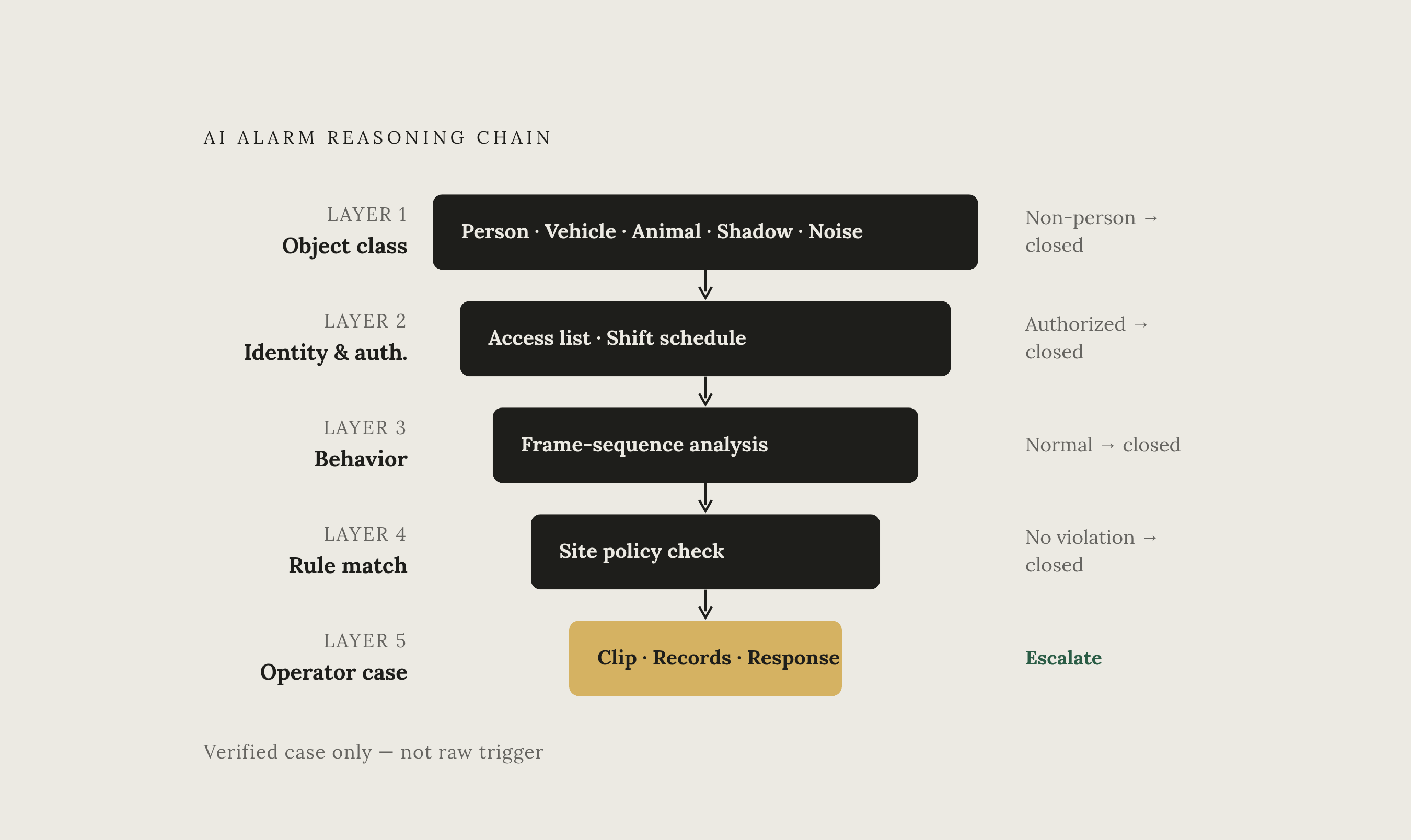
A well-designed AI agent does not make a single pass at an alarm. It works through a sequence of increasingly specific questions, and the answer at each layer determines whether the event continues toward a human operator or is closed. Layer one asks what is in the frame: a person, a vehicle, an animal, a shadow, a blowing object. This is the filter that catches environmental noise rule-based systems cannot. AI anomaly detection learns what normal looks like from data, so it ignores the trees, shadows, and weather that drown out rule-based approaches. A poor sensor feed produces unreliable outputs regardless of model sophistication.
Layer two asks whether the person or vehicle is known and authorized to be present at this time. It cross-references access control records, badge activity, or a learned roster of authorized individuals. Authorization is time-bound. The same person who is authorized at noon may not be authorized at 2 a.m., which means the agent must evaluate identity and schedule simultaneously. Layer three moves to behavioral signal: is what the person or vehicle is doing consistent with authorized activity, or does it deviate in a meaningful way? The tracker and action model make this possible because the system evaluates a sequence of actions, not a single frame.
Layer four evaluates whether this combination of object, identity, and behavior violates a rule the site has established as meaningful. Based on rules and learned normal patterns, for example no person in the yard after 10 p.m., the system decides which events are suspicious and generates alerts only for those. A construction site, a multifamily loading dock, and a retail back entrance have entirely different definitions of normal. An agent that cannot encode site-specific rules produces the same noise a rule-free motion sensor would. If an event clears all four layers as a probable threat, layer five assembles the information a human operator needs to make a fast, informed decision: video clip, access records, behavioral summary, and suggested response options. The human receives not a raw trigger but a pre-assembled case.
Why site-specific context is not optional configuration — it is what makes the reasoning meaningful
An AI agent reasoning without site-specific context performs pattern recognition against a generic baseline. It will either miss threats that are normal elsewhere but abnormal here, or flag normal activity that looks suspicious to a model with no knowledge of this site's operations. The reasoning chain is only as good as the rules and learned norms it evaluates against. Site-specific protocols encode what a facility considers authorized: personnel rosters, shift schedules, delivery windows, vendor access hours, and known vehicle plates. An agent with that information can close events that would alarm a generic system, because it knows that a delivery truck at 5:30 a.m. is a scheduled vendor, not an intrusion.
The external scoring system makes this concrete. For an AI agent's output to earn a high AVS-01 tier, the alert must carry enough site-specific context to support that classification. The monitoring center, or the operator's own security operations team, must be capable of attaching AI-derived evidence to a dispatch communication that the receiving PSAP can score under AVS-01. That requires the alert to have been built with site context from the start. The practical difference is not theoretical. A center equipped for video or audio verification assesses the situation before escalating. That distinction determines whether a system earns priority response or is deprioritized as likely noise.
What the reasoning chain changes about speed — and why speed is the right metric
Speed matters not because faster is always better, but because a threat that waits behind a queue of unverified alarms has already cost something. The legacy model's latency problem is not network speed or camera resolution. It is queue depth. Every alarm, real or not, occupies the same human attention slot, so a genuine threat's position in line is determined by how many false positives preceded it. An AI agent that reasons through the five layers removes non-threats from the queue before they reach a human, compressing the queue to verified events only. The operator's first contact with the event is the pre-assembled case, not the raw trigger. That compression is where the speed gain actually lives.
SLA language conceals the distinction. "Alarm acknowledged" and "threat assessed" are not the same event. A system can acknowledge an alarm instantly via automated receipt while the actual human review waits in queue for many minutes. Buyers need to ask what the SLA covers and at what stage of the chain. The objection that AI reasoning introduces its own latency is real but misframes the tradeoff. A reasoning layer that takes seconds to close a false positive is faster than a human who would have spent minutes on it before reaching the same conclusion. What reaches the human at the end of the chain is the difference between a monitoring system that reacts and one that assesses.
What the human operator does after the agent's reasoning — and why that role is qualitatively different
When an AI agent delivers a pre-assembled, verified event, the operator is no longer doing triage. They are exercising judgment on a question that genuinely requires it. The operator who receives a verified event does command work: confirming the number of individuals on site, whether weapons are present, vehicle descriptions, points of entry, and whether a crime is actively in progress. That shift significantly improves situational awareness before officers arrive. A trained human overseeing the agent's reasoning log is a real security layer, not a formality.
The claim that AI eliminates operator jobs inverts the actual dynamic. Operators freed from classification work become more valuable, not redundant. The skill set required rises, and the decisions they make carry more consequence per hour of attention. The operator's time goes to decisions that require judgment, not to reviewing events that clearly do not. The result is a better human decision, made with better information, in less time.
Where the reasoning chain can fail — and what makes it robust against those failures
The reasoning chain is only as reliable as the data flowing into it and the breadth of conditions it was trained on. Models that perform well in benchmark conditions can collapse when deployed on unfamiliar camera geometry, lighting, or scene content. Cross-dataset generalization is the primary technical risk. A model calibrated on one facility's cameras may perform at near-random-chance accuracy when moved to a site with different conditions. That is not a flaw in the concept but a deployment reality requiring site-specific training or calibration. Visual noise and distortion from challenging environments are primary causes of AI malfunction and false alarms. Establishing a trusted data environment to solve these issues is the industry's top priority as of 2026. The practical implication is that learned normality must be established at this site, with this camera placement, under these lighting conditions, before the reasoning is trustworthy.
Security-specific failure modes go beyond accuracy. AI agents are a specific subset of AI systems with multi-step incidents involving multiple components and dynamic interactions, and existing incident reporting approaches do not capture them adequately. What makes the reasoning robust against these failures is a combination of measures. The strongest objection, that AI reasoning simply shifts false alarms rather than eliminating them, is answered by the architecture. The agent's job is not to be perfect but to be faster and more consistent than a human reviewing the same queue volume, and to ensure human attention lands on the residual uncertain cases rather than on obvious noise.
What a monitoring architecture looks like when the reasoning chain is working correctly
When a monitoring architecture gets the reasoning chain right, you get a qualitatively different operating environment. Verified threats reach humans with enough context to act, operators spend their attention on genuine decisions, and the system builds a track record of trustworthy escalations that reinforce rather than erode confidence over time. The practical shape varies by site type. In commercial retail, AI agents review every camera simultaneously, filter authorized staff and known vendors, flag unknown individuals in restricted areas or after hours, and surface only those events with a pre-assembled behavioral summary. In multifamily properties, the outcome is measurable. A property manager using AI-augmented remote video monitoring to detect vagrancy near dumpsters after hours deterred six intruders in the first two weeks. The shift from discovering damage after the fact to intervening before it occurs is the operational outcome of a working reasoning chain. In industrial and truck yards, video analytics on existing cameras cover perimeter intrusion, loitering, PPE compliance, forklift near-misses, smoke and fire, and slip-and-fall events. Agents monitor sensor feeds and video data for safety violations, alert supervisors in real time, and generate incident documentation automatically for compliance records. The human operator in this architecture is not watching cameras. They receive verified escalations with enough context to make a fast, informed dispatch decision. Trust in the system is earned incrementally as the agent's track record of accurate escalations builds. AI should earn operator trust by proving its value over time, surfacing alerts that matter, filtering noise, and building a record that makes the system worth paying attention to. That is a design goal as much as a technical one. The legacy model's fundamental flaw, that every alarm looks the same to the human receiving it, is resolved not by better cameras or more operators but by a reasoning chain that arrives before the human does and does the work of distinguishing signal from noise. For security buyers evaluating vendors, the question is not whether a system uses AI. It is whether the AI reasons or merely detects, and whether the human operator receives a pre-assembled verified event or a raw trigger that requires them to do the reasoning themselves.