Industrial Facility Perimeter Security and Intrusion Detection
Verified alerts matter more than camera count when stopping an intruder depends on speed.
AI-augmented remote video monitoring for truck yards and freight facilities works when it connects perimeter detection to a verified threat and a configured human response. Industrial facility perimeter security and intrusion detection fail when that chain breaks, even if cameras record the intrusion. The useful test is how quickly an actionable signal reaches someone who can intervene, and what happens next.
Why industrial perimeter detection is a solved problem that keeps failing
A fence-line camera records an intrusion, but nobody acts on the footage while there is still time to intervene. The camera has performed its detection function. The security operation has not performed its response function. This is the central paradox at industrial sites where cameras already cover fence lines, access points, and loading zones. An event can be visible to the system without becoming actionable to the people responsible for protecting the site.
Most large industrial campuses already have the hardware needed to capture activity in these areas. Yet recording motion is only the first link in a longer operational chain. Someone must distinguish a threat from routine activity, understand where it is happening, and reach a person with the authority to respond. Each handoff can separate the captured event from an intervention. More detection hardware does not, by itself, connect those handoffs.
This distinction changes what a successful perimeter system looks like. Footage establishes what happened, while verified response creates the possibility of changing the outcome. The two functions are not interchangeable. A facility can therefore have extensive camera coverage and still leave a breach unattended. Its weakness lies not necessarily at the fence line, but in the path between the sensor and the person who can act.
How human attention degrades inside a monitoring operation, and why adding cameras makes it worse
Operators must watch many feeds at once through long shifts, looking for activity that matters among routine movements. That load is built into the job. Research cited in Activu’s The Command Center Design Guide: Building for Operational Intelligence in 2026 describes how operators can miss significant activity during continuous monitoring. Enough training alone does not solve the problem.
Human attention degrades under sustained observation, and additional feeds increase the material competing for it. Adding cameras to an already overloaded operation therefore expands the viewing burden as well as the physical coverage. The distinction is operationally important. Covering a new zone does little to protect it right away if the monitoring process cannot reliably pick out a threat in its footage. The system has acquired another view without acquiring a dependable way to use it.
Staffing can distribute work, but it does not remove the limits of continuous human vigilance. Treating every missed event as an operator failure leaves the underlying design untouched. It also treats footage that is recorded as though someone is watching it. Camera count describes the extent of the equipment. Where alert volume is already unmanageable, expansion can deepen the fatigue that prevents the existing cameras from supporting timely intervention.
The queue math problem: why a real threat waits behind dozens of false alarms
The same attention constraint becomes a backlog when motion events generate alarms. A legacy rule-based detector may flag both a forklift that passes through a monitored zone and a copper-theft crew that cuts fence wire. If both enter the same queue at the same priority, the operator must establish the difference. The fence breach does not pause during that review. A genuine threat waits behind routine notifications while its intervention window narrows.
Repeated false alarms also change how operators respond to the queue. When most events have little value, people pay less attention to the notifications that follow and are more likely to miss a real threat, a pattern known as alarm fatigue. The system keeps asking for attention without giving people information that calls for it.
Fragmented tools add work to every review. Operators may have to move between VMS, CAD, and SIEM platforms to connect an alarm with the relevant camera feed. The Activu guide calls this “swivel-chair inefficiency” and identifies it as a primary failure point of traditional command center design. Those manual pivots consume time before the operator can even judge the event. If notifications arrive faster than people can clear them, overtime, offshoring, or alarm-muting does not resolve the structural imbalance between incoming work and review capacity.
Why response time is the correct metric and what it actually measures in a perimeter context
Response time exposes the delay that an alarm count conceals. An alarm firing, a trained human receiving a verified threat, and that threat being contained are distinct events. A facility can detect a breach quickly but leave the notification in a queue. Measuring only the trigger therefore credits the system before it has delivered the information needed for protection.
Activu’s The Evolution of the Station Command Center: 2026 Trend Analysis notes that, in high-stakes environments, a delay of even 30 seconds can compromise safety and operational integrity. That observation explains why latency deserves operational scrutiny. At a fence line, time spent sorting notifications or finding video consumes the window in which interception remains possible. Once that window closes, the same footage may help people investigate what happened.
The useful monitoring SLA measures the interval from a real event to a trained human receiving a verified, actionable signal. That interval must remain distinct from the time required to contain the threat. Otherwise, labels such as “mean time to react” and “mean time to respond” can hide different endpoints under apparently comparable results.
What AI agents actually do differently — reasoning about context rather than flagging motion
Instead of presenting every motion event for manual review, the AI layer assesses which events require attention and supplies context for those that do. The human remains the decision-maker in this architecture. The architecture protects that person’s capacity for judgment.
The Activu trend analysis identifies a shift from asking what is happening across the network to asking what requires immediate attention. It projects that, by 2026, 70% of critical infrastructure operators will abandon continuous manual monitoring in favor of automated, event-driven alerting. The success of individual implementations remains unestablished. Its architectural significance is the move away from requiring people to discover threats by continuously watching feeds.
Vision-language models can make sense of activity and describe it, going beyond flagging motion. With the relevant context, they can distinguish a maintenance technician following an authorized route from an unauthorized person loitering near a restricted entrance. Line-cross detection and restricted-zone intrusion logic narrow the trigger to a breach of a defined boundary. Behavioral analytics can also connect a vehicle’s repeated evening visits and stops near a restricted entrance, surfacing possible reconnaissance across days. These functions serve different purposes, but each can reduce the interpretive work required before a human evaluates the threat.
Why site-specific context is what separates a useful AI layer from one that reproduces the original noise problem
Industrial activity does not follow a generic definition of normal. Shift changes, contractor access, delivery schedules, and after-hours maintenance all bring people through monitored areas for legitimate reasons. A person entering a zone at 3 a.m. may be an authorized maintenance technician or an intruder. Appearance alone does not establish which interpretation is correct. The system needs the operating context that makes the activity authorized or suspicious.
Region-of-interest configuration and operational scheduling give that distinction practical form. They encode which zones are active when and which personnel are authorized at particular hours. Machine-learning-based false alarm filtering can also learn site-specific behavior over time. Its usefulness depends on both the environment it has learned and the underlying model’s capability. Without that grounding, a faster analysis layer can make the same false-positive errors more quickly.
Context must also reach the operator through the existing workflow. Integration with the site’s VMS or PSIM platform avoids creating another interface that requires separate attention and manual correlation. A parallel screen can reintroduce the switching cost that filtering was meant to remove. A steady stream of alerts with little context can also lead operators to leave. A control room that repeatedly loses operators cannot accumulate the site knowledge needed to recognize an anomaly that the camera configuration did not anticipate.
How escalation protocols determine whether a verified threat produces an actual intervention
An operator who receives clear video and a precise location must know which actions are available and how to initiate them. At industrial sites, those actions can include remote access-control lockdown, law enforcement notification, and on-site security dispatch. They are not interchangeable responses to every intrusion. Their usefulness depends on protocols configured for the site and escalation paths tested before an event.
The Activu trend analysis describes unauthorized entry automatically pushing the relevant video feed and geospatial data to the decision-maker through visual escalation. That presentation reduces the work of finding the event. It does not remove the need to decide what the event warrants. A truck yard requires a different escalation tree from a retail site or a chemical facility with restricted zones and regulatory compliance requirements.
Without that site-specific tree, the operator must improvise under pressure. The cognitive burden removed from the alarm queue then returns at the point where a clear decision path is most valuable. With a configured protocol, the operator can judge a verified threat and respond within a plan already in place. Speed to verification delivers value only when this downstream chain is ready. Otherwise, the architecture breaks at its final handoff.
What should AI-augmented remote video monitoring for truck yards and freight facilities look like in practice?
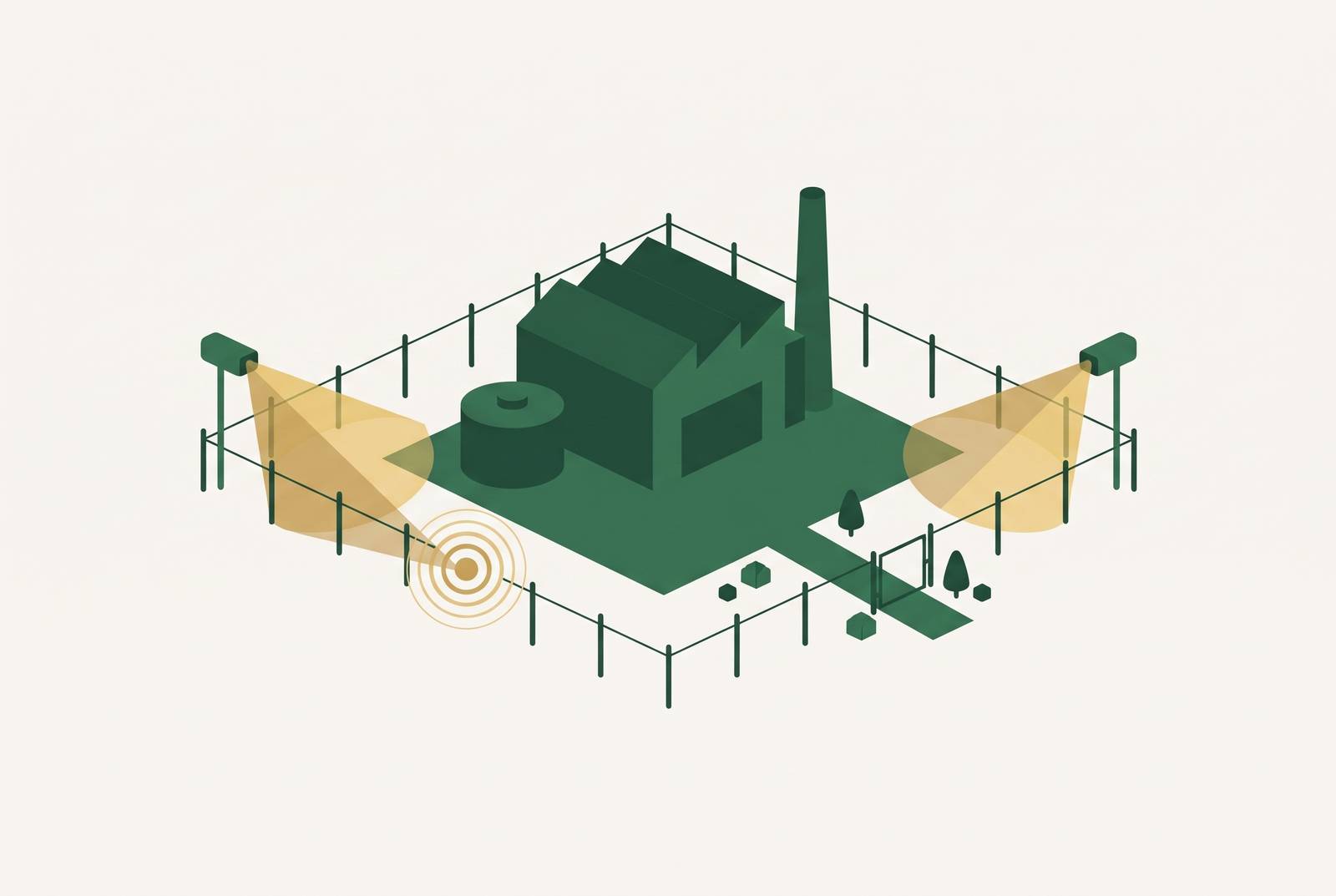
For a truck yard or freight facility, an end-to-end architecture begins with complementary detection. Fence-line sensors, radar, and AI cameras cover the site in different ways and can fail in different ways. Together, the information they gather helps with object-class verification and with telling authorized activity from threat behavior. Detection supplies the evidence for the next stage. It does not independently establish that every boundary event requires intervention.
The reasoning layer processes alarms through detection, contextual assessment, and escalation. In this design, environmental noise and authorized activity are filtered before the remaining signal reaches a trained operator. The escalated event arrives with a video clip, location tag, and timestamp, so that the operator does not have to reconstruct its basic circumstances across disconnected tools. Human confirmation then activates the configured response path. Depending on the site’s protocol, that path can lead to law enforcement notification, access lockdown, or on-site security dispatch.
For an unmanned freight yard after hours, this is the practical distinction between recording activity associated with cargo theft and supporting a response while it unfolds. An alert described as “instant” is insufficient if it leaves the operator searching for footage or deciding whom to contact. The relevant buying criteria are contextual filtering, actionable verification, workflow integration, and tested escalation. None works as a substitute for the others.
The Activu guide reports that operators can miss up to 25% of critical incidents when manually monitoring fragmented data silos. It also identifies a recurring investment imbalance in which organizations acquire high-end displays and ergonomic furniture while overlooking the software that makes the hardware useful. For a team evaluating a monitoring service, the decisive question is therefore operational. How long after a real event does a trained human receive a verified, actionable signal, and what happens next?