AI Agent Escalation Logic in Video Monitoring Workflows
Smarter filtering of video alarms keeps operators focused on actual threats instead of noise.
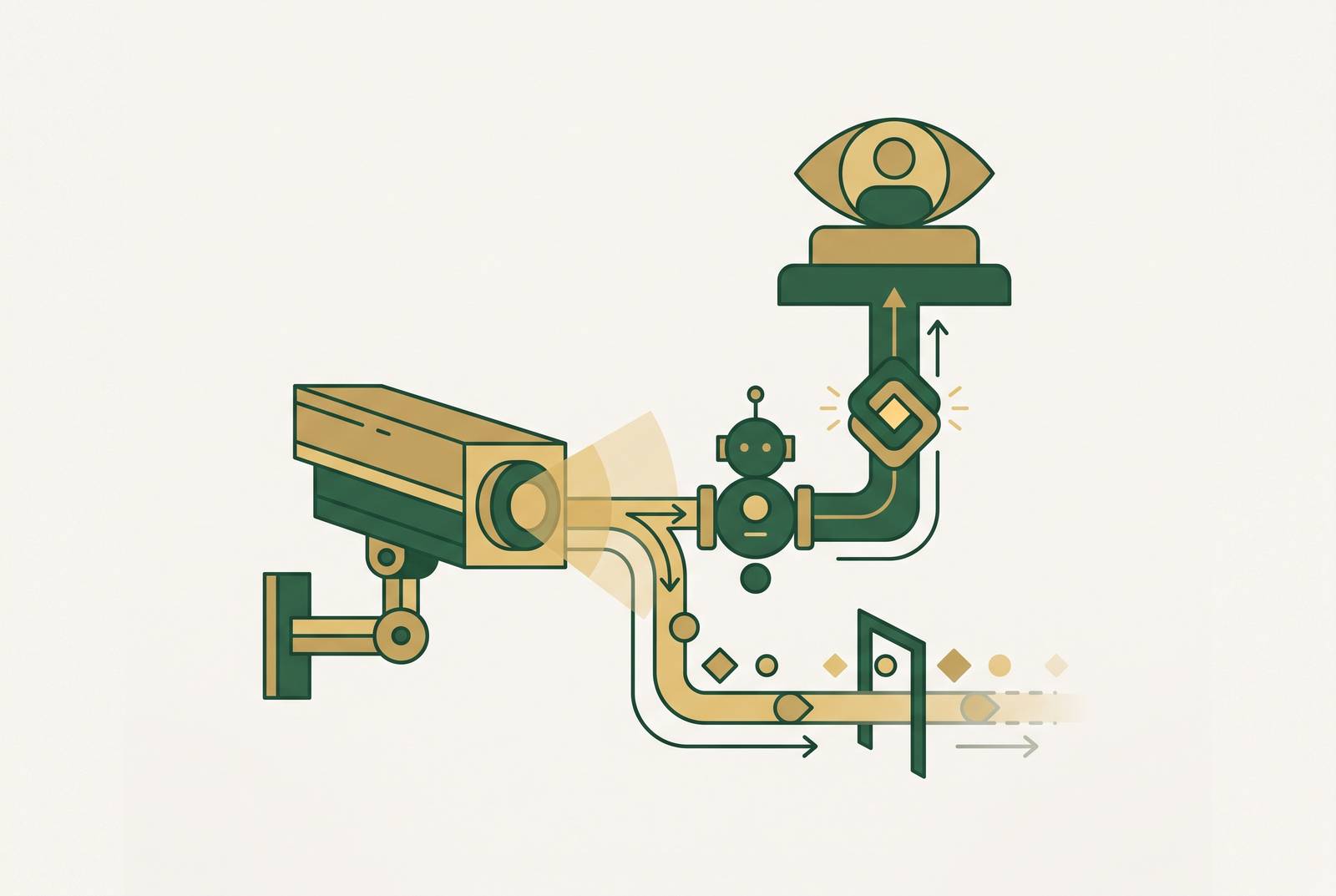
AI agent escalation logic in video monitoring workflows decides which alarms a person needs to review. Its value is not in flagging more activity, but in filtering environmental noise, interpreting behavior against site-specific context, and routing verified threats for human judgment. Effective monitoring therefore depends on the architecture before the operator as well as the number of operators available.
Why the legacy monitoring queue is an architectural problem, not a staffing one
The legacy monitoring queue puts real threats in the same line as environmental triggers. Most motion triggers are not threats, so noise occupies the queue before an operator can establish what matters. A real incident can wait behind dozens of alarms that need no response even when staff follow their procedures correctly. The architectural flaw is that human review comes before meaningful filtering, making attention the bottleneck for every event.
That attention has biological limits. It degrades within minutes when operators monitor multiple simultaneous feeds, and experience or training cannot eliminate those limits. As alarms accumulate, response latency can grow from seconds to tens of minutes. Adding operators changes the capacity available to process the queue, but it does not change what enters it. The necessary correction is to separate noise from actionable events before both compete for the same human attention.
What escalation logic actually does inside a monitoring workflow
Escalation logic is the structured reasoning layer between a raw alarm and a human operator. Detection identifies activity, while escalation logic selects activity requiring human action now. Human dispatch is a later decision about the response. These functions are related, but treating them as interchangeable leaves the operator responsible for interpreting every detection.
The distinction becomes clearer when the workflow is separated into perception, understanding, and action. Perception identifies what is in the frame, understanding interprets what happens across frames, and action determines what should happen next. Escalation logic belongs in that action layer. For example, a motion trigger may correctly flag activity that escalation logic dismisses because it matches a known schedule and authorized access pattern.
Without this layer, adding AI detection can recreate the original queue with a different source of alarms. The system may be better at spotting activity but still ask a person to decide what every event means. Effective escalation filters events into a set of verified threats and ranks them.
The reasoning steps an AI agent applies before routing an alarm to a human
The sequence begins with environmental filtering. Lighting changes, moving foliage, reflections, and camera artifacts can trigger detection even when there is no behavioral signal. A reasoning layer trained on these patterns dismisses them before behavioral classification begins. This is where much of the volume that would otherwise enter the legacy queue is removed.
The events left after filtering must then be assessed across frames. Object detection establishes presence, but tracking and action classification help distinguish a person standing still from someone approaching a restricted entry or circling for an extended period. These are different behaviors with different escalation weight. The essential transition is from recognizing a person to recognizing conduct that warrants scrutiny. A single-frame snapshot cannot provide the same account of how that conduct develops.
Behavior alone, however, does not establish whether an event is anomalous. Context matching checks it against the site's operating hours, patterns of authorized personnel, lists of known vehicles, and camera zone designations. A forklift in a pedestrian lane at 3 a.m. carries a different signal from the same forklift during a scheduled shift. The agent must receive that baseline separately from its generic training. This separates context-based reasoning from a trigger that fires whenever a fixed condition appears.
Finally, confidence thresholding routes the event to dismissal, continued monitoring, or escalation to a human. Passing the earlier stages does not automatically make an event a verified threat. The agent assigns confidence and routes the event accordingly. When escalation is justified, the operator receives a clip, a classification, a confidence score, and the site context that explains the anomaly. Verification here is a structured, fallible assessment for human review.
Why site-specific context is not optional configuration — it is what makes classification meaningful
Anomaly is a relative judgment. Activity is unusual only in relation to what should be happening at a particular site and time. A generic model can recognize behavior, but it cannot supply the site's operating baseline. The site operator must provide that knowledge for classification to support a meaningful escalation decision.
The required inputs include operating schedules, authorized access lists, restricted and open camera zones, known vehicle plates, vendor arrival windows, and guard patrol routes. Together, these show what activity to expect and what needs to be looked into. Without them, an agent falls back on generic behavioral thresholds. That can reproduce legacy false positives at greater speed while leaving their cause unresolved.
The relevant protocols also differ by property type. Retail needs access classification that takes schedules into account, while multifamily monitoring needs defined package room and perimeter zones. Industrial monitoring requires PPE zones, vehicle lane designations, and shift timing. These distinctions determine what the same observed behavior means in each setting. A service that loads and maintains those protocols therefore provides a structurally different product from one that applies a generic model to the same cameras.
How the architecture of the escalation channel shapes what the human operator actually receives
Once an agent decides to escalate, the handoff must preserve the reasoning that made the event important. A raw clip forces the operator to reconstruct the classification and find the relevant site context. A packaged escalation instead presents the clip, classification, context, and anomaly flag together. The operator can then verify the assessment and choose an intervention without repeating the screening process. The channel also has its own latency, so a fast classification is not enough if the result waits before reaching the operator.
Gomez (2025) establishes why the credibility of an escalation path matters. In that work, a channel providing independent review and a structured pause reduces harmful action rates to 1.21%, substantially more than a nominal channel that is merely available, though this figure is not a physical security performance guarantee. Escalation must provide a designed handoff that gives operators a usable route to independent judgment.
Fokou (2026) argues for cognitive-executive separation, in which the system that reasons is structurally separated from the system that acts. In monitoring, this maps to agents verifying events and humans authorizing the response. The operator confirms the classified threat and chooses how to respond, with options that include voice-down, dispatch coordination, and site notification. This division of labor is a strength because the operator can see what the agent decided, why it decided it, and what requires authorization.
What response speed looks like when escalation logic is working correctly
Removing the noise queue can make a faster response possible. AI detection can occur in seconds, followed by streaming to an operator in seconds more. Operator viewing and the onset of intervention can then fall within tens of seconds from the event's start. These are potential outcomes of the architecture. Performance depends on the full path from detection through verification, delivery, and human decision.
The useful response window also depends on the property. In retail, intervention matters before a subject exits the floor. At an industrial perimeter, the relevant window is before a person or vehicle reaches a restricted asset. In multifamily settings, it is before a confrontation or property damage escalates.
APCO International and The Monitoring Association provide an alarm-data transmission protocol for another part of the response workflow. It delivers alarm event data digitally into a PSAP's computer-aided dispatch system, eliminating the verbal hand-off between a monitoring center operator and 911. This accelerates dispatch by roughly two minutes per qualifying call. It addresses the final dispatch handoff rather than the earlier reasoning task, showing why response speed must be considered across the workflow.
Where escalation logic breaks down and how the architecture prevents it
False dismissals are a real risk, particularly when site context is incomplete or stale. An outdated authorized access list can cause an unauthorized person to be accepted as a known pattern. Protocols must be kept up to date as part of day-to-day work after onboarding ends. Anomaly detection on top of context matching provides another safeguard by scrutinizing behavior that appears authorized but is unusual in pattern.
False escalations send noise back to the operator. They are common during early deployment before the model is calibrated to the site's baseline. A calibration period must be planned for, with human decisions feeding back into the agent's calibration. Operators marking false escalations provide the signal that tightens future filtering. Without that feedback, the human layer can acquire a new queue despite the presence of AI.
Manipulation presents a different architectural risk. Fokou (2026) argues that prompt-level guardrails are insufficient for agents with execution capability because safety instructions share the same computational substrate as adversarial inputs. In physical monitoring, a related vulnerability is filtering logic that can be taught to ignore a pattern through repeated authorized-looking activity. Parallax-style cognitive-executive separation addresses this risk by separating classification from execution and placing a structurally independent validation layer before action. The human operator makes the final verification before a threat response.
These measures make classification's failure modes explicit and give the architecture ways to contain them. The relevant comparison is AI escalation against a queue in which volume, fatigue, and delayed review already cause threats to be missed.
What buyers should look for in a monitoring service that claims AI-driven escalation
Buyers need architectural evidence because “AI-powered monitoring” can describe anything from rules-based triggers to a reasoning-and-verification layer. Buyers need to establish where site context lives and who maintains it. Ask how often schedules, access data, and zone definitions are updated, who owns those updates, and what triggers a protocol review. A service without this process offers faster flagging without site-specific escalation reasoning.
Look for an escalation package that has the clip, classification, anomaly context, and recommended action. A raw camera feed leaves the operator doing the screening the service claims to have automated. The operator's task should be verification and authorization, with the agent's assessment available for scrutiny.
Response commitments should then be examined as seconds-to-operator for verified threats. Ask how the clock starts, what qualifies as a verified threat, and how SLA performance is reported. Staffing claims cannot substitute for evidence about that interval. Muting noisy cameras, offshoring operators, and charging overage fees may change staffing costs or coverage, but none shows that the queue architecture has changed.
The AI-to-human boundary deserves equal scrutiny. A trained human operator should authorize every threat response, and buyers should question agents that dispatch or act without a human first confirming the threat. Records that show a human authorized dispatch decisions are important for regulated industries and for insurance.
Finally, ask about the calibration period, false-escalation tracking, and post-calibration alert volume per site per day. A claim that the service works perfectly from the start leaves unexplained how it is tuned to each site. A well-tuned deployment should deliver a small number of verified escalations.