How Camera Muting Reshapes Threat Probability Across an Entire Site
Silencing noisy cameras shrinks real coverage and hides the gap.
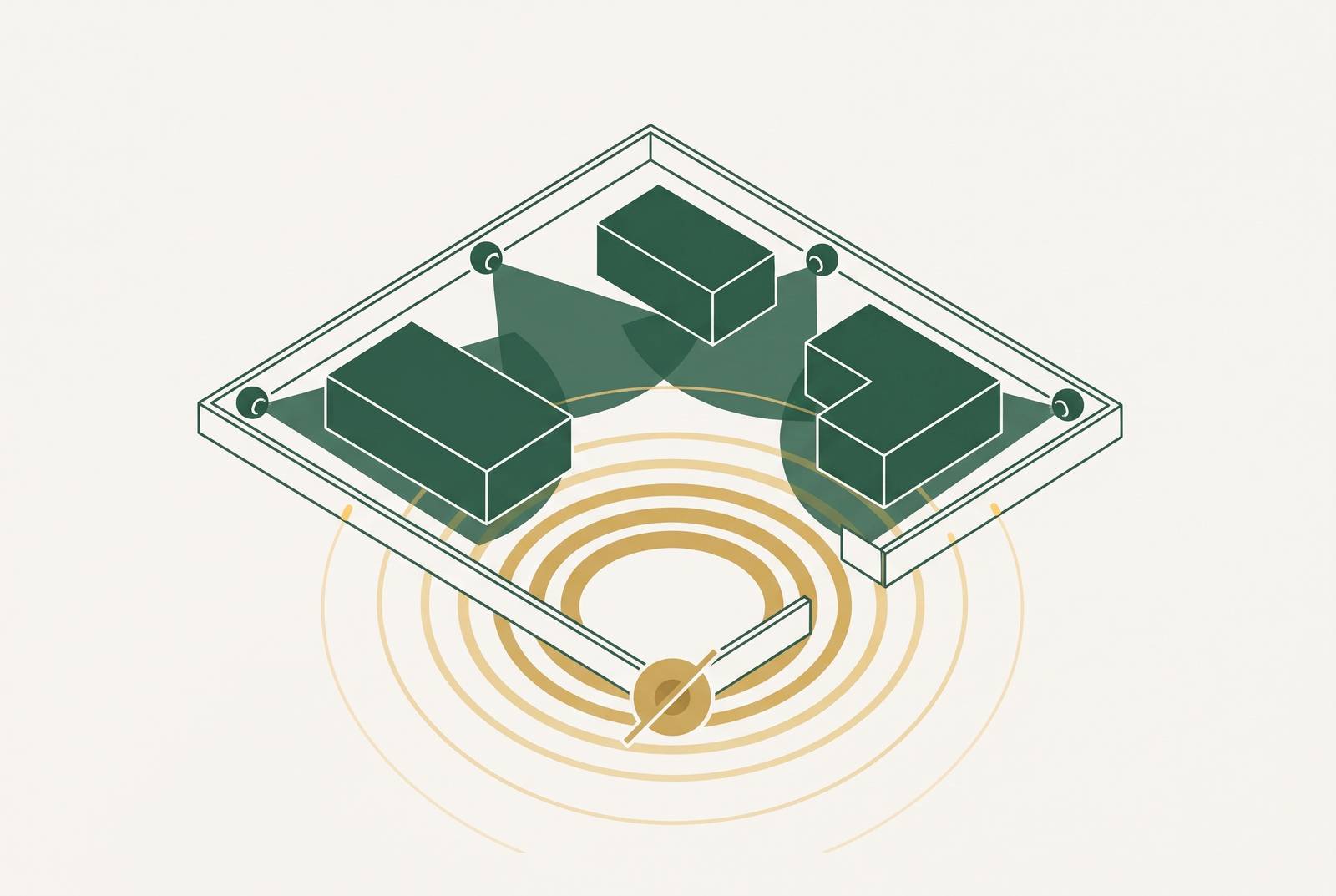
Muting noisy cameras fails as a monitoring solution because it reduces alerts by removing monitored coverage. It leaves risk unresolved in muted zones while making the remaining feeds appear to represent the whole site. This article explains how that redistribution creates a structural vulnerability and why noise must be filtered before it reaches operators.
Why muting noisy cameras feels like a reasonable monitoring solution but is not
For an operator facing a queue of repeated false alarms, silencing the worst feed looks like a way to protect attention for genuine threats. The relief is immediate, and the camera can be unmuted later. That makes the decision appear contained and reversible. Yet turning notifications back on later cannot bring back the chance to respond while the camera was muted.
The pressure comes from the monitoring architecture itself. A reactive-alarm relay model passes signals to people without doing enough to sort threats from routine activity across the many cameras now in use. When the available controls all mean receiving less signal, muting becomes their logical endpoint. The flaw is that suppressing a feed also suppresses awareness of the place it covers.
How the false-alarm queue makes muting feel inevitable
Traditional monitoring follows a relay model in which a sensor trips, a signal reaches a central station, and an operator calls and dispatches. The operator inherits the burden of deciding whether the signal deserves action, a flaw in the alarm queue that Verdun, an AI-powered remote video monitoring service pairing AI agents with trained human operators, identifies as the root failure of legacy monitoring. The LAPD found that 97 percent of its alarm calls were false. That figure describes alarm calls rather than camera-alert accuracy, but it illustrates the burden that false signals place on a reactive response system.
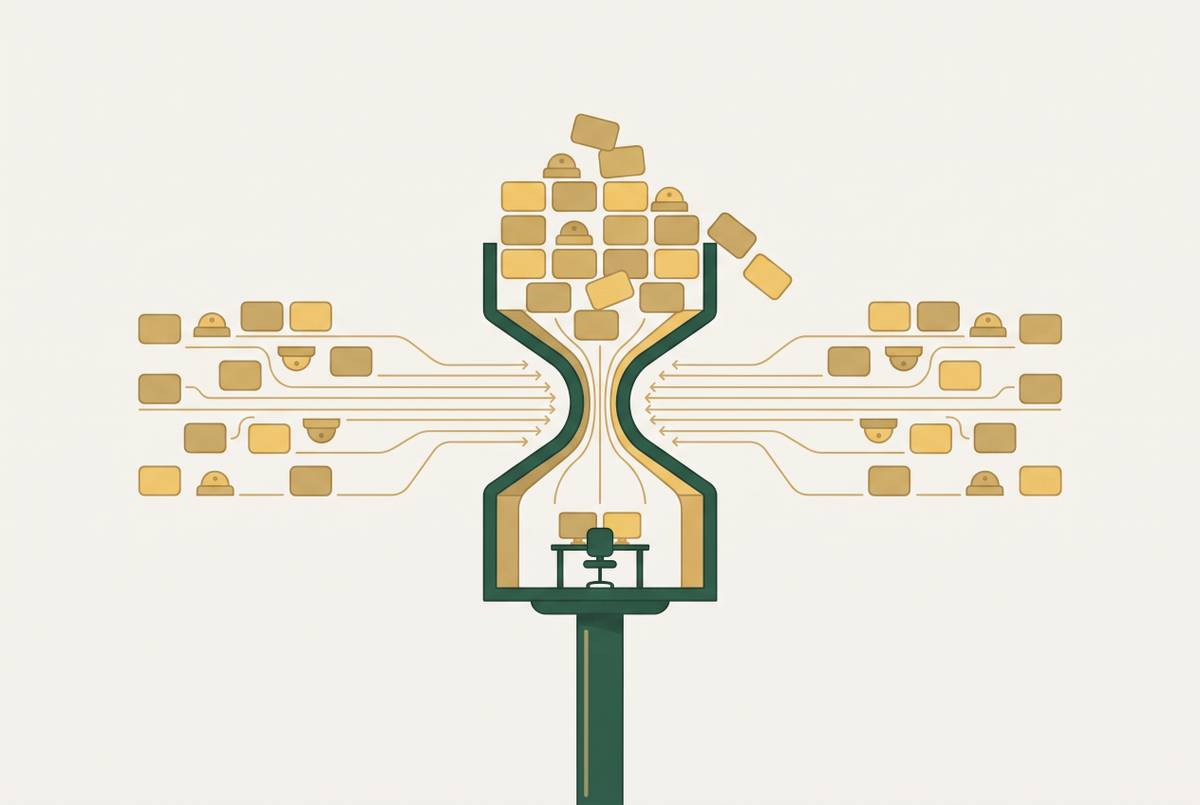
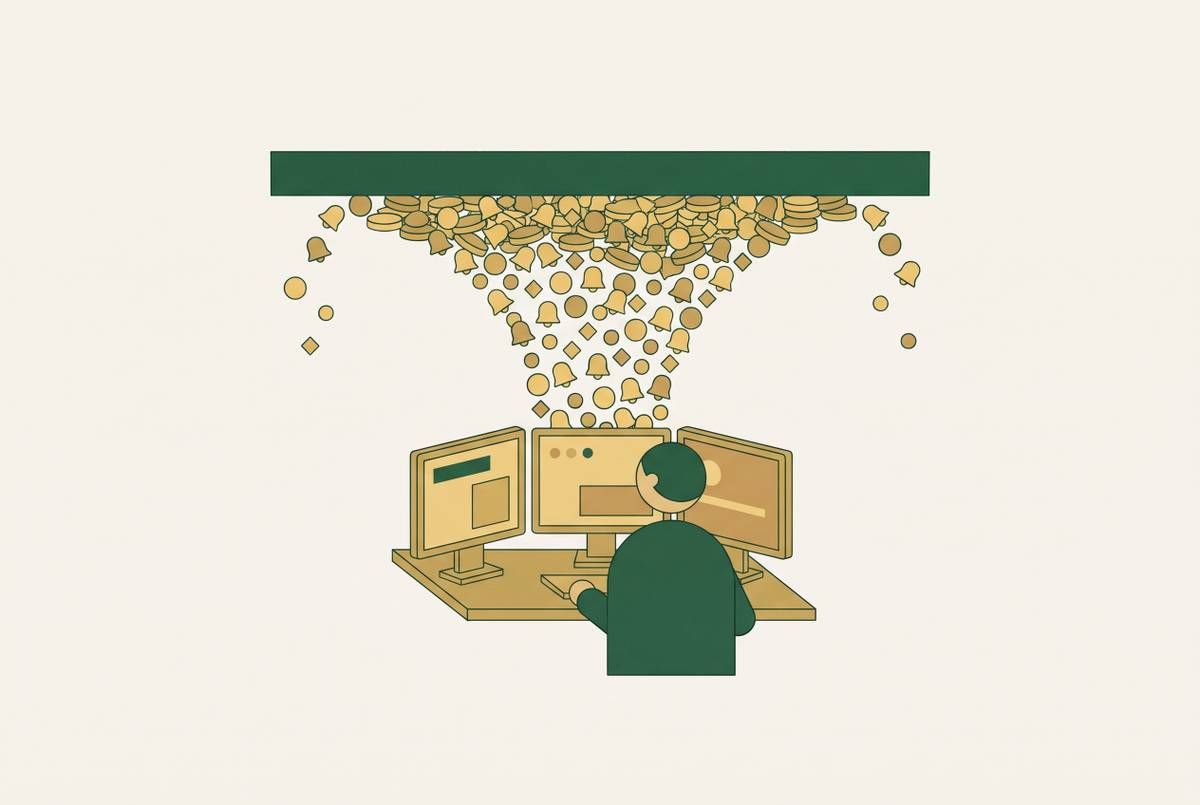
Human attention cannot absorb that burden indefinitely. Operators usually watch dozens of feeds at once, though attention fatigue can set in within minutes of live-feed monitoring. VideoraIQ’s analysis of alert fatigue describes how teams lose trust in alert queues when the volume stays high. A chronically noisy feed therefore does more than consume time. It teaches the operator that another notification from that camera is unlikely to warrant attention.
Retuning analytics seems like a better way to deal with the noise. However, it requires time, expertise, and access that most monitoring contracts do not provide, while muting is available in seconds. The decision is understandable without being safe. The operational objection is that silencing a troublesome camera changes what every remaining camera can tell the control room about the site.
What a muted camera actually removes from a site's coverage picture
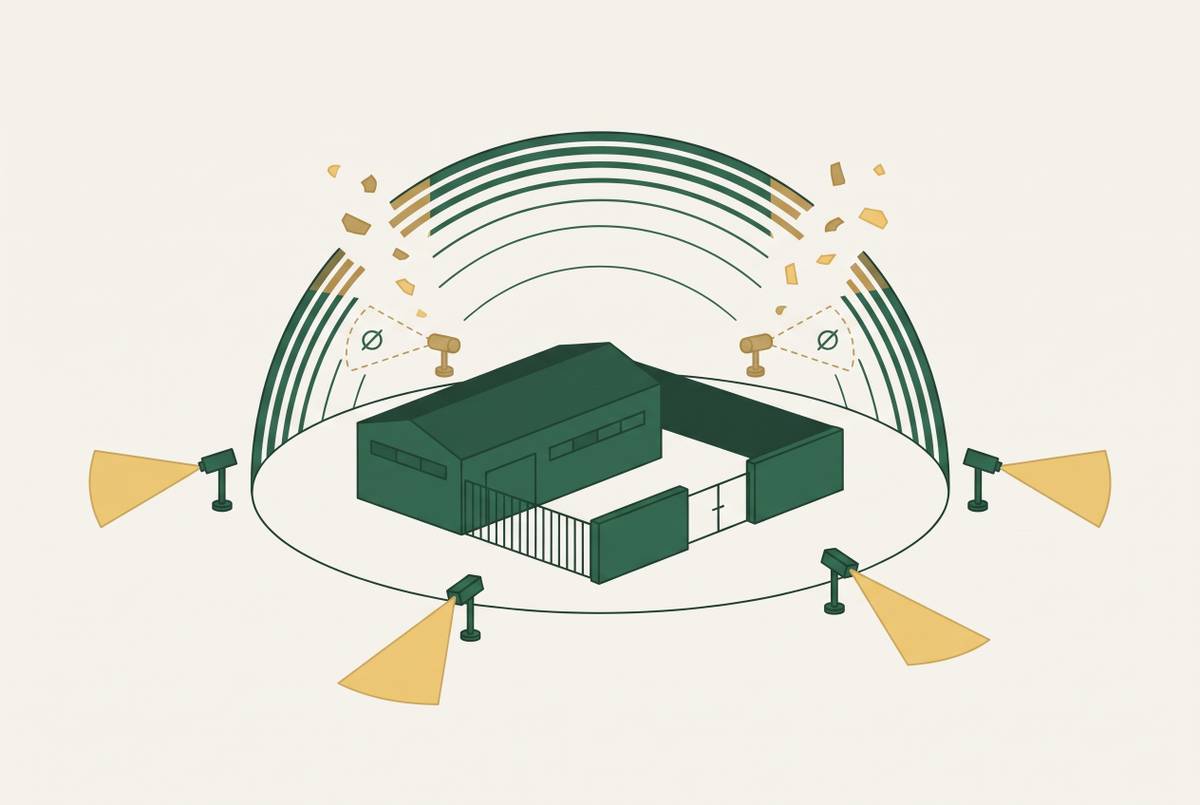
A camera layout is an overlapping coverage network. Each field of view includes areas shared with neighboring cameras and areas that only that camera can see. Muting removes that unique area from active monitoring. Where no other monitored feed covers it, monitored coverage drops to zero, even if the camera continues recording.
Recording and monitoring serve different purposes here. Footage available after an incident is not equivalent to a timely opportunity to intervene. VideoraIQ notes that a threat can be captured on camera and still go unaddressed because nobody sees it in time.
The geometry is especially consequential at high-motion locations, including loading docks, entry points, and perimeter fencing. These areas generate nuisance activity, but they are also places where genuine threats can originate. The camera an operator most wants to silence may therefore cover a high-risk spot. Adding cameras without improving alert quality can deepen the same fatigue and prompt further muting. Once one zone loses coverage, its unresolved threat probability changes what the cameras still active can tell operators about risk across the site.
How threat probability redistributes across the cameras that remain active
The redistribution changes the relationship between where threats can develop and where operators can detect them. Unmonitored zones offer opportunities for threat actors, while the remaining cameras become the basis for decisions about the whole site.
A site with most cameras active does not necessarily retain a matching proportion of its ability to detect threats. Location and detection boundaries determine what remains visible. Operators may see interior corridors but lack the entry-point views they need to understand the activity coming into them. They respond to what the remaining feeds show without knowing what the muted feed would have shown.
Overlapping views qualify the gap but do not automatically close it. An adjacent camera may capture the edge of a muted zone, yet an operator watching its whole frame is not necessarily watching that sliver. Events there will not trigger alerts unless they cross into the adjacent feed’s configured detection zone. Physical overlap and active detection are different properties. Coverage depends on both.
The feedback loop makes this vulnerability difficult to recognize. A muted camera produces no false alarms, so the queue appears healthier immediately. That apparent improvement rewards the decision without revealing the threats it may have suppressed. Muting decisions can then accumulate as cameras remain silenced after conditions change, shrinking the monitored footprint while the reported camera count stays the same. The consequences depend on what those missing views protected. The same practice therefore produces different exposure across site types.
How the redistribution effect plays out differently across commercial, multifamily, and industrial sites
Commercial sites generate frequent activity at entrances, loading areas, and parking perimeters, making those feeds likely candidates for muting. A loading dock or rear-entry camera, however, covers a location where after-hours theft commonly originates. Interior cameras cannot replace that view. Operators may still see the sales floor and corridors while the way into those spaces goes unmonitored. The site retains visible activity on its screens without retaining the same ability to detect an intrusion at its origin.
Multifamily properties often lack on-site staff to absorb what a muted feed misses. There may be no guard making rounds or receptionist watching a lobby monitor. Garage entries, package rooms, and mailroom corridors are particularly consequential gaps because unmonitored access affects resident safety directly. The fallback is limited as well as costly. When enterprise-scale alternatives do not fit the property’s economics, accepting the gap can appear to be the only affordable response.
Cameras along an industrial perimeter get nuisance triggers from wind-blown debris, vehicle headlights, and people walking through at shift changes. Silencing them removes monitored coverage where unauthorized access, cargo theft, and safety incidents can begin. Portfolio operations compound that exposure across sites. In a security operations center handling many locations, one muted camera may go unnoticed for days. The shared control room can continue processing alerts from the portfolio while a particular site’s perimeter remains outside its effective awareness.
Why raising alert thresholds and muting cameras are the same mistake dressed differently
Raising alert thresholds can preserve the appearance of an active camera while suppressing events that previously reached operators. Muting suppresses a feed, while threshold-raising suppresses a class of signals. Used simply to make the queue smaller, both substitute reduced sensitivity for better discrimination. Their scope differs, but the underlying trade is the same.
A false positive is visible to the operator. A false negative may never enter the queue at all, making the cost of suppression harder to observe than the nuisance it removes. VideoraIQ warns that raising thresholds to reduce volume can convert false positives into false negatives, with consequences including compliance gaps and audit findings. In physical surveillance, that same logic means an event can remain within a camera’s view without receiving the response it requires.
An overloaded operator can miss genuine threats too. That objection is valid, but it does not make indiscriminate suppression a sound alternative. Choosing between a queue that exceeds human attention and a queue that excludes threats preserves the architectural failure. The alternative must improve the decision about what warrants escalation before the event reaches a person.
What addressing the noise problem at its source actually requires
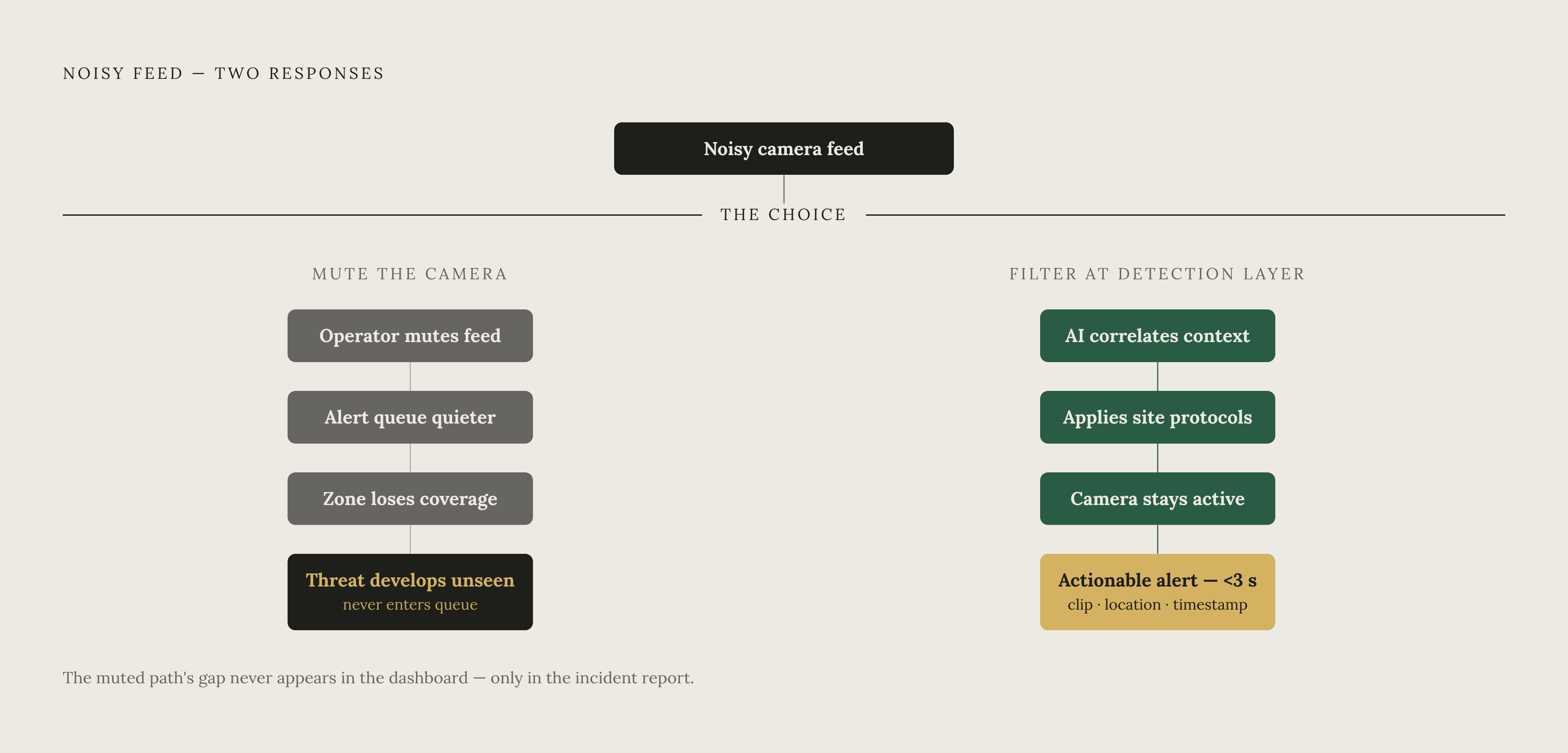
Addressing noise at its source means filtering at the detection layer while keeping the camera and its zone under active monitoring. Traditional surveillance AI fires an alert when it detects the objects or movements it was set up to look for. Reasoning-based, agentic systems add a decision about security context before escalation. The distinction is between detecting activity and determining why that activity requires attention.
Scene-specific baseline learning gives the system some of that context. A behavioral model of what happens around the camera includes patterns of arrivals, planned activity, when the cleaning crew comes, and the hours contractors work. Those details distinguish an expected presence from one that needs investigation. A person entering a scene is not, by itself, a complete security judgment. The relevant question includes whether that person’s presence fits the site’s expected activity.
Instead of silencing the camera, the system requires corroboration from detection models before escalating an event. An agent can also check access logs, correlate adjacent camera views, and classify activity before involving an operator. The camera remains part of the monitored network throughout that process. This is a different mechanism from lowering alert volume by excluding the scene from consideration.
The agent needs site-specific protocols to make that distinction. An agent that does not know the cleaning crew arrives at 6 p.m. can flag the same expected event every night. With that protocol context, it can dismiss the routine arrival and continue watching what follows. The approach therefore depends on the quality of the site context. Even when models agree, they still need to know which activity is allowed.
Escalation must include the evidence that led to the decision. VideoraIQ describes actionable alerts delivered in under three seconds with a short video clip, precise location tag, and exact timestamp. That package removes the operator’s need to locate the relevant footage before evaluating the event. It also gives the operator a concrete basis for trusting the queue. The architectural change is from passing raw triggers to people toward presenting events that have already been assessed in context.
The role human operators play when AI handles the noise — and why their judgment matters more, not less
An operator buried in alerts with little context spends attention sorting notifications and has less to spare for judging what an unfolding event means. When AI handles that preliminary work, the operator can receive the clip, location, timestamp, and prior activity needed for a decision. Authority to escalate, dispatch, or resolve still depends on trained judgment.
Site knowledge strengthens that judgment over time. VideoraIQ identifies operator retention as a security metric because a control room that repeatedly loses staff also loses accumulated understanding of its sites. That understanding can reveal an anomaly a camera configuration did not anticipate. Burnout is therefore a security failure as well as a staffing problem. Reducing noise protects the continuity on which informed decisions depend.
The two layers have distinct responsibilities within the monitoring operation. AI keeps watching cameras, zones, and alarms without getting tired, while trained operators handle events that have been assessed and need human authority. Neither layer replaces the other. For sites evaluating a monitoring provider, the practical questions are how long a verified threat waits before a human sees it and what mechanism prevents muting from creating blind zones.