The Monitoring Center That Mutes a Camera Has Already Lost the Argument About Coverage
Silencing noisy cameras trades real protection for a shorter queue.

Muting noisy cameras fails as a monitoring solution because it reduces alarm volume by removing coverage without distinguishing threats from routine activity. When high-alert cameras are silenced, the monitoring center trades the protection of those locations for a manageable queue. Alert fatigue requires a different response, namely scene reasoning before human review, with routine activity resolved and ambiguous or high-stakes events escalated.
What happens to security coverage when a monitoring center mutes a camera
An operator faces a camera that keeps generating alarms and a queue that will not clear. Muting that camera offers immediate relief. Fewer notifications need attention, the alarms that remain are easier to handle, and the camera no longer adds to excess alarm charges. At the console, the decision can look like a practical adjustment to an unreasonable workload.
But the relief comes from withdrawing attention from a location the center was engaged to protect. The camera is not necessarily producing useless images. Rather, the monitoring model cannot process the activity those images contain without overwhelming the people responsible for reviewing it. Calling the camera noisy assigns the system’s interpretive failure to the input.
The distinction is between managing activity and abandoning it. Muting leaves the scene’s safety, the nature of its activity, and its need for a response unassessed. It removes that scene from the alarm-review process. Where the commercial promise is continuous coverage, an undisclosed mute breaks that promise while leaving the client with the appearance of protection.
Why the queue produces the muting decision in the first place
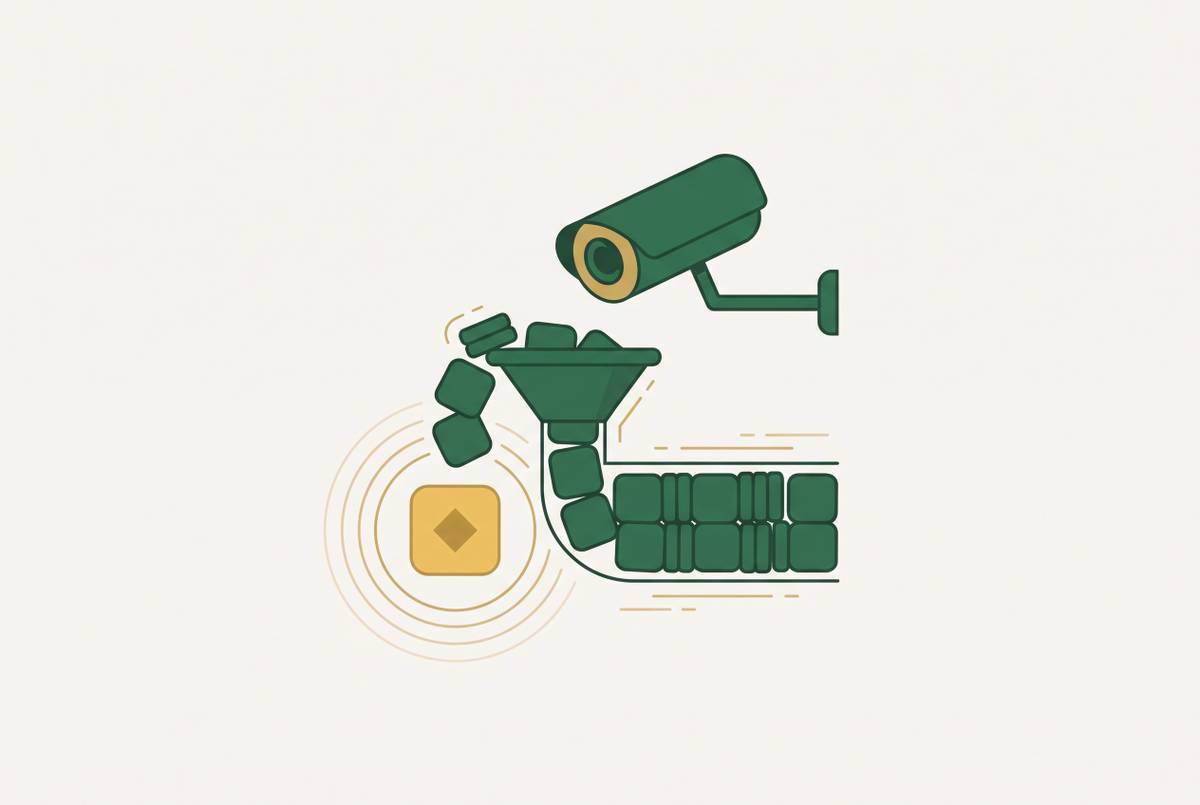
The human review queue breaks down when events come in faster than operators can check them. Motion-based detection adds events to that queue when pixels change because of wind, shadows, headlights, or a cashier restocking. Those inputs do not all represent security incidents, but each becomes a candidate for attention. The system makes a person work out the context that detection leaves out. Routine activity therefore consumes the same scarce resource needed to recognize a threat.
As the backlog grows, operators have less time to give each alarm meaningful attention. A real event buried in the queue has to wait behind false ones. Its urgency does not make it visible sooner when the system has not yet distinguished it from ordinary activity.
The available workarounds each surrender something different. Muting removes coverage, overage fees make the customer pay for excess alarms, and sending alarms to lower-cost offshore seats cuts the cost of review at the expense of its quality. None of these workarounds cuts the rate at which ordinary activity creates events. They change who bears the burden or whether the burden remains visible.
Muting is the starkest version of that trade. Instead of attempting to process the camera’s output, the center suppresses its contribution to the queue. An operator can have good reason to use that control when the system has more work than it can handle. The decision may be understandable without being defensible as coverage.
What the muted camera reveals about object detection as the foundation of monitoring
The backlog begins upstream of the operator, in the definition of an event. Object detection identifies presence. A person or vehicle can be detected correctly while the resulting alarm is still useless for security because the activity requires no response. Accurate recognition of an object is therefore not the same as an accurate decision to alert. A system built around presence leaves the consequential question unanswered.
That unanswered question is what the person or vehicle is doing in the scene. Without reasoning about activity, the system sends normal operations onward for human interpretation. The overwhelming majority of alarms can then represent things that happened without requiring intervention, a mismatch between what detection establishes and what monitoring needs to know.
A retail entrance, truck yard gate, or delivery bay generates frequent detections because normal operations keep people and vehicles moving through it. Yet those places still need protection when the activity is no longer routine. Under an object-only model, the volume that makes a camera difficult to monitor is inseparable from the activity that makes it valuable to monitor.
Sensitivity adjustments cannot supply the missing judgment. Lower sensitivity can miss events, while higher sensitivity sends more activity into the queue. Queue management therefore cannot repair the underlying distinction between presence and threat, and the pressure to mute is built into the design before the operator sits down.
Where the blind spot lands hardest: retail floors, truck yards, and employee lots
On retail floors, loss concentrates in specific aisles and at specific times, making the location and sequence of activity important. Fast concealment, multi-person coordination, and repeat approaches are behavioral patterns. Their significance depends on context. A camera covering a target aisle may generate frequent alarms during normal shopping and restocking, but muting it also removes the opportunity to assess those patterns.
Truck yards present the same conflict through vehicle activity. Gates and delivery bays are busy because movement through them is part of normal operations, while cargo theft makes coverage of the yard consequential. Vehicle presence alone does not explain that movement. If ordinary traffic keeps creating events for people to review, the system puts pressure on the very cameras needed to tell routine operations from a threat. Suppressing those alarms does not resolve the distinction between the two.
Employee lots expose the trade at night. Headlights can generate constant false alarms, yet after-hours vehicle patterns and loitering can be early indicators of a planned event. Muting a camera because it reacts to headlights removes the coverage needed to assess that nighttime activity. The practical consequence is not merely a lower notification count, but a gap with potential liability.
In all these places, activity makes a camera both hard to monitor and important to watch. The wrong model treats that combination as a reason to reduce attention. The cameras most likely to be silenced cover locations where context is especially valuable. A quieter queue can therefore conceal a more exposed site.
Why AI-verified detection changes the trade-off rather than just improving the queue
AI-verified detection changes where the judgment occurs. Instead of forwarding object presence for a person to interpret, an agent reasons about what is happening in the scene and resolves routine activity before it becomes a human-review event. The system is no longer using the operator as the default interpreter of everything that moves.
That change produces a different kind of queue. Ambiguous or high-stakes cases reach the operator because human judgment adds value. The operator has fewer events to handle because the system has checked them, without leaving cameras out of review. A camera can remain covered while much of its ordinary activity produces no demand on a person.
The agentic model supports continuous monitoring by assigning routine interpretation to agents and reserving consequential uncertainty for people. In physical security alarm triage, autonomous resolution has a specific purpose. It prevents familiar, non-actionable activity from consuming the capacity needed for a difficult decision.
This is how alert fatigue can be addressed without turning off camera notifications indiscriminately. A camera muted because object detection could not handle its activity becomes coverable again if scene reasoning can distinguish that activity reliably. The qualification is essential. A model that replaces motion alarms with an equally noisy stream of AI judgments gives the work a new label but leaves people with just as much to do.
For a buyer, the practical test is performance on footage from the actual site. Night, IR, rain, and occlusion belong in that test because they are operating conditions. Clean daytime video cannot establish whether a system will control false alarms in an autumn parking lot. The relevant measure is whether selective escalation holds up where coverage is required.
The honest limits of AI on real-world footage, and why they matter to the argument
Real-world footage puts limits on what any model can infer. Low light, IR, rain, fog, motion blur, and camera-angle occlusion can degrade computer vision performance. These conditions are routine in outdoor security deployments. A system that reasons well from a clear image may have insufficient evidence when the scene is obscured. Calling that system AI does not remove the limitation.
The 2026 infrared nighttime re-identification benchmark NightIR-ReID reports that adverse weather further degrades image quality and pedestrian occlusion obstructs critical visual cues. Its best reported method achieves a Rank-1 accuracy of 50.4%. That figure concerns re-identification. It illustrates the gap between useful visual evidence and difficult nighttime footage without establishing how a particular alarm-verification system will perform.
When a scene is obscured or unreliable, it should flag that condition rather than silently dropping events or presenting confident-looking conclusions from bad inputs. Otherwise, the apparent improvement in alarm volume could hide a failure to interpret the scene. Fewer alarms are not evidence of better protection when the reduction comes from lost visibility.
Agentic systems also need controls on their behavior. Alireza Lotfi and colleagues’ research accepted to the ACM AI Leadership Summit 2026 identifies how sequences of individually permissible agent actions may collectively violate system-level constraints. For monitoring, this means behavioral containment and runtime assurance must be built into the system, with no option to leave them out. Checking an isolated action is not enough if the sequence can cross a boundary the system must preserve.
The lesson for a buyer is to evaluate failure behavior as closely as normal operation. What happens when footage is bad, the queue spikes, or the agent encounters an unfamiliar edge case? A credible answer must address both the quality of the visual evidence and the limits on autonomous action. The right comparison is not human monitoring against anything labeled AI, but a coverage model against the conditions that can defeat it.
What a monitoring center should be able to say about every camera, all the time
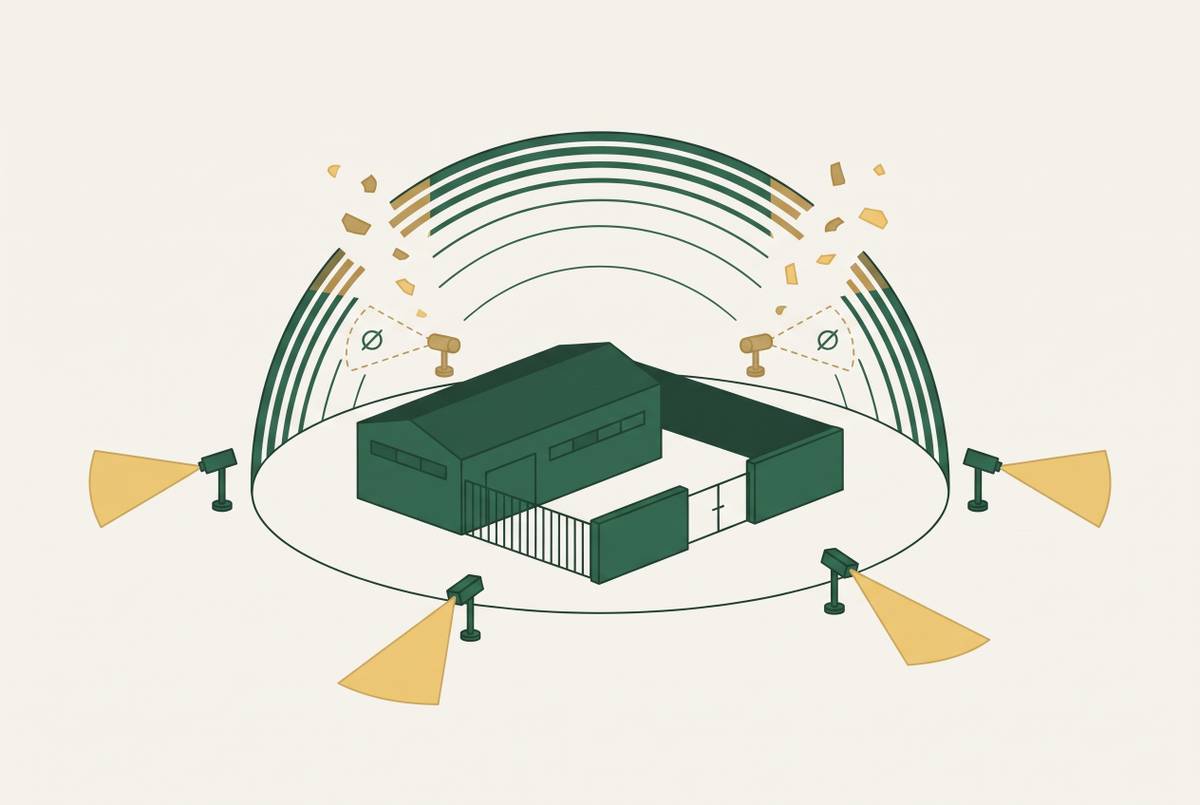
A monitoring center should be able to account for every camera in real time. An installed camera is not, by itself, coverage. Coverage requires the ability to reason about what the camera is showing and act on that reasoning within a useful timeframe. When the image cannot support that judgment, the center must recognize the limitation rather than count the camera as protected without qualification.
The structural goal is review before an alarm becomes a loss event. A real threat should not wait behind routine activity simply because both entered the same undifferentiated queue. Agents that verify and resolve ordinary activity, with people handling ambiguous and high-stakes cases, align the workload with that goal. No camera should be taken out of the review process merely to make the remaining queue manageable.
Muting is visible, but lowering sensitivity can also cut alarms while causing events to be missed. Neither adjustment answers the underlying question of whether the center can interpret the site’s activity. A claim about protecting the whole property must account for those exceptions.
For a security buyer, the most diagnostic request is direct. Show which cameras are currently muted or operating at reduced sensitivity, and explain why. If the explanation is that coverage is adjusted to manage alarm volume, the center has identified its own constraint. Whether the monitoring model protects the site as it operates, or only the cameras it can afford to hear, remains unanswered.