What Operators Should Do the Moment an Overactive Camera Flags for Muting
A step-by-step fix for noisy cameras that keeps real alerts visible.

Muting noisy cameras is not a monitoring solution because it removes alerts for real events as well as nuisance activity, turning a configuration problem into a coverage gap. Operators can reduce false alarms without surrendering coverage by correcting the scene, zones, sensitivity, classification, and schedules, then adding verification where noise persists.
Why muting noisy cameras is a configuration failure, not a monitoring solution
An operator has to deal with a camera that keeps firing while other events need attention. The mute control offers immediate relief from repeated interruptions. That pressure makes suppression understandable, but it does not make suppression a correction. Most false alerts trace to zone design, sensitivity, or object classification.
Vision Detection Systems describes full-frame detection as “lazy zone setup” because it admits continual triggers from activity that should never have entered the alert stream. Muting leaves that upstream fault untouched while removing the camera’s contribution to monitored coverage. It treats the alert as the problem rather than evidence of a problem that can usually be corrected.
What alarm fatigue actually does to operator judgment before anyone reaches for mute
Repeated false alarms train operators to discount notifications from the same source. A genuine event then arrives through a channel that has lost credibility. Detection accuracy suffers before anyone reaches for mute. The problem compounds as each nuisance event consumes attention without prompting useful action, making the next alert less likely to receive a careful assessment.
For that reason, raw alert volume is an inadequate measure of monitoring quality. The alert count can fall even as more events are missed. Precision shapes how much operators trust the stream, while recall measures how many real events detection finds. Even with strong recall, a system can work poorly if it produces so many false positives that operators learn to ignore its alerts. The response must therefore improve the proportion of actionable alerts, and the diagnostic sequence must be credible enough to use under pressure.
The first thing to do before touching any setting is read the event log
Read recent events before changing any setting. Record the time of day, weather or lighting conditions, frame location, and event type. Look for repetition across alerts. A single review session is usually enough to identify the dominant pattern and distinguish a persistent configuration fault from a sudden physical change.
Alerts clustered at dusk and dawn point toward excessive sensitivity during lighting transitions. Events confined to one frame edge suggest a zone extending into a road, tree line, or reflective surface. Alerts that cluster during business hours suggest that the same rules may be running at times when normal activity is expected. A sudden spike after a quiet period instead points toward a dirty lens, insects near an IR emitter, or a new reflective object.
These patterns give the next intervention a reason. Without them, lowering sensitivity is a guess that may suppress real events along with nuisance motion. The log also establishes which condition the correction must address, so that a quieter camera is not automatically mistaken for a better-configured one.
Fixing the scene before the software means correcting physical causes
Inspect the camera before tuning its analytics. Clean the lens and housing, check for insects near IR emitters, and confirm that the camera angle has not shifted. Fog, condensation, and debris degrade the image before inference begins. A moved bracket may also admit a road, reflective wall, or sky that the original installation excluded.
Alpha9 Solutions describes a warehouse yard where cleaning housings, adding low-level security lighting, and raising minimum object size cut overnight alert spam by a large amount. Those changes improved both the image and the detection settings without relying on sensitivity alone. If cleaning and angle correction eliminate the spike, no software change is needed. If noise persists, zone and settings review can proceed without tuning around a damaged or obstructed view.
Zone redesign as the highest-leverage software fix
Draw detection zones around approach, action, and exit. These are the paths through which an incident unfolds, rather than an instruction to cover the largest possible portion of the image. Zone redesign offers the strongest software leverage because it determines which activity can enter detection in the first place. Vision Detection Systems contrasts one large zone producing “always motion” with several tight zones defining “where motion matters”.
That distinction makes exclusions as important as inclusions. Roads and sidewalks outside the property line, tree lines, tall grass, flags, and moving signage are common sources of irrelevant motion. Headlight sweeps, water reflections, glossy walls, and glass storefronts also create recurring nuisance triggers. Including sky and dead space at the top of the frame makes the zone larger but may not help it cover incidents. The goal is to narrow detection to the key paths that lead to doors, windows, or storefronts.
Several small zones also permit more precise control. Each can have its own schedule, sensitivity, and object filter instead of forcing different parts of the scene under one rule. Record why the boundaries were chosen, particularly where public sidewalks are excluded. Those choices can have legal and evidentiary implications in some jurisdictions, so the rationale belongs in the configuration record.
Sensitivity adjustment and object classification as the second layer of control
Once the zones are right, tune what happens inside them. Lower sensitivity when wind, shadows, or image noise repeatedly trigger alerts, but raise it gradually when people are missed at frame edges. Minimum object size provides a separate control. Increasing it can exclude insects, small animals, and distant headlights without lowering sensitivity for human-sized objects.
Change one variable, then observe for 48–72 hours. Small adjustments followed by observation make it possible to identify which setting reduced noise or introduced a missed-event problem. Changing several controls together obscures that cause and effect. A moderate sensitivity reduction is a starting point that requires checking whether real events remain detectable under the conditions that produced the original alerts.
Object classification then narrows alerts to the actual risk. Person and vehicle rules work well for perimeter monitoring, while person-only rules can work for doors and gates. Alpha9 recommends vehicle-only rules at driveway or parking entrances, with separate rules per zone so schedules and sensitivity can differ. Model performance can still deteriorate with occlusion, low light, or an unsuitable camera angle, so category filters must be assessed against the scene.
Schedule-based rules as the fix for predictable, time-bound noise
A correctly drawn zone can still be noisy when its rules ignore normal operations. At a retail site, pedestrian activity during business hours is expected, while a person lingering near the premises after close may warrant attention. Rules can allow expected daytime traffic and use person detection and loitering rules after close to handle each case.
Delivery windows and shift changes deserve the same treatment because they create legitimate high-motion periods that should not escalate. As the seasons change when it gets dark, the hours that need night monitoring change too. Loitering and direction-of-travel rules complement schedules by distinguishing a person passing through from someone remaining near vehicles, gates, or equipment after hours.
What to do when physical fixes, zones, sensitivity, and schedules are not enough
Some cameras remain difficult after disciplined configuration work. Night and IR footage, rain and fog, and partially obscured subjects are genuine limits. A model that performs well under one lighting condition can produce a different false-alarm pattern when the scene changes. In low light, reducing sensitivity may cut nuisance alerts while also increasing missed events, leaving no satisfactory setting that solves both problems.
Alerts from a camera that remains hard to tune should stay in monitoring and go to a person for review before dispatch. Vision Detection Systems describes a workflow in which an alert triggers video review, escalation follows only when the review confirms the event, and the event is documented with its time, clip, and notes. This separates detection from the decision to dispatch. It preserves the camera’s security role while reducing wasted responses, although it introduces an attention cost that the monitoring operation must address.
How AI pre-filtering changes what the verification layer costs in operator attention
Sending every nuisance event to a human verifier merely relocates the original fatigue problem. Verification becomes scalable when AI reviews and filters alarm volume before operators receive it. The operator then assesses probable events.
An AI filtering layer should minimize the ratio of alerts to true positives while maintaining acceptable recall. Maximizing recall without controlling false positives reproduces the same fatigue problem at a higher level of automation. But cutting alerts while missing more real events would leave the same holes in coverage that make muting unacceptable.
This architecture changes what verification costs in operator attention. Human review becomes a focused assessment of events the AI has already characterized, rather than continuous attention to a wall of feeds or an undifferentiated queue. It also allows an operator to cover more cameras than a workflow requiring manual review of all alarm volume. For persistent nuisance cameras, testing that arrangement is a direct extension of triage alongside correcting poor zones or settings.
Why muting damages the integrator relationship, not just the monitoring operation
A muted camera creates a commercial problem as well as an operational one. Its monitoring contract is at risk because suppression removes the service contribution the customer expects. Analytics embedded in daily triage, escalation, and reporting become an operational dependency. That practical usefulness supports retention and longer contract terms.
Recurring revenue also affects how much the integrator’s business will sell for. CT Acquisitions documents higher valuation multiples for integrators with strong recurring revenue from monitoring and managed services than for project-heavy businesses. The implication is concrete without assigning a valuation to an individual camera. Leaving cameras suppressed puts present monitoring revenue at risk and weakens the recurring-revenue base on which the business is valued. Correcting noisy cameras therefore protects both the service relationship and the asset the integrator is building.
Muting as a documented last resort, not a default response
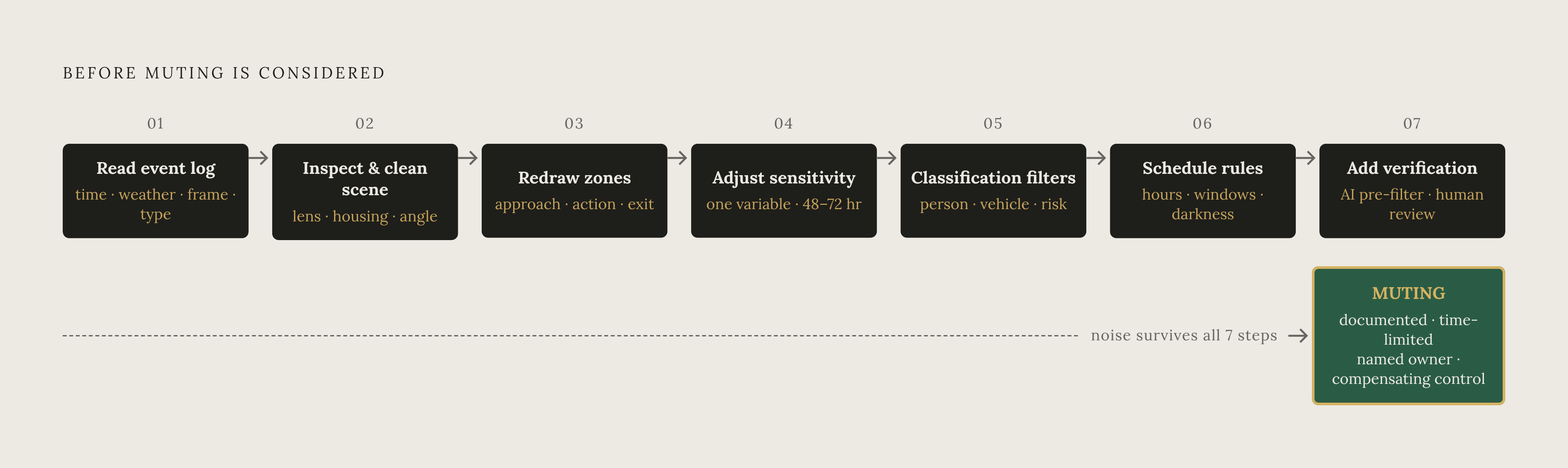
Muting for a short time can be justified, but frequent alerts alone are not enough reason. The cause must have been investigated, the risk assessed, and suppression approved with a defined expiry and a compensating control. Those conditions distinguish a managed exception from an unresolved camera quietly disappearing from coverage. They also make clear who is responsible while normal alerting is unavailable.
The usable sequence begins with recent event logs and a record of the false-alarm pattern. Inspect and clean the camera, then correct its angle if it has shifted. Redraw zones around the paths of approach, action, and exit, leaving out known sources of noise. Adjust sensitivity and minimum object size one variable at a time, observing each change for 48–72 hours, then apply classification filters matched to the risk. Add schedules that reflect business activity, delivery periods, shift changes, and darkness.
If residual noise remains, add verification. A demo or pilot of AI-assisted verification provides a next step for assessing how pre-filtering fits that workflow. If muting remains unavoidable after diagnosis, record the owner, approver, start time, expiry time, and active compensating control. That record is the professional standard for a temporary coverage exception.