Alarm Reduction Strategies Ranked by Whether They Keep Every Camera in the Fight
Muting cameras cuts noise by cutting coverage; only reasoning before the queue does neither.
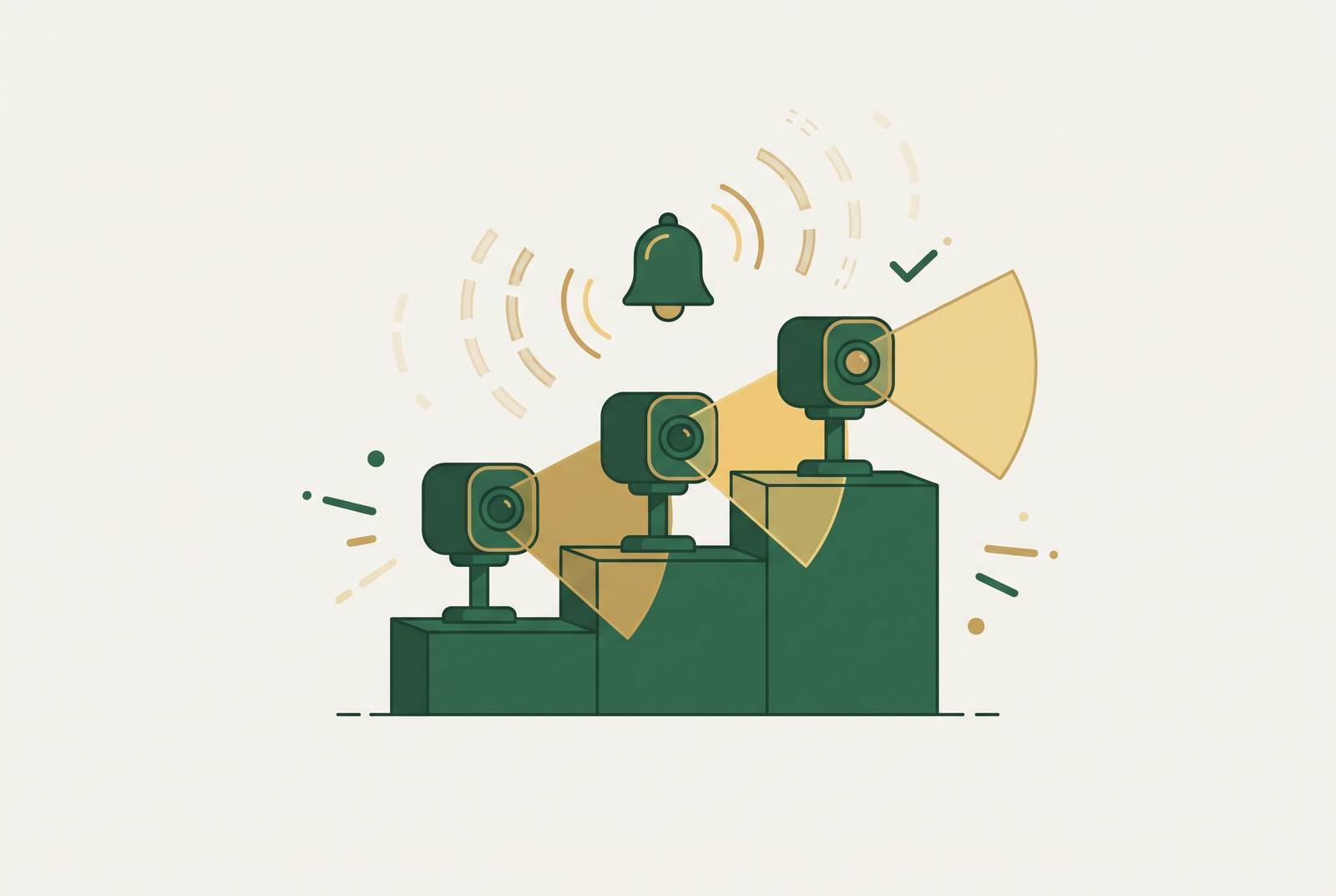
Muting noisy cameras is not a monitoring solution because it stops real events from reaching review along with false alarms. This ranking evaluates alarm-reduction strategies by whether every camera stays active and its events remain reviewed. The strongest approaches reduce human workload by reasoning about footage before it reaches the queue, rather than silencing cameras, excluding event classes, or leaving reviews unfinished.
Why every alarm-reduction strategy eventually trades coverage for quiet
Coverage preserved is the axis on which alarm reduction should be judged. A smaller queue proves only that fewer events reached operators, leaving the system’s ability to distinguish harmless activity from threats unproven. That distinction separates analysis from omission. Most common strategies fail this standard before their speed or convenience enters the comparison, because they reduce the amount of activity eligible for review.
The pressure to do so begins with motion-pixel detection. A pixel change fires an alert whether a person, shadow, branch, or headlight caused it, so the system sends operators raw changes in a scene. Traditional motion-based alerts fire falsely more than 97% of the time, producing thousands of events per shift across sites with hundreds of cameras. The volume is a consequence of the design. Staffing enough operators to clear it becomes uneconomic, while muting, threshold changes, and skipped events quietly reduce what gets reviewed.
What operator overload actually looks like before any strategy is applied
A single operator covering dozens of sites can face thousands of events per shift, most of them false. Distinguishing the false from the real requires watching each clip, so an apparently simple dismissal still consumes attention. The queue exceeds what one person can reliably process. The failure begins in the workload.
Repeated false alarms also degrade the ability to respond to real events, a phenomenon the security industry calls alarm fatigue or noise fatigue. More cameras produce more noise, which accelerates habituation and raises the probability that a real event remains unreviewed. Widely used monitoring platforms were built for a pre-AI era with far fewer cameras per site and fewer events than they face today. Fast fixes become understandable in that environment, even when they remove the coverage the operator is trying to protect.
The coverage-preservation test and why most common strategies fail it immediately
A strategy passes the coverage-preservation test only if every camera continues to generate events that are reviewed after it is applied. Review need not mean that a human watches every clip. It means the system analyzes events before deciding whether a person needs to look at them. A strategy fails when a camera is silenced, an event class is skipped, or review is deferred indefinitely.
Three failure modes make that boundary explicit. Camera muting leaves hardware running but stops its events from reaching any review queue. Threshold inflation lowers sensitivity until activity that used to trigger review stops doing so. Event-class suppression excludes whole categories, including vehicles, small figures, or low-confidence detections, without evaluating their significance in context. Reducing the number of cameras feeding the system also fails, because fewer inputs reduce coverage while leaving triage unimproved.
These failures can arise without a formal decision to accept reduced protection. Fora Soft’s 2026 anomaly detection playbook states, “False-positive rate is the product. Operators mute anything noisier.” Too much noise can therefore weaken coverage even when the system was designed to keep every camera connected. The test concerns the monitoring outcome.
Why muting noisy cameras is not a monitoring solution
Muting and threshold inflation occupy the bottom tier because both fail at the point of application. Muting gives an overloaded operator immediate relief from a noisy camera, but it also prevents real events from that camera from reaching review. Consider a camera pointed at a windy parking lot. Silencing it is a rational triage decision under an impossible workload. The system created the choice between an unmanageable queue and an unmonitored view.
Threshold inflation creates a less visible version of the same loss. The camera remains active and some events still get processed, while real activity below the new threshold no longer prompts review. Active-camera counts do not reveal that missing coverage. Both strategies can leave system logs showing running cameras and processed events while the actual security posture deteriorates.
The playbook identifies how quickly operator trust can collapse. It states that above one unexplained alert per camera per day in critical zones, or 2–3 in open areas, operators mute the channel. A strategy that depends on tolerating persistent noise therefore has a practical adoption limit. Once operators cross it, the cameras listed as covered no longer show what gets attention.
Strategies that partially pass — object detection filtering and static rule-based suppression
Object detection filtering improves on pixel-change alerts by identifying whether a person or vehicle is present. That is genuine progress over indiscriminate motion detection. It does not, however, establish whether the activity requires intervention. The playbook distinguishes object detection, which identifies what is in the frame, from anomaly detection, which judges whether behavior is unusual for the zone and time.
A person standing still in a waiting room and a person standing still in a restricted warehouse at 2 a.m. can produce identical object-detection outputs. Their security significance is not identical. Context supplies the distinction that the object label lacks, while temporal reasoning assesses behavior over time.
Static rules, including fixed sensitivity thresholds, exclusion zones, and scheduled suppression windows, can further reduce noise. Their weakness is that they encode assumptions about normal activity which become wrong when site conditions change. These strategies partly pass because they keep camera inputs and improve filtering, but they fall short when they cut volume by leaving out activity classes.
Why the benchmark-to-production gap undermines any strategy that relies on AI accuracy alone
Any strategy that substitutes AI judgments for human review inherits the model’s accuracy on actual footage, which is lower than published benchmarks and varies by site conditions. Night and IR footage, low light, backlighting, fog, motion blur, and weather degrade performance. Those conditions are a routine part of security work. Tests for perimeters, parking lots, loading docks, and overnight retail must include more than clear demonstration footage.
The playbook gives the relevant purchase rule. “Buy on tests against your own cameras, not a demo reel”. That standard applies to any claim that AI preserves coverage while reducing review volume. An accurate benchmark result does not establish how often a system misses activity or sends false alarms to operators at the target site. If production noise becomes intolerable, operators can still mute the camera, defeating the design regardless of its published accuracy.
Strategies that pass — contextual and temporal reasoning before the queue
Contextual and temporal reasoning passes the test by reviewing events before deciding which ones need a person's attention. Object detection establishes that a person or vehicle is present. A model of normal behavior then provides expectations for each zone and time window, while temporal reasoning identifies deviations from those expectations. Presence alone is no longer the trigger. The system assesses what the detected activity means in that setting.
This changes the basis of alarm reduction. Every camera continues to contribute events for evaluation, but the human queue receives events selected through reasoning. The playbook describes reasoning on top of detection as the frequently omitted component that makes alerts useful to operators. Without it, object detection produces noise and unsupervised scoring produces alerts that operators cannot explain.
Detection at the camera or on a local server reduces latency and bandwidth demands, helping cameras on constrained networks remain in the reviewed pool. That benefit has a cost. Contextual reasoning requires more compute, calibration, and integration than threshold filtering, so an honest comparison must also account for missed events, false dispatches, and damaged police credibility from miscalibrated or muted cameras.
Agentic AI as the highest-ranked approach — reasoning plus human judgment at the right moment
Agentic AI with human-in-the-loop review ranks highest because it combines event-level reasoning with escalation when automated judgment is insufficient. Agents review every event from every camera and send unclear or high-stakes cases that need human judgment to an operator. Uncertainty becomes a reason for review. This differs from AI-triggered monitoring that classifies activity into pass/fail categories and leaves humans to resolve the resulting exceptions.
For a security buyer, the operational distinction is where human attention goes. Night and IR footage, weather, occlusion, and site-specific edge cases can go to a person for review when the model cannot make sense of them with confidence. Human involvement is therefore part of the coverage mechanism. It helps keep false-positive rates low without forcing the system to make an automated binary decision when footage is unclear.
AI detection linked to an on-site response, including an audio challenge, lighting, or escalation, can avoid waiting for raw video or a basic alarm to work through a remote guarding queue. Human verification remains part of the response where judgment is required. Coverage requires attention in time to respond as well as classification. A real threat should never sit at position twenty in a queue. Verdun, a remote video monitoring service that pairs AI agents with trained human operators, frames that queue as the root failure of legacy monitoring and reviews every alarm before anything reaches a person.
Where the agentic model can still fail and what honest evaluation looks like
An agentic architecture does not automatically pass the test. A poorly matched model can reason badly about difficult footage and route more events to humans than a well-calibrated threshold filter. Tests must show whether reasoning leads to better decisions on the site’s cameras, without taking for granted that a more complex system works better.
Input integrity creates another failure mode. Adversarial inputs, sensor manipulation, and deepfake threats can lead an agent to misread a scene and send bad decisions to humans or suppress real events. Individual action checks are not sufficient protection. Trajectory assurance evaluates whether the agent’s sequence of decisions over time remains coherent, addressing failures that appear acceptable when each step is examined alone. An evaluation must therefore consider both what the agent sees and how its decisions develop.
Calibration also has to follow changing site conditions. New equipment, seasonal lighting, and changes in staffing patterns can make earlier assumptions unsafe to rely on. Continuous monitoring of false-positive and false-negative rates is part of preserving coverage after deployment. A concrete evaluation therefore includes site-footage performance, human-review workload, resilience to manipulated inputs, decision-sequence assurance, and calibration under changed conditions.
How to apply the coverage-preservation ranking when evaluating a monitoring strategy
For buyers and operators, the practical application begins with an audit of what the strategy removes from review. Can the system show which cameras have had events suppressed, thresholds raised, or activity muted recently? If not, coverage loss remains invisible. Evaluation next moves from a vendor benchmark to performance on the site’s actual footage, including night, IR, weather, and specific camera angles.
Ambiguous events provide a particularly revealing test. Does the system route an event it cannot confidently resolve to human review, or does it drop it? The answer exposes whether uncertainty preserves scrutiny or ends it. For events that reach an operator, median time from detection to human review tests whether a manageable-looking queue delivers timely attention.
When muting or threshold inflation is already common, fixing the upstream model can restore lost coverage. Those practices diagnose a mismatch between alarm generation and review capacity. Contextual reasoning and agentic AI with human review rank higher only when they correct that mismatch without excluding activity. The decisive question remains whether lower volume comes from understanding the footage better or from no longer reviewing some of it.