The Vendors Whose Alarm Queue Diagnosis Changed How the Industry Understands Response Failure
Alarm queues overload operators before dispatch, so real threats slip through unseen.

Alarm response time failure in traditional video monitoring centers begins before dispatch, when motion-triggered noise overwhelms the attention needed to recognize a real event. The alarm queue therefore causes detection failures. A credible correction must filter noise before human review, escalate real or uncertain events quickly, and count failures that dispatch-time averages leave out.
How the alarm queue became a detection failure, not a staffing problem
Customers believe they are buying real-time surveillance and intelligent detection. What they often receive is a motion-detection queue dominated by administrative triage. The industry's founding assumption was that more operators, faster protocols, and stricter false-alarm fines would close that gap. Under that model, an overloaded queue was a backlog to clear rather than a signal environment that could undermine detection.
A backlog suggests that enough people will get the work done in time. Sustained noise creates a different problem because operators lose trust in the signal and the attention needed to evaluate it. The sharper diagnosis is alarm blindness, a predictable cognitive failure that begins upstream of any individual decision to respond.
Why do traditional video monitoring centers miss alarms before anyone responds?
People cannot pay more attention just because more notifications arrive. When incoming alerts exceed processing capacity for long enough, people stop responding to some of them, including genuine threats. Observable signs include growing backlogs, medium-severity alerts dismissed without review, threats discovered only after an incident, and higher turnover. Vectra AI's 2026 analysis found that 63% of security alerts go unaddressed in organizations. That finding concerns security operations broadly, rather than a measured failure rate for video monitoring centers, but it illustrates the gap between generating an alert and investigating it.
Nathan Conklin, Peng Gao, and Chris North at Virginia Tech frame overload as a cognitive-security problem in their 2026 research on human-AI oversight in cyber operations. Their paper identifies five dimensions that overload degrades, including attention, belief formation, memory, judgment, and agency. A monitoring operator needs all five to distinguish a real event from an irrelevant notification and decide what to do. Motivation cannot supply attention that has already been exhausted. The research also connects demanding operating environments with consequential threats, so diminished oversight and the highest-stakes moment cannot safely be treated as independent risks.
What legacy motion detection feeds into that mechanism
Legacy motion detection checks whether enough pixels have changed. Wind, weather, passing headlights, and animals can all satisfy that condition without presenting a security threat. The system thus gives people work before checking whether there is a security threat. In the traditional signal-and-respond loop, a sensor trips and the center follows a protocol to call the keyholder, the police, or both. No one checks the scene as part of that basic sequence.
Short, low-context clips can leave an operator without enough information to distinguish harmless movement from an intrusion, encouraging either dismissal or precautionary dispatch. Both outcomes weaken confidence in the service over time. As camera counts grow from a handful to dozens or hundreds per site, motion-triggered noise grows with them, while the human capacity receiving it does not. Adding coverage can consequently make the detection environment harder to interpret.
Safe4's 2025 industry analysis points to problems with how multi-channel monitoring is built. Operators must tell real threats from harmless events in streams that arrive at the same time from different sensor technologies, using legacy platforms that were not built to handle all of this. The resulting constraint is an architecture that produces irrelevant work faster than human judgment can absorb it.
How police departments began counting what the industry would not
Police departments learn how much to trust alarms from the calls they receive. When those calls repeatedly turn out to have no link to crimes, departments have reason to avoid that cost and keep officers free to respond elsewhere. Their policy changes make the industry's signal quality visible outside the monitoring center. They also expose a distinction that internal throughput measures can obscure. An alarm processed successfully by a center can still be an unreliable request for police action.
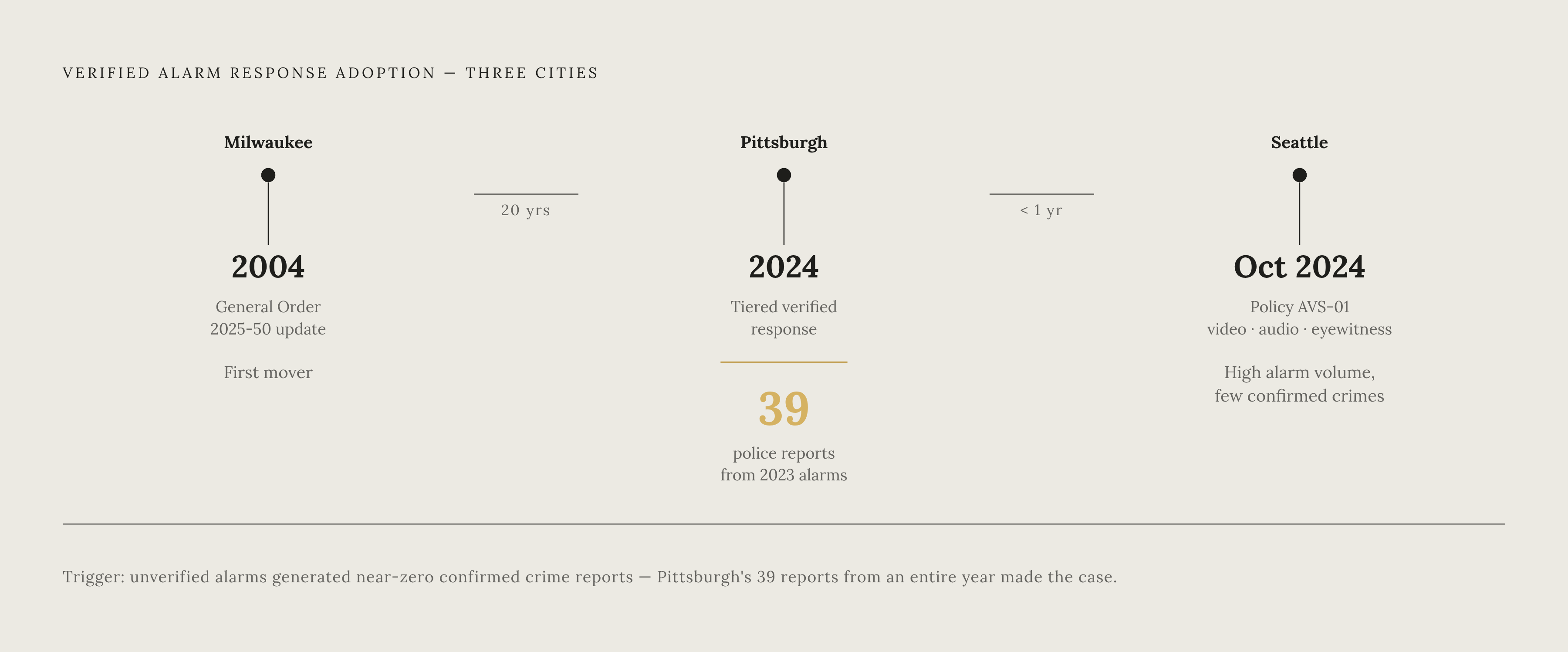
Seattle Police Department implemented policy AVS-01 in October 2024, requiring video, audio, panic, or eyewitness confirmation before responding to intrusion alarms. The Seattle 911 Center had received a large volume of alarm calls in 2023, only a small fraction linked to confirmed crimes, and alarm companies received less than three weeks' notice of the change. Pittsburgh adopted tiered verified response in 2024 after its 2023 alarm calls produced only 39 police reports. Milwaukee's Verified Response Policy dates to 2004, with General Order 2025-50 updating it.
The Security Industry Alarm Coalition raises a legitimate objection. Verified response burdens the large majority of alarm users who generate no false alarms in a 12-month period. That distributional argument does not change how unreliable alarm calls are for police overall. Formal verification requirements, and less formal deprioritization, show downstream agencies filtering a signal they no longer accept at face value.
The reframe: response failure begins before anyone fails to respond
The old definition of response failure begins with an operator receiving an alarm and acting too slowly or not at all. The broader definition includes an architecture that prevents accurate detection before that decision occurs. A real intrusion can pass through the queue unreviewed because sustained noise has exhausted the attention available to assess it. No deliberate choice to ignore that intrusion is necessary. The failure is already present in the conditions under which review is supposed to happen.
That changes the meaning of response-time measurement. An average calculated only from dispatched alarms starts the clock too late and excludes events that never reach a meaningful decision. Reducing the alarm count presented to humans is therefore a prerequisite for detection.
Noonlight's 2026 State of Emergency Response and Monitoring report describes a growing gap between detection and response. Systems generate notifications without resolving the situations behind them, leaving overloaded users to filter alerts themselves. The report identifies alarm fatigue as a mechanism that breaks trust and leads to disengagement. When customers stop engaging in this way, it counts as response failure even if the center's records show no delayed dispatch.
What a corrective architecture actually requires
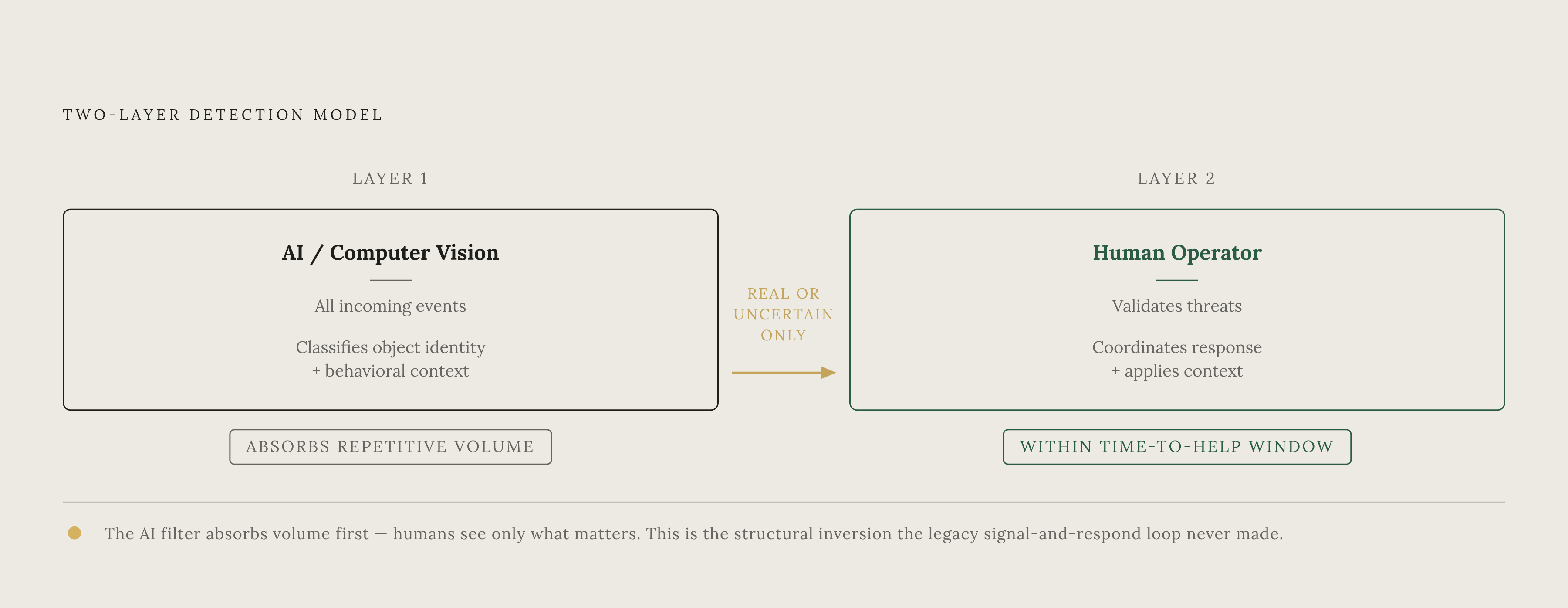
The corrective model puts AI filtering before human judgment. Computer vision reviews and classifies incoming events by asking what caused the movement and whether its behavior has security relevance. Object identity and behavioral context provide a basis for filtering that raw pixel change cannot. The model absorbs repetitive volume before it reaches an operator. A person still needs to assess anything real or uncertain.
Both layers are necessary, and neither substitutes for the other. Automated review must address false alarms without concealing real incidents, while human review needs sufficient context to make a decision. Anything real or uncertain must reach human eyes within that window, while there is still time to help. Police arrival times fall outside the scope of this escalation standard.
Noonlight's report positions operators in this hybrid model as active decision-makers who validate threats, coordinate response, and apply context automation cannot supply. Conklin and colleagues propose judging oversight by looking at both model-side risk and an estimate of how much an operator can mentally handle under the conditions they work in. Attention becomes a resource to manage. Video verification also strengthens the downstream request for help because departments with verified response policies require or prioritize supporting evidence.
Where the hardest unsolved problems remain
Reliable performance on production footage remains an engineering challenge. Small objects are difficult to detect under adverse weather, poor illumination, dense backgrounds, occlusion, and motion blur. These conditions are common in surveillance. A model that simply passes through a different assortment of irrelevant events has not corrected the architecture. Its filtering must keep real and uncertain events while cutting the amount of work people have to judge.
Infrared imaging can support detection in low light through thermal signatures, but standalone IR data lacks the spatial and textural richness of RGB images. Combining those inputs is not trivial in production. Site conditions also change with time of day, season, and weather, so a model trained on a fixed snapshot can drift. Production systems need rolling baselines or models conditioned on environmental context.
CVPR's LoViF 2026 workshop ran the first dedicated challenge on weather removal in videos. CVPR's NTIRE 2026 workshop held the second challenge on day-and-night raindrop removal for dual-focused images. These research efforts identify unresolved difficulties in processing visual input. The structural case for filtering remains intact. What remains demanding is the execution needed to make that filtering dependable on the footage operators actually receive.
What the reframe means for integrators building recurring revenue on existing cameras
An architectural failure creates demand for a different service layer. For dealers and integrators, that makes managed monitoring more than an additional charge attached to a camera installation. Existing cameras can support monthly recurring revenue without hardware replacement when the missing capability is the intelligence and response layer. The commercial proposition follows directly from the diagnosis. Customers are paying for relevant events to receive timely judgment.
Clear Watch launched a national Dealer Program in August 2026 that enables security dealers and integrators to add proactive AI-powered remote video monitoring to existing camera installations. Its operations run on the DICE Corporation video monitoring platform for event handling, operator workflows, and dispatch. Alarm.com acquired CHeKT in February 2025 to expand its remote video monitoring capability for central stations. That purchase adds a video service layer to systems already in use that are known for reactive signaling. ESX 2026 also highlighted proactive video monitoring and AI-driven video analytics as a recurring monthly revenue opportunity for integrators.
Those developments show where the business is heading, but they alone do not prove how good the service is. An integrator who understands the queue's failure can distinguish a corrective service from a legacy workflow with an AI label. The honest sales argument connects filtering, contextual review, and verified response to the customer's expectation of intervention. Its durability depends on operational delivery, because recurring revenue does not by itself establish that real events will be caught.
What a credible fix commits to that the legacy model never did
A credible provider commits to reviewing every alarm. That excludes sampling, muting busy cameras, or bypassing review when volume spikes, because unreviewed alarms are precisely where real events can disappear. Those commitments must apply throughout the detection process, including to events that never produce a dispatch. Otherwise, favorable response-time averages can coexist with the original failure.
Context is part of the commitment as well. Operators need enough information to judge the event and take meaningful action, whether that means talking down an intruder, dispatching the appropriate response, or notifying the customer's team. A provider must also accept material accountability for misses rather than disclaim responsibility for the outcome its service promises. Noonlight's report describes the industry's direction as outcome-driven platforms.
For integrators ready to evaluate a provider, the next step is a demo or pilot built around those commitments. The test is whether every alarm receives review, uncertainty reaches a human promptly, and the escalation provides enough context to act. That is a more demanding standard than showing that AI can suppress motion alerts. It tests whether the service has corrected the detection failure that made timely response unreliable in the first place.