The Alert Fatigue Trap That Turns Security Teams Into Queue Managers Instead of Threat Hunters
Fixing alert fatigue requires detecting threats before they reach humans, not managing more queues.
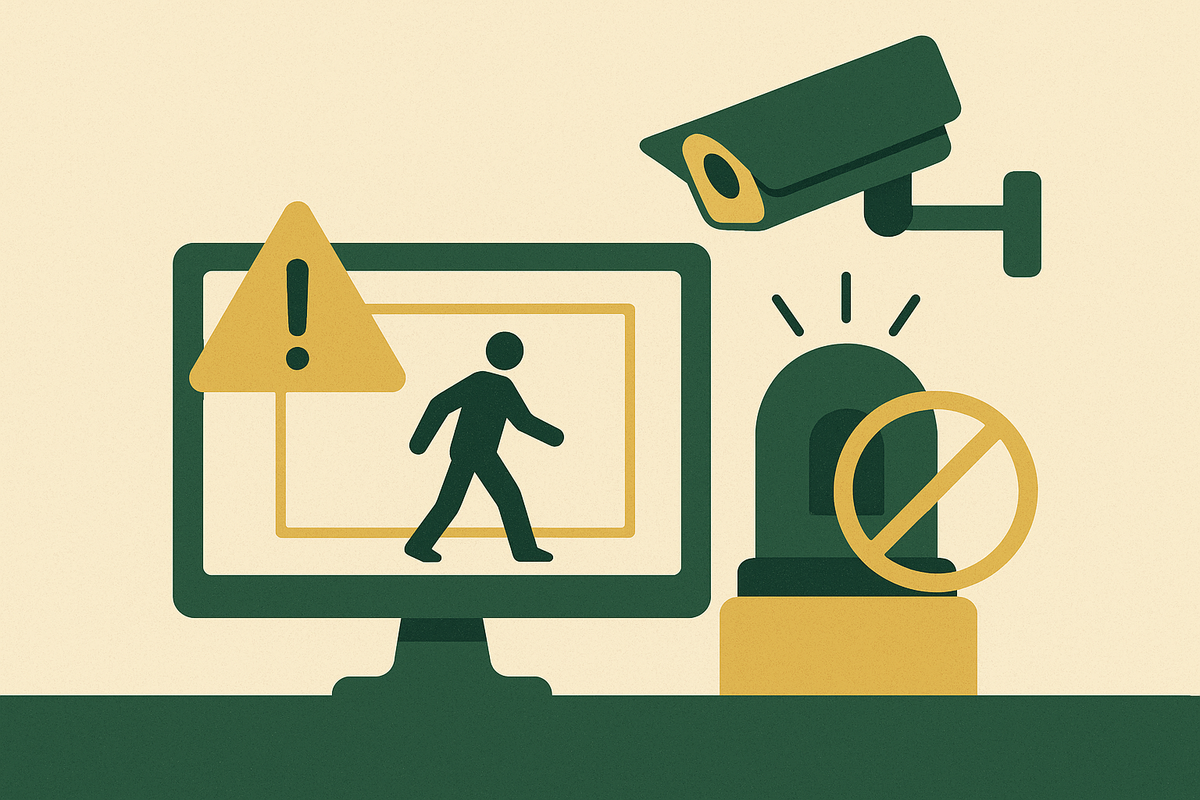
Muting noisy cameras is not a monitoring solution because it removes notifications from a location rather than distinguishing false alarms from real threats. It reduces the queue by sacrificing alert-based coverage. The alert fatigue trap leaves security teams managing queues because legacy systems send alerts without looking into them. The structural fix is to verify events before they reach a human.
Why alert fatigue is a system design problem, not a human endurance problem
The common explanation is that analysts burn out, lose attention, or stop caring. The structural explanation starts with the workload they receive. Legacy systems create a gap between the number of alerts generated and the number a person can fully investigate. That gap is there before anyone gets tired, and working harder cannot make up for it forever.
Systems must be built to respect the limits of human attention. When more notifications arrive than people can handle, they stop responding to every one, including those that point to a real threat. This is a predictable response to an impossible workload. In a physical monitoring center, the same constraint applies to an operator expected to distinguish intrusions from a continuous stream of routine motion.
The system therefore assigns the wrong unit of work. An analyst must “touch the alert” to keep the queue moving, even when protecting the site requires time to establish what happened and whether intervention is needed.
How legacy detection architecture manufactures noise at scale
Static thresholds, separate alert streams, and context that arrives late make too many alerts the norm. Vectra AI’s 2025 analysis found that organizations received an average of 3,832 security alerts per day. That figure describes the workload generated by detection alerts still requiring verification.
Static rules spot when a threshold is crossed without knowing what caused it. A CPU spike during a nightly backup can resemble a spike during an intrusion because the rule lacks the context to distinguish them. Motion detection creates the physical equivalent. A delivery truck at 6 AM and an intruder at 2 AM both generate movement, so both can enter the operator’s queue before their significance is established.
Tool sprawl multiplies the work around individual events. The same company’s 2026 research found most organizations use more than ten detection and response tools, with a large share deploying twenty or more detection tools. An incident on one host can produce separate alerts in the endpoint tool, identity provider, and SIEM. The analyst then has to connect those fragments manually, across different formats and severity scales.
Context arrives after the demand for attention. A cyber analyst opens an alert, retrieves the user record, and checks host history before learning that the activity was routine. A surveillance operator faces the same sequence when a motion flag lacks authorization schedules, expected site activity, or a useful account of what is normal at that camera.
What the queue math actually looks like for the analyst doing the work
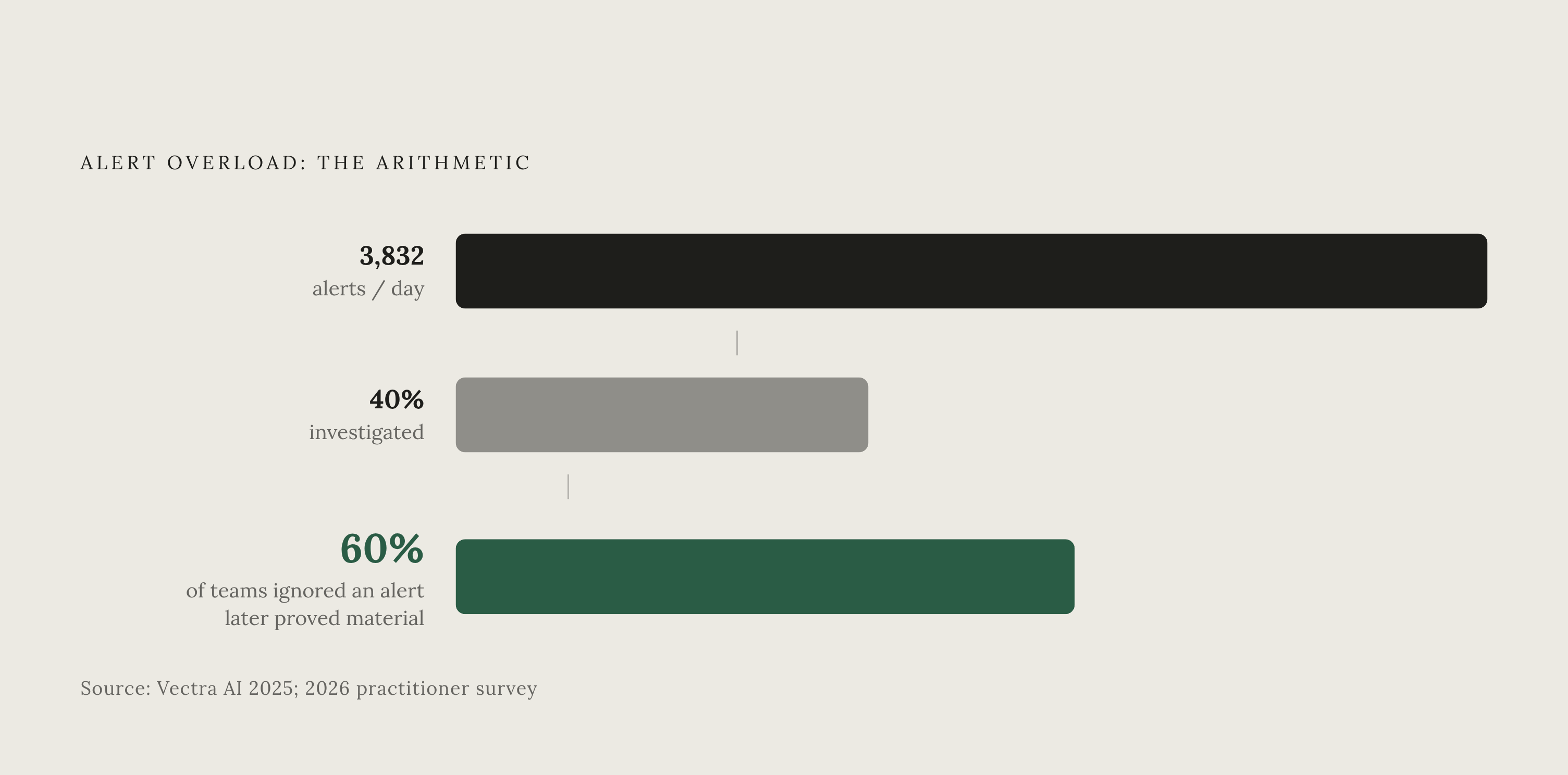
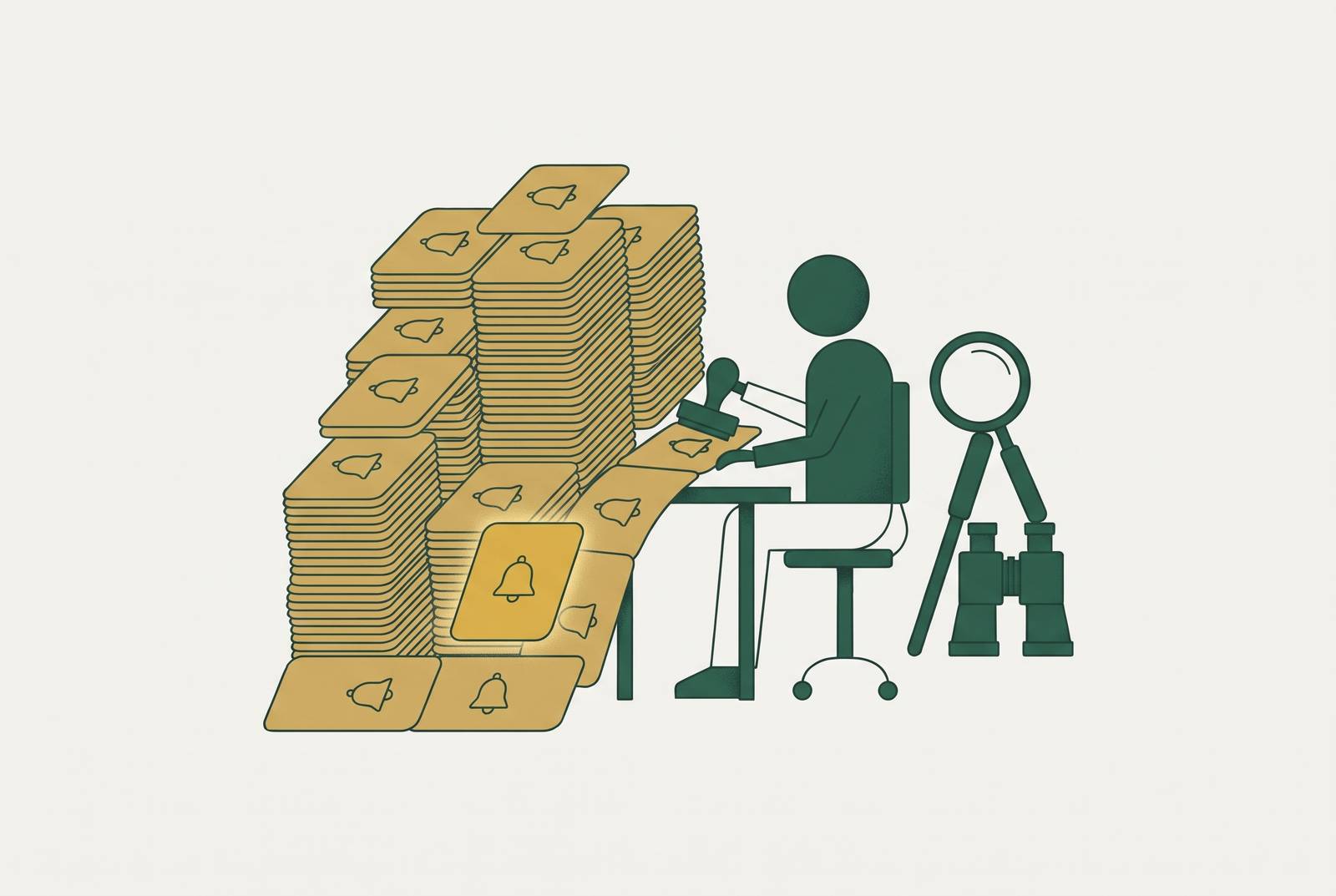
The operational arithmetic is simple even without a universal investigation time. Every alert requires some share of a person’s available hours, and each unresolved event remains ahead of later arrivals. When work comes in faster than people can investigate it, the backlog grows. Faster detection does not resolve that imbalance if a person must still gather context, build a timeline, and reach a verdict for every event.
Under that pressure, pattern recognition becomes a shortcut. An analyst closes an alert because it resembles earlier routine events rather than because the evidence establishes that it is benign. Vectra’s 2026 research reports that a large share of alerts go completely uninvestigated. A separate 2026 practitioner survey found that 60% of security teams admitted to ignoring or never investigating an alert that later proved material.
An intrusion that sits behind hundreds of motion-triggered false positives waits for someone to look at it while the response clock keeps running. Its urgency does not automatically move it ahead of events that have not yet been examined. Alert flooding can also make these gaps exploitable, because threats can be deliberately buried in noise.
Turnover compounds the loss of investigative capacity. Experienced analysts take institutional knowledge with them when they leave, while replacements face the same workload with less familiarity and pattern recognition. Closing alerts by resemblance is a rational adaptation to impossible demand, but that adaptation is precisely what makes the architecture dangerous.
Why don’t tuning, thresholds, more headcount, or muting noisy cameras close the gap?
Tuning helps by cutting out alerts that are not needed. SOAR playbooks also help by automating repeatable responses to scenarios that already have a defined procedure. Neither benefit should be dismissed. Relief from known noise does not change the investigation required for an unfamiliar event, where context still has to be assembled before a decision is possible.
Suppression has a different limitation because it can remove visibility together with workload. Muting a camera that sends many alerts keeps its notifications out of the monitoring queue, including those that could point to a real intrusion. Cutting noisy rules can create the same blind spot, while repeated tuning remains necessary as the stack grows or detection rules degrade.
Raising severity thresholds moves more events into the unexamined pile. It changes which alerts get attention without showing whether the events left out are harmless. SOAR reaches its limit elsewhere, at the alert for which no suitable investigation or response playbook exists.
Hiring increases capacity while leaving the work per investigation unchanged. ISC2’s 2025 data puts the global cybersecurity workforce gap at millions of unfilled positions, with a majority of teams reporting critical or significant skills gaps. Adding analysts thus means finding people with scarce skills, and that investment can be lost when they leave. In physical monitoring, offshoring and overage pricing similarly redistribute the investigation burden to cheaper or overflow labor. These fixes change how many alerts arrive, where they go, or who handles them, but people still have to gather the context by hand.
What it means to change the unit of work from "touch the alert" to "stop the threat"
If investigation is the bottleneck, the architectural intervention belongs there. Context gathering, classification, and correlation move upstream into an AI layer before an event reaches the human queue. The operator then receives an event already assessed as requiring a decision.
The distinction is between flagging an alarm and reasoning about it. An AI agent given the site’s access schedule, the camera’s typical activity, and the ability to distinguish a person from a moving shadow can dismiss a false positive before escalation. Object classification, behavior analysis, and comparison with a dynamic site baseline provide information that a fixed motion threshold lacks. The human no longer has to reconstruct that same context simply to establish that nothing requires action.
The performance measure changes with the task. Traditional operations measure Mean Time to Resolve, the interval from alert to closure. In this model, the more useful measure is how quickly the system understands the event and surfaces a verified threat. Closing alerts quickly alone does not show how well a site is protected, because an alert can leave the queue without anyone looking into it closely enough.
Tariq et al. identify automation, augmentation, and human-AI collaboration as three major mitigation strategies and research directions for alert fatigue. AI supplies scalable, continuous attention, while trained operators provide contextual judgment and the authority to act. However, the arrangement depends on genuine site knowledge, because a system cannot infer from motion alone why a loading dock is routine at 6 AM but anomalous at 2 AM.
How site-specific protocol encoding determines whether the AI layer filters or just shifts the noise
Site-specific protocol encoding gives classification a set of rules for the site. It defines who is authorized at particular times, which activities are routine in each location, what normally appears within a camera’s field of view, and what constitutes an anomaly there. These inputs determine whether an AI layer filters noise or simply relabels it. A generic ability to recognize people and vehicles does not by itself establish whether either belongs at a particular site.
Commercial and industrial properties often present relatively bounded tasks. A fence line, loading dock, or server room entrance can have a defined perimeter and a narrow authorized activity window. At a logistics site, accurate activity baselines can let behavior analytics on cameras already in place cut the number of nightly alerts by a large amount. The remaining events are useful because they depart from the site’s expected activity.
What counts as normal is different at residential properties. Multifamily threats can appear across common areas, corridors, and parking structures, where authorized activity is harder to define by schedule alone. Detection methods must therefore fit those patterns instead of treating the site as a single commercial perimeter. Industrial and construction sites introduce another constraint when connectivity is unreliable, making edge AI processing in cameras or an on-site server important without removing the need for protocol encoding.
Calibration also has to survive changes at the property. New tenants, shift schedules, construction phases, and seasonal activity can make an earlier baseline stale. Clean camera sightlines, schedules that are up to date, and well-calibrated rules help the system investigate accurately, but missing or old inputs bring back false positives under an AI label. A monitoring partner that treats setup as a finished deliverable rather than ongoing calibration will drift back toward noise as site conditions change.
What response speed actually means when a verified threat reaches a human
Response speed depends on what starts the clock. A monitoring agreement can specify a response time to a raw motion trigger or to a verified threat, and those commitments describe different work. A quick acknowledgment of an unexamined alarm does not show how soon a person understands the danger. Measuring only the time after verification, in turn, leaves out the time spent on the investigation before it.
The operational outcome is the interval between threat appearance and human decision. In a traditional queue, that interval includes waiting behind routine events and gathering the context needed to judge the alert. When AI performs the investigation first, the operator receives an event already classified, correlated against site context, and confirmed as warranting a response. The intended gain comes from removing unnecessary waiting and manual reconstruction.
Human monitoring has a practical capacity limit. As more cameras are assigned to an operator, individual events wait longer for meaningful attention. AI review can work across feeds in parallel without fatigue, reserving operator attention for verified events. At logistics facilities, industrial yards, and other properties where intrusion has immediate financial consequences, responding in seconds instead of minutes has operational significance beyond the reported service level.
The practical question for buyers is therefore not simply “what is your SLA?” but “what is your SLA measuring?” The answer needs to distinguish response to a raw alarm from response to a verified threat and make clear where investigation sits in that interval. Cameras whose alerts are suppressed or left waiting can support a claim of documented coverage without providing actual coverage when a threat appears.