Why High-Volume Alert Periods Expose the Operational Ceiling of Traditional Monitoring Centers
AI filtering before human review can reduce operator queue depth by 70–90 percent during surges.
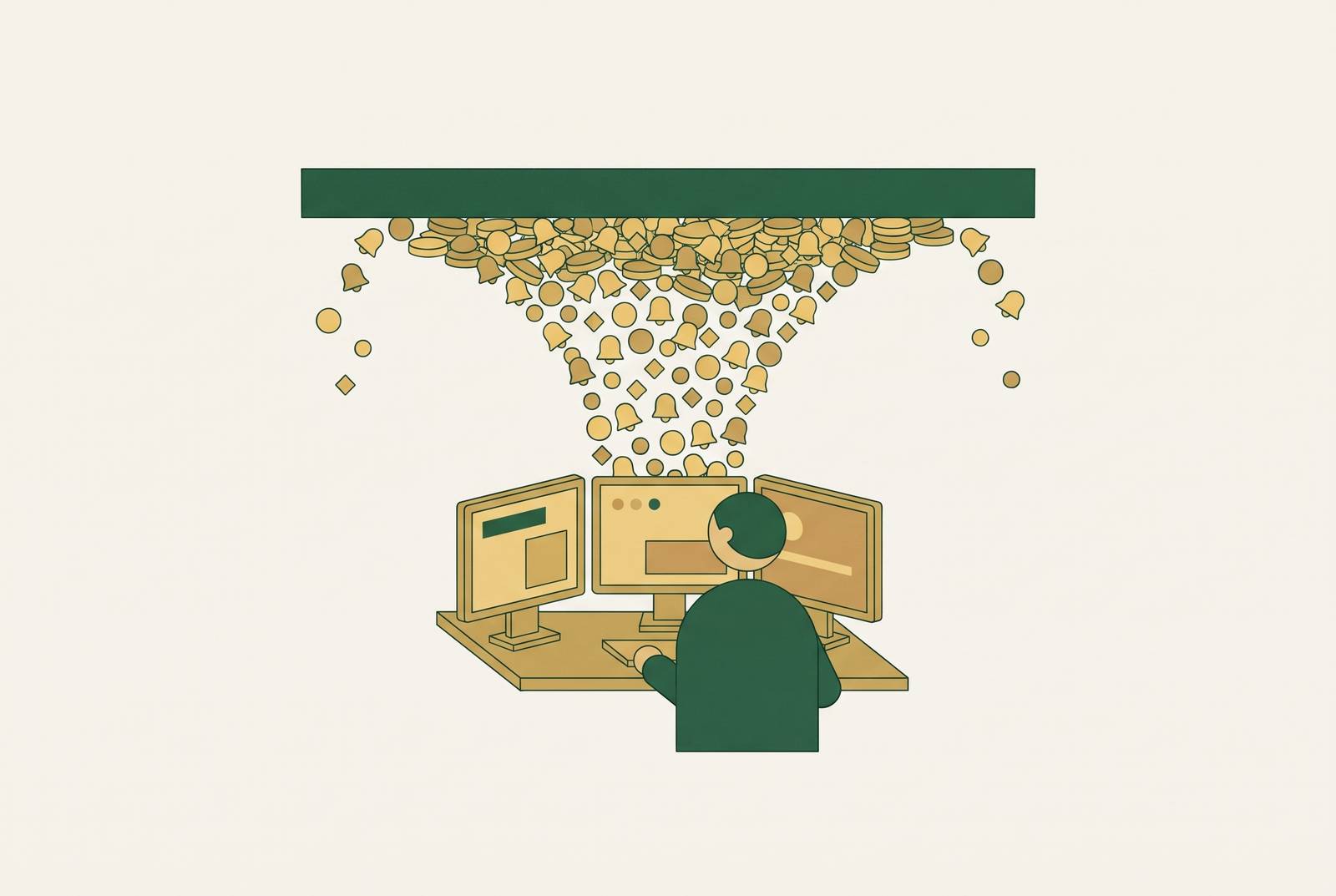
Alarm response time failure in traditional video monitoring centers occurs when incoming alarms outpace the human operators available to review them sequentially. High-volume periods expose that existing structural limit. Faster verified response requires filtering non-events before they enter the human queue.
The fixed ceiling inside a traditional monitoring center
Traditional monitoring centers operate as relay systems. A sensor trips, a signal reaches a central station, an operator calls the premises, and police are dispatched when required. Each operator works through alarms one at a time, so another alarm must wait until handling capacity becomes available.
The constraint is built into the workflow. Its capacity depends on the number of operators on shift and the time each alarm takes to handle. Multiple operators can work concurrently, but each provides another sequential path through the backlog of alarms requiring human review. On a quiet night, arrivals remain within that capacity and the queue clears. A surge changes the balance between arrivals and completed reviews, exposing a limit that was already present.
Why almost every alarm that arrives is already noise before an operator touches it
ASU Center for Problem-Oriented Policing / DOJ COPS Office data show that 94–99 percent of alarm activations that reach police nationally are false alarms. LAPD data likewise show that the overwhelming majority of its annual alarm calls are false. These figures describe the police-facing end of the alarm response chain. They nevertheless establish the scale of non-events passing through the alarm response chain.
A sensor-triggered system cannot distinguish authorized activity from intrusion without additional context, so it passes that decision to a person. A false alarm therefore consumes handling time even though it produces no security response. The queue becomes a collection of unresolved events.
Cities with verified-response policies require an alarm to be confirmed before police are sent. Their reductions in alarm call volume demonstrate how much activity did not justify a police response. For queue composition, the distinction is consequential. When few alarms come in, operators can clear those non-events and reach the real threat among them. During a surge, each non-event ahead of that threat adds delay without adding protection.
Why do security monitoring centers fall behind on alerts during high-volume periods?
A weather event across a region, a holiday weekend, or a power fluctuation across a wide area can cause more alarms at monitored sites at the same time. The staff available to handle that volume is fixed for the shift. Unlike opening another retail checkout, assigning another monitoring position requires an operator who is actually available. A surge cannot summon personnel who are absent from the roster.
Once arrivals exceed completed reviews, queue depth grows. Later arrivals inherit the unresolved work ahead of them, turning a wait measured in seconds into one that can extend for many minutes. The SLA clock runs throughout that delay. An alarm does not become less time-sensitive because the center has not yet reached it.
This is how response can fail before review begins. A real event remains unseen while operators resolve earlier signals, causing response to fail because of its position in the queue even if nobody deliberately deprioritizes it. That distinction separates an overloaded workflow from a poor decision made after viewing the evidence.
The same surge also stretches operator attention. As back-to-back review continues, the quality of attention available to each alarm declines while new alarms keep arriving. The cascade therefore has two dimensions, which are longer waits and weaker review.
Why adding operators or muting cameras cannot raise the ceiling
Adding operators helps when there are too few people to handle the alarms. It can increase the number of alarms reviewed concurrently, but it does not remove the sequential limit within each operator’s workload. Staffing an around-the-clock monitoring post requires roughly five full-time equivalents to cover weekends, holidays, and absences. Industry benchmarks put a single around-the-clock on-site security position at $218,000–$306,000 annually on a fully loaded basis. That on-site security benchmark illustrates the staffing burden of continuous human coverage.
Additional staff also take time to deploy. They cannot absorb tonight’s surge if they have not yet been hired and placed on the roster. ASIS International data identify extremely high annual turnover in the U.S. security guard workforce, adding instability to the wider security labor pool. More staffing can raise a center’s current capacity, but it leaves capacity dependent on available human labor.
Muting noisy cameras tackles a different immediate problem. It reduces queue depth by stopping inputs, but it also removes those cameras from monitoring. A real event that would have been detected through a muted camera is no longer visible to the center. This exchanges coverage for throughput rather than improving the system’s ability to distinguish threats.
Offshoring lowers the cost per operator-hour while leaving the order of review the same. Overage pricing makes the client pay the costs of peak volume while leaving the alarm’s wait time the same. These choices can be rational responses to cost and workload pressures, but none changes what must happen before a human reaches a real threat.
How operator attention degrades as queue depth grows
A queue treats handling capacity as though it were stable. Human attention is not. Operators reviewing many feeds must divide their attention across fragmented information, and a high alarm arrival rate adds repeated decisions to that workload. Sustained monitoring and back-to-back reviews reduce the attention available for detecting the next incident.
That degradation compounds the arithmetic of overload. An operator two hours into a shift processing continuous alarms is not necessarily providing the same quality of review as at the beginning. Yet the queue continues assigning work through the same mechanism. Its sequence treats an operator whose attention has been depleted by non-events as equally available for review.
More people can distribute the workload, but each person remains exposed to the same attention demands if every ambiguous signal still requires manual inspection. The operational limit is therefore not just a maximum processing rate. Review quality can deteriorate as the center approaches that rate, leaving reliability weakest during the periods that demand the most sustained judgment.
What alarm throughput looks like when AI agents do the filtering before a human sees anything
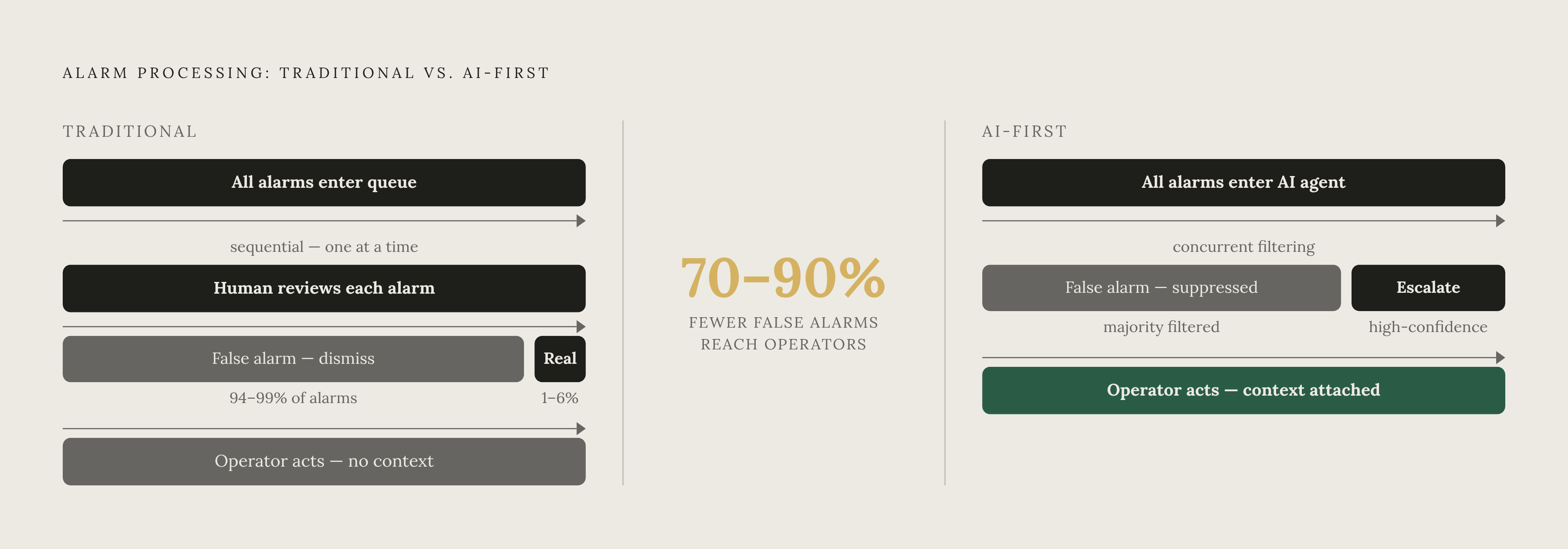
An AI-first architecture changes where disambiguation occurs. An AI agent examines alarms before a human operator receives them, dismissing events it can resolve against site-specific context and escalating those that require attention. AI analytics stacks that have been tuned can cut the false alarms that reach operators by 70–90 percent.
The agent’s role is assessment. It evaluates an alarm against information such as delivery schedules, authorized personnel, time of day, and known behavioral baselines. An escalation then reaches the operator with supporting context. The human begins with a candidate for action instead of first having to establish whether ordinary activity triggered the alarm.
Parallel processing changes the throughput constraint as well. The AI layer can assess alarms concurrently rather than depend on one person finishing an event before beginning another. People can still respond to only so much at once, and they must still judge events the agent cannot dismiss. The improvement comes from reducing the number of alarms competing for that judgment.
A real threat can then reach a person sooner. Its path no longer includes the same accumulation of routine activity that a human-first queue would require operators to clear. This also reduces the attention spent on non-events before a consequential decision. AI and human review serve complementary purposes, with the first narrowing the workload and the second determining the response.
Why site-specific context is what separates an AI filter from another source of false alarms
An AI filter without local context can reproduce the original failure. Detecting activity does not show whether it is allowed, expected, or a threat. At a loading dock, deliveries, shift changes, and normal operations all generate alarm traffic. An agent that cannot distinguish a scheduled delivery from unauthorized entry moves the ambiguity to another layer.
Relevant context includes operational schedules, authorized personnel and vehicle patterns, behavioral baselines by zone and time of day, and defined escalation protocols. These details allow the agent to compare what is happening with what should be happening. A generic motion threshold cannot make that comparison. The quality of filtering therefore depends on the configuration work.
Property layout changes what normal activity means. A commercial perimeter with a defined fence line presents different boundaries from a multifamily property with semi-public amenity zones. Residents may have legitimate after-hours access to common areas, so presence at night does not by itself establish intrusion. A useful filter must keep that distinction while spotting activity that falls outside the site’s normal patterns.
Manufacturing facilities face a similar problem because they have so many Door Forced Open and Door Held Open alarms. Delivery schedules and shift rosters can explain many such events, but without them, each signal looks like a possible intrusion. Dismissal volume alone is therefore an inadequate test. The stronger criterion is whether escalated alarms are systematically more likely to be real than dismissed alarms, without using aggressive suppression to conceal missed threats. A monitoring partner’s investment in site configuration is central to that distinction.
What verified, fast-escalation monitoring requires from the humans still in the loop
Once filtering shortens the queue, people can focus their work on the events that remain. The operator receives an event with a video clip, site-specific notes, the time of the event, and an account of what the agent observed and why it escalated. That information reduces the need to reconstruct the situation from scratch. It does not remove uncertainty. The operator still has to decide what response the evidence warrants.
Trained human judgment remains essential at that point. It combines ambiguous context with community knowledge and supports decisions that cannot be settled by recognizing activity alone. Operators also communicate with responders or property contacts in real time. Those responsibilities are different from dismissing a routine delivery alarm, and they benefit from attention that has not already been consumed by a backlog of non-events.
For time-sensitive after-hours theft or unauthorized access, a verified human decision must come quickly enough for intervention to interrupt the event. An acknowledgment records that an alarm has been touched, but it does not establish that someone has understood the threat and can act on it. The distinction belongs in the monitoring commitment. AI-assisted review workflows, timestamped escalation logs, and site-specific protocols document how the service moves from detection to judgment. They also create a record of reasonable security practice for property operators managing liability exposure.
The buying criterion follows from that architecture. A property owner should be purchasing verified threat response. The corresponding SLA is “a verified threat reaches a trained human within 90 seconds of becoming visible,” rather than an assurance that most alarms are acknowledged quickly. To meet that commitment, the workflow must remove pre-escalation delay and give usable evidence to the person who has to respond.