Throughput Limits Are the Structural Defect Legacy Monitoring Centers Were Built Around
Monitoring centers fail on response time because people review every false alarm first.
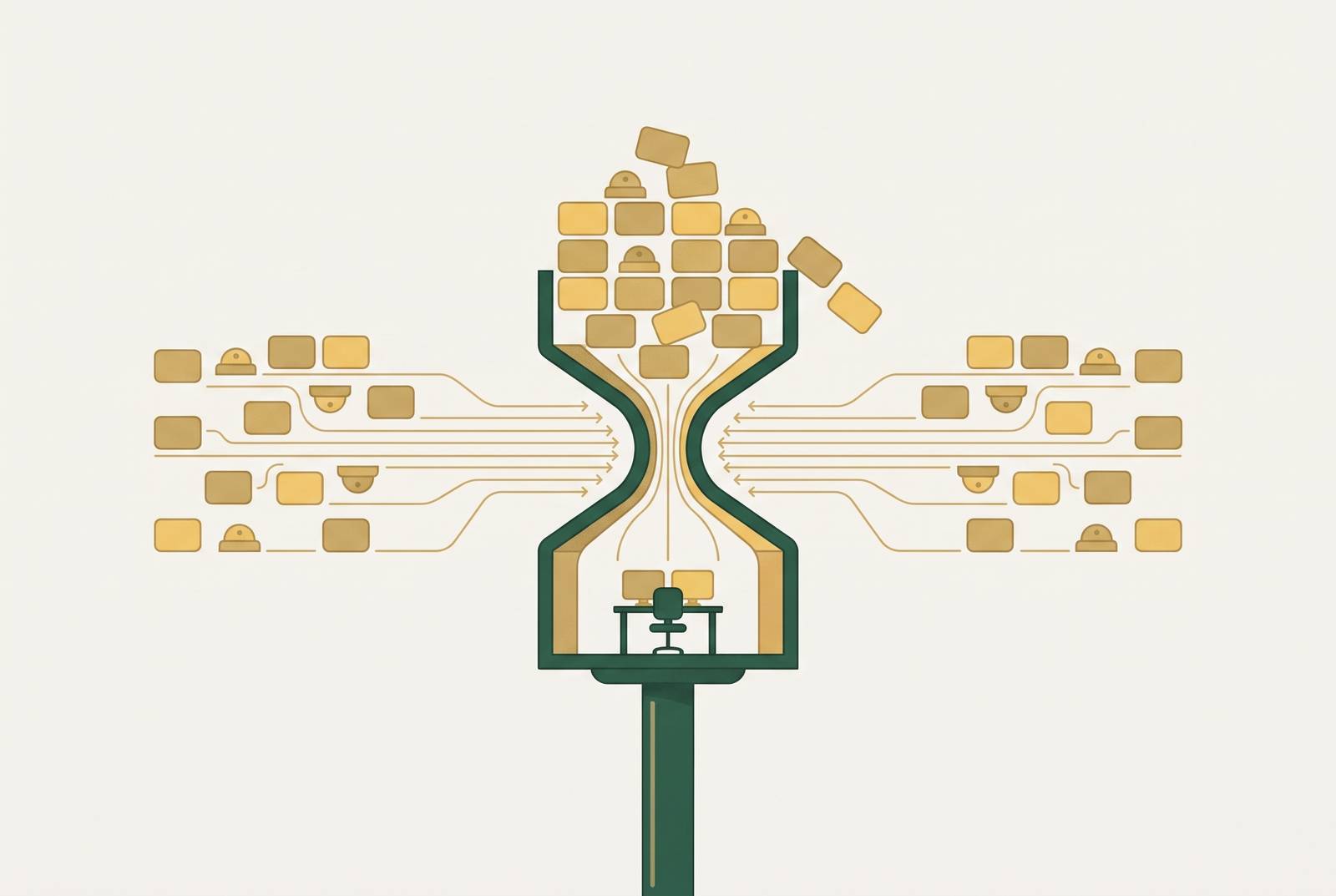
Alarm response time failure in traditional video monitoring centers begins with a structural assumption that human operators can keep pace with incoming alarms. When sensors send more noise than people can review, real threats wait behind false alarms, even if the signals arrive reliably. Correcting that failure requires verification before the human queue.
The load-bearing assumption that was always false
Traditional alarm monitoring follows a relay model. A sensor trips, a signal reaches a central station, an operator triages the event, and a responder is dispatched. Each stage passes work to the next. The operator is therefore not reviewing an isolated event but serving as the decision point through which incoming signals must pass before a response can follow.
This arrangement depends on operators clearing the queue before incoming alarms outpace their work. That assumption was false from the outset, because peak alarm volume could always exceed finite human throughput. Better staffing changes the volume a center can absorb, but it does not remove that limit. Even good technology and well-run operations can have this defect. The architecture makes response time depend on whether people can review inputs as fast as they arrive, at a rate the center cannot control.
Athenalarm’s structural analysis of monitoring service gaps identifies the monitoring chain as sequential and only as reliable as its weakest linked stage. In this model, a bottleneck at triage delays everything that depends on the operator’s decision. The center works as a relay business, even though its key step calls for judgment. False-alarm backlogs, coverage workarounds, and delayed responses are connected consequences of that mismatch.
Why sensor design guarantees noise the human queue cannot absorb
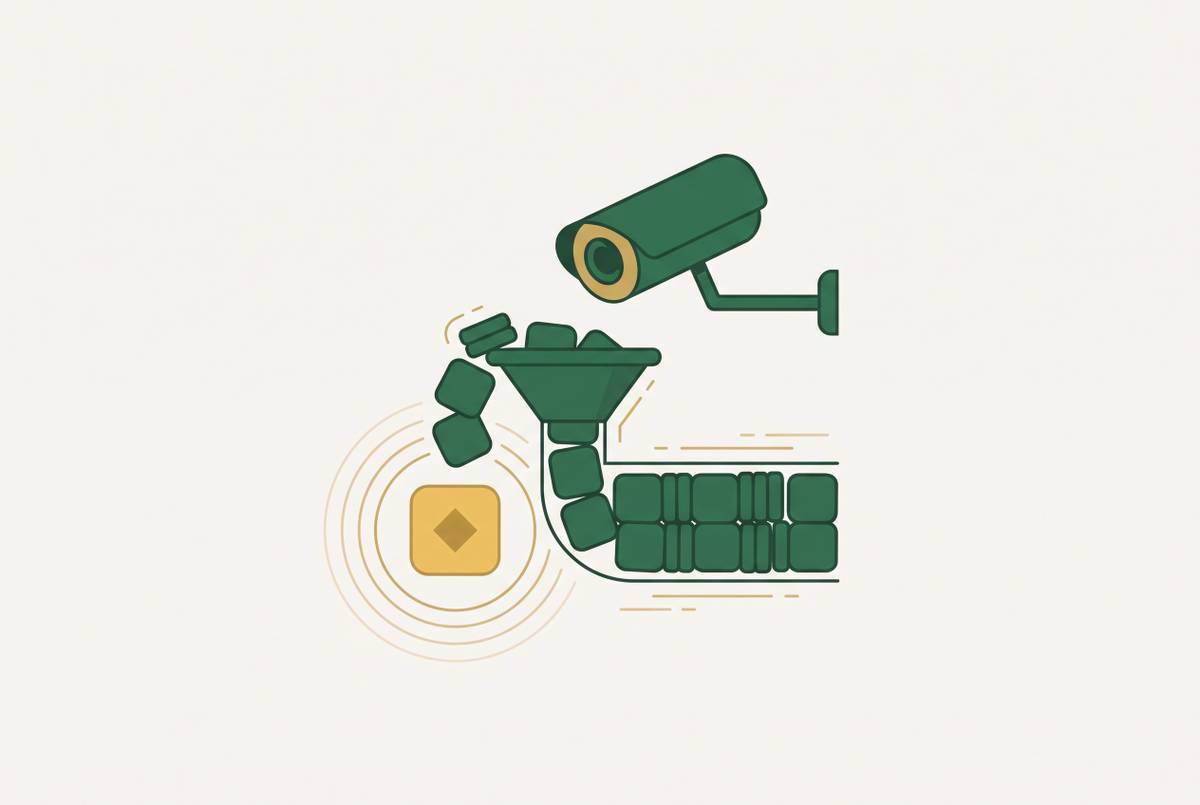
The signals entering that relay do not arrive with an explanation. A genuine intrusion, a spider crossing a lens, a pet, a shadow, or headlights sweeping a room can produce the same operational output, which is an alarm trigger. The trigger establishes that something changed while leaving unresolved whether someone needs help. That distinction is left for the operator to resolve.
A passive infrared sensor illustrates the underlying limitation. It detects changes in thermal radiation but cannot interpret the source of those changes. Its output is a voltage change that is thresholded into a trigger signal. The physics supplies detection without context. Improved hardware does not turn that sensor category into a system that understands whether the detected change represents an intrusion.
The resulting burden is a large number of unresolved questions, each occupying the same path to human review. An operator still has to look at an event before dismissing it, even when it turns out to need no response.
This is why operator speed is an incomplete explanation for a growing backlog. The queue is fed by devices whose function is to detect changes, while the center needs decisions about threats. Those are different tasks. When context-free triggers pass directly to operators, the architecture assigns the entire gap between detection and understanding to a finite human workforce.
What a queue filled with 98% noise does to the operators inside it
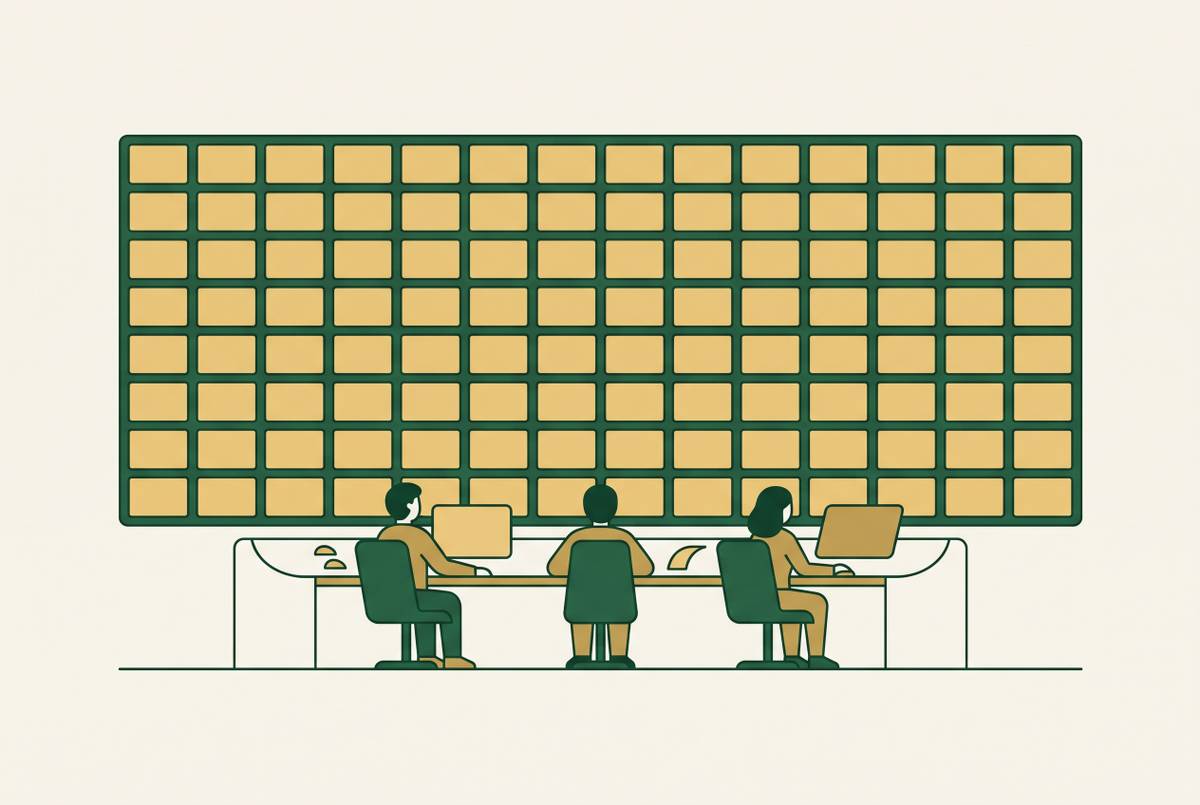
In a queue filled with 98% noise, most of the work goes into dismissing alarms. Operators look at signals again and again and find that no response is needed. That repetition changes the character of the work. The system demands sustained vigilance while continually presenting evidence that the next alarm is likely to be benign.
Alert desensitization is the behavioral consequence of that imbalance. Operators who learn that the overwhelming majority of signals are false begin treating the queue as routine. Genuine events can then receive the same processing weight as noise. This is the human cost of an environment that repeatedly asks for urgent attention without an urgent cause.
Slow throughput consequently affects more than waiting time. It also weakens the judgment the relay depends on once an event reaches the front. Burnout and desensitization contribute to high turnover in the security monitoring workforce, taking accumulated site knowledge out of the center. Edge cases become harder to interpret when the people familiar with them leave.
Centers respond by adding operators or suppressing noisier inputs. Both responses are understandable under pressure. Neither changes the reason the work is exhausting, which is that human attention remains the primary filter for a stream dominated by events requiring no action.
The three workarounds centers use and why each one trades coverage for the illusion of control
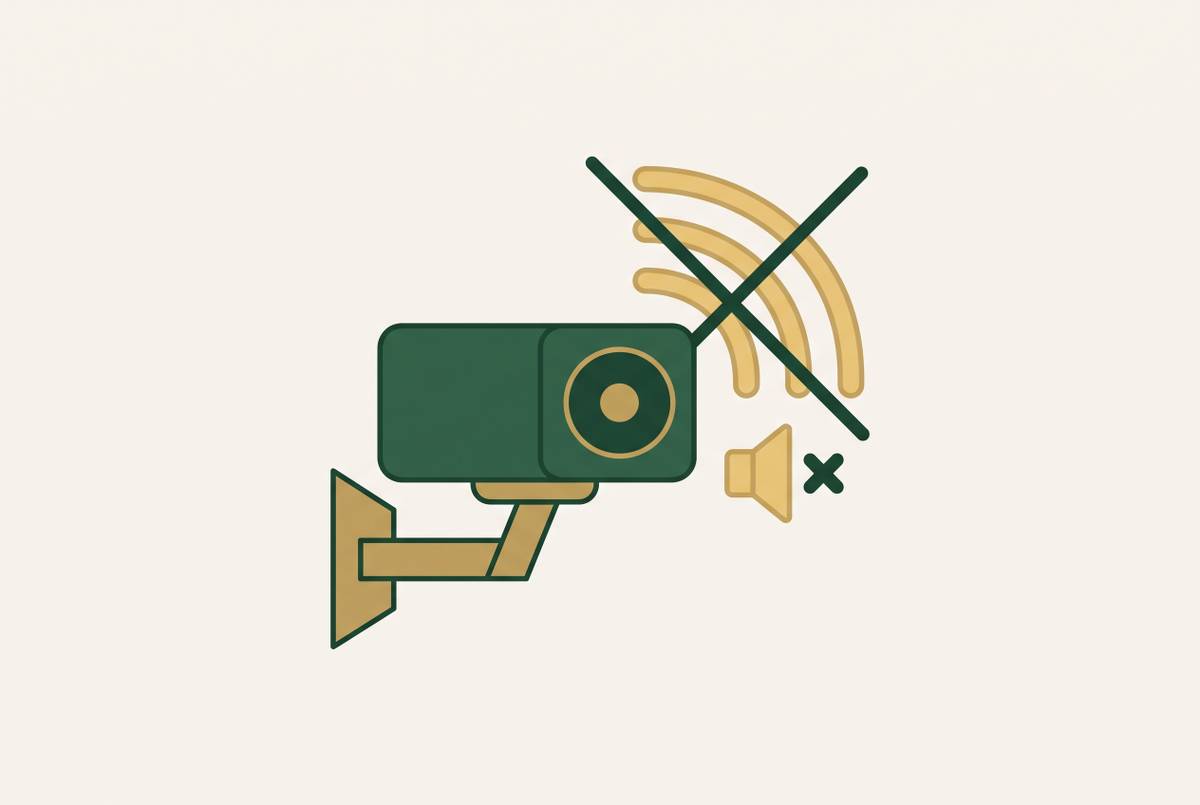
When better human performance cannot clear the backlog, centers turn to three adaptations, namely muting noisy cameras, charging alarm-volume overage fees, and adding cheaper offshore seats. These are rational responses to an impossible constraint. Each changes a visible operational burden. None changes the underlying requirement to separate real threats from noise before timely action becomes possible.
Muting cameras directly reduces the incoming workload. It also removes coverage from the zones those cameras serve, which are frequently the zones with the most exposure. Loading docks, parking perimeters, and after-hours access points can generate disproportionate activity while also being likely origins of actual threats. The center has reduced the work by excluding part of the area it was meant to protect.
When alarm volume exceeds contract thresholds, the client pays for the additional burden imposed on the center. But that payment does not classify the events waiting ahead of a genuine intrusion. The queue can remain backed up while the client pays more for the same inadequate throughput. Unlike muting, the sacrifice here is not necessarily a disabled camera, but coverage whose timely delivery remains unresolved.
Offshore staffing adds human capacity at lower cost. That can expand the volume the center processes, but the same 98% noise still reaches the review stage. Operators may also have less site-specific context and face time-zone or language gaps that slow verification. The qualification is important, because location alone does not determine operator quality. The structural limitation is that additional seats still perform the same filtering task, while any loss of context can make the consequential cases harder to resolve.
Why monitoring centers fall behind on alerts and leave a real threat at position twenty
Consider an after-hours intrusion at a truck yard gate. Its alarm enters the monitoring queue at position twenty, behind nineteen events that will turn out to be false alarms. Those earlier events may come from wind, shadows, or a cashier working late at another site the center monitors. The intrusion has reached the center successfully. What it has not reached is an operator able to recognize its significance.
In a serial review queue, that distinction determines the delay. The operator works through earlier events because their true character is not yet known either. The real threat cannot receive priority based on a classification that has not happened. Its position reflects arrival order.
Nothing in this scenario requires a failed sensor, a lost transmission, or an operator refusing to act. The relay can perform each step as designed and still deliver help too late. During high-volume periods, the incoming workload exceeds the rate at which operators can resolve it.
The consequence becomes sharper where verified response requirements apply. If the event at position twenty clears operator review only after the applicable response window has closed, it generates no police response at all. This failure is conditional on the jurisdiction’s response requirements. But it exposes the operational stakes of the queue.
Why policy-driven verification did not fix the queue and why technology pressure is the remaining lever
By requiring visual or audio confirmation before dispatch, they prevent unverified noise from automatically generating police responses. That changes the conditions for dispatch. It does not, by itself, change how much raw alarm traffic reaches the operator or how quickly that traffic can be reviewed.
A center can meet the rules by having operators check events before asking for a response. Yet those operators can still review only so much, and the same noise keeps coming in. Verification remains necessary, but verification at the dispatch boundary protects dispatch alone, while verification before the human queue also reduces the workload upstream.
The policy route also depends on consensus. Its intent is to reduce unnecessary responses, while the underlying engineering problem is how to distinguish actionable events at the rate they arrive. A rule can require a decision without supplying the capacity to make it promptly. That mismatch helps explain why policy-driven verification stalled and left the architecture’s defect in place.
Technology pressure remains because the verification task has not disappeared. If policy cannot mandate effective verification at scale, monitoring architecture must provide it before the human bottleneck. Technology must change what reaches human review.
What agentic AI does to the queue that human throughput cannot
Agentic AI addresses that requirement by placing triage before the human queue. AI agents examine every event, handling the volume they can reliably classify and directing ambiguous or high-stakes cases to operators. Humans no longer serve as the first filter for raw sensor output. Their attention is reserved for events that require judgment rather than consumed chiefly by confirming that nothing happened.
The human-in-the-loop design follows from that division of work. It is not a concession to an otherwise autonomous system. The architecture assigns repeatable filtering to AI while preserving human review where uncertainty or consequence warrants it. Its structural advantage comes from changing the queue’s composition. More human capacity can then support judgment instead of reproducing the original dismissal workload.
That advantage depends on the model’s actual performance. A model that performs well on high-resolution daylight footage may degrade on the 720p night-shift cameras covering a parking garage. A model trained on one threat type may also underperform on another. These limitations can prevent the filtering layer from sending the right events forward.
A poorly chosen model can therefore perform worse than the human queue it replaces. Instead of delaying an event behind noise, it may filter out an event that should reach an operator at all. The intervention must be assessed against that failure mode as well as its ability to reduce volume. A shorter queue is not evidence of better coverage if important events have been removed from it.
Athenalarm’s framework points to verification architecture as a key weakness in how reliably monitoring works. That framing places model fit within the service’s basic design, because the AI layer is only as strong as its performance under the footage conditions on site. The evaluation standard is therefore not perfect certainty or the smallest possible queue. It is sub-90-second human review of genuinely ambiguous events, with high-stakes cases reaching the people whose judgment the architecture is designed to preserve.