Naming the Failure Before the Industry Would Admit It Had One
Video monitoring's 98% false alarm rate was a design choice.
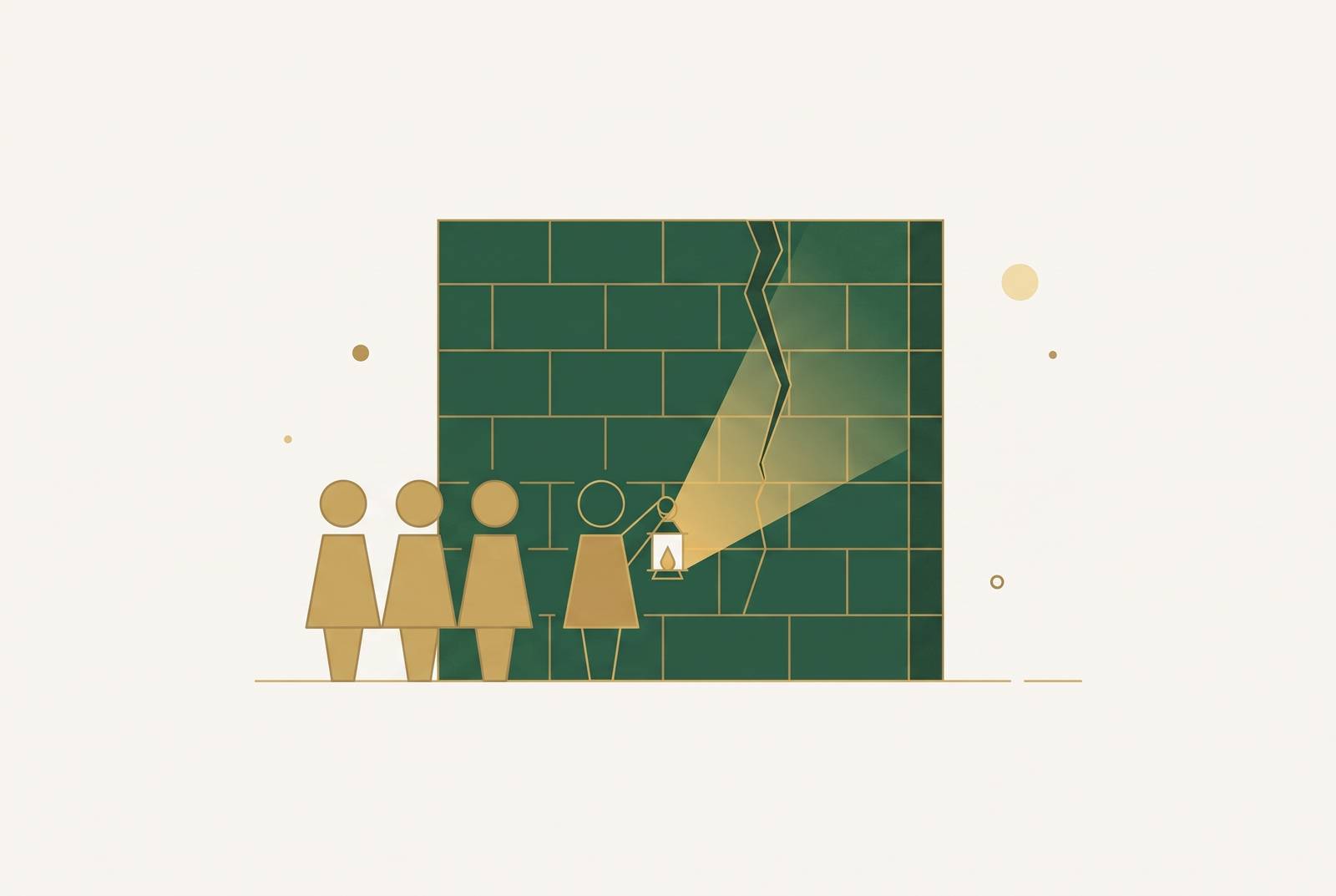
Alarm response time failure in traditional video monitoring centers begins when unverified alerts compete for human attention, leaving real incidents behind motion artifacts and routine activity. False alarm rates approaching 98% show that the system was built to pass on signals without establishing what happened. Naming that failure honestly is the prerequisite for fixing it, because the industry’s silence protected a business model whose productivity measures rewarded processing noise and left its elimination unrewarded.
The arithmetic of failure was always visible
False alarm rates approaching 98% of all activations were available in the operating arithmetic of central stations. An operator, dealer, or central-station manager did not need a new theory to recognize the imbalance between incoming signals and genuine events. The queue showed that imbalance on every shift. What required a harder judgment was whether the imbalance represented an unavoidable cost of security or a failure of the service being sold. The industry largely treated it as the former.
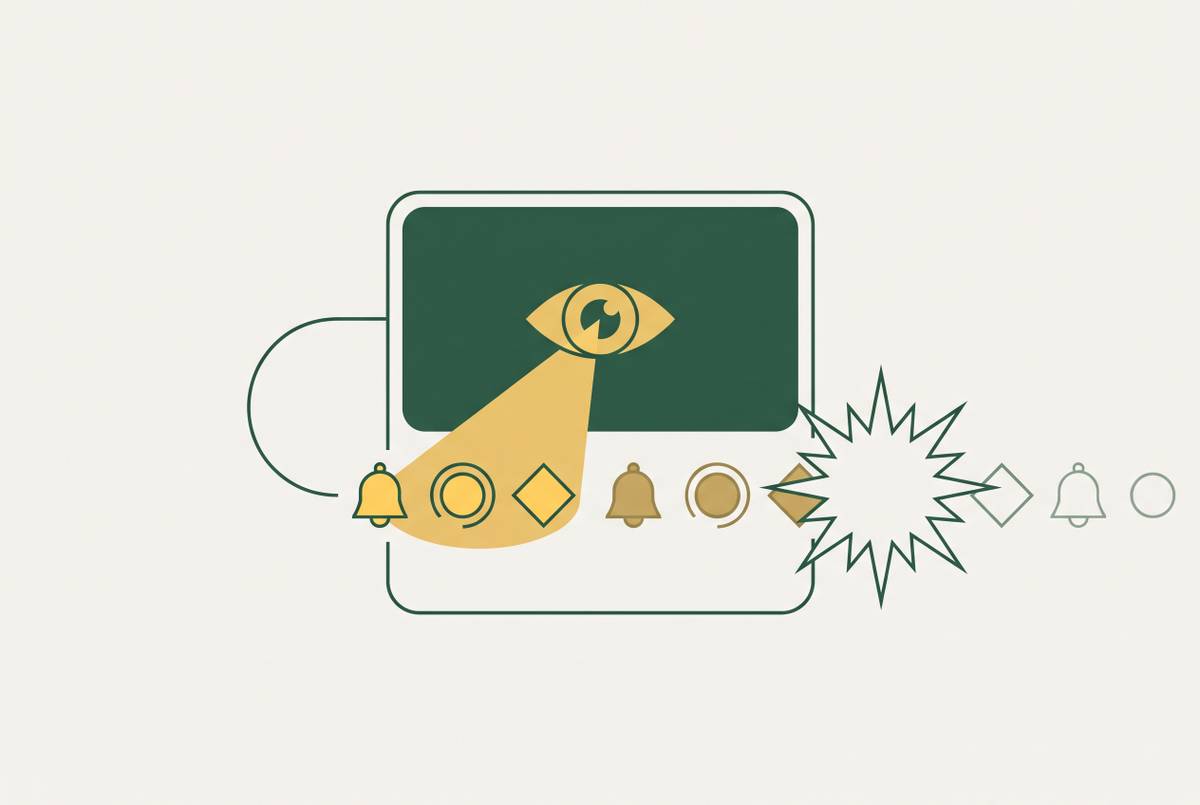
The “detect and notify” model explains why the result was predictable. A sensor triggers, a signal is sent, and a response is initiated without the context needed to establish whether anything warrants intervention. Traditional motion analytics detect movement. A flag, a headlight, rain on a lens, and an intruder can all produce the same basic instruction to a monitoring center. The system transfers the work of distinguishing them to whoever receives the signal.
Detecting movement can be technically correct while producing an alarm that has no security value. A rate approaching 98% points to more than individual sensors that need adjustment or a shift on which people did their jobs poorly. It reflects the central tendency of a model that forwards ambiguity as work. Once that work reaches a shared human queue, the consequences extend beyond nuisance alerts to the time available for genuine threats.
Why the industry never said it aloud
The industry’s silence was structurally rational from the incumbents’ perspective. That is an editorial conclusion about incentives. Dealers sold monitoring contracts measured in monthly fees, while central stations could count it as a gain in productivity when each operator handled more alarms per shift. Neither measure required the incoming alarms to be useful. Revenue and service quality pointed in different directions.
A station could improve its handling of false alarms without challenging the mechanism that generated them. Customers, meanwhile, were conditioned over decades to accept false activations as an unavoidable feature of security. That expectation protected the commercial arrangement from scrutiny. If noise was normal, dissatisfaction could be addressed through customer education and penalty avoidance while leaving the monitoring design unchanged.
False alarms nevertheless eroded subscriber confidence, creating a contradiction inside the service relationship. Customers paid for attention when something went wrong, but the operating model consumed that attention on events that did not require a response. Acknowledging the contradiction would have shifted the standard for judging monitoring from how efficiently a station processed its workload to why so much unnecessary work reached its operators at all.
Silence therefore required a commercial framework that treated the failure rate as background noise and excluded it from performance measures.
Why do traditional video monitoring centers fall behind on alerts?
That commercial framework shaped the work in the operator’s queue each day. Rain, shadows, headlights, insects, wind-moved objects, and normal staff activity arrived as events requiring attention. Each alert presented a demand without first establishing its significance. The operator had to supply the missing judgment. With real incidents mixed into that stream, the same person had to split attention between clearing routine activity and spotting a threat.
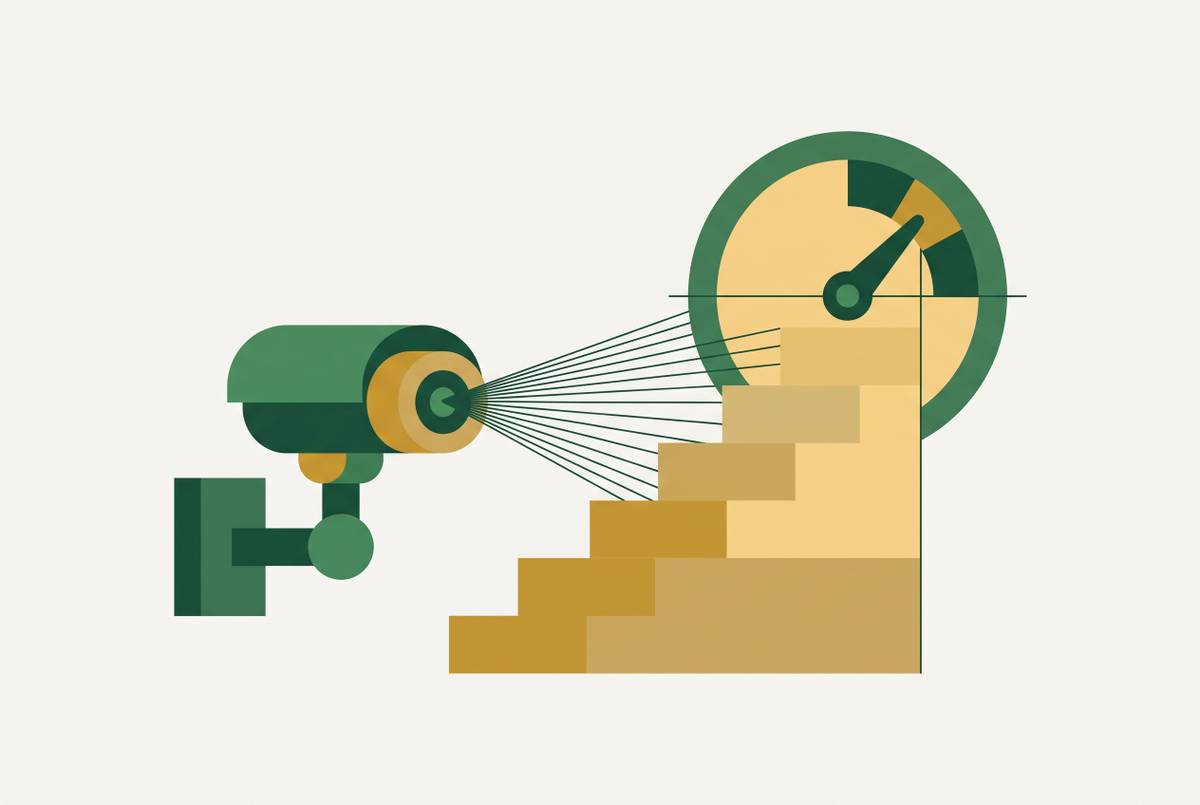
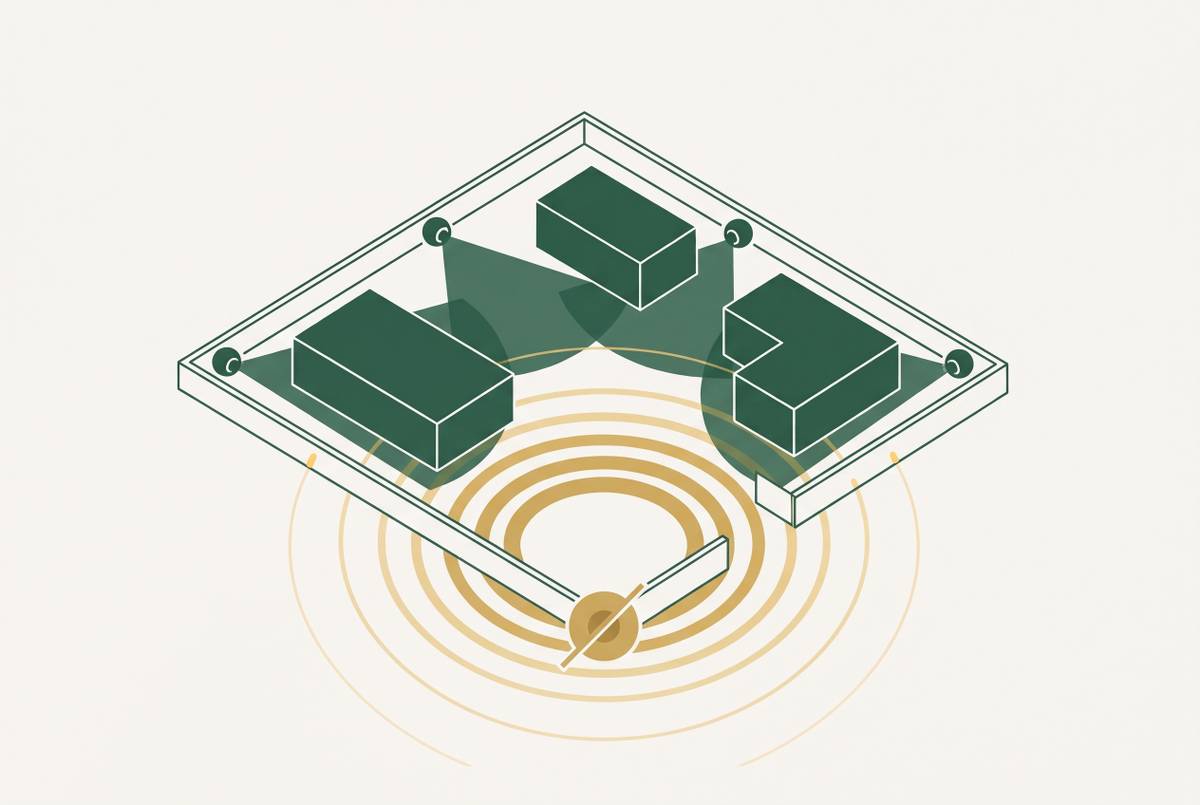
Camera growth intensified the imbalance between those demands. Sites expanded from handfuls of cameras to dozens or hundreds, while the event load per operator scaled with camera counts independently of staffing. A camera could add visibility at the site while adding delay at the monitoring center. The distinction is critical because collecting more footage does not itself create more capacity to interpret it.
When almost every alert is noise, operators begin to skim or discount events because the queue has taught them to expect that almost nothing requires intervention. This is an understandable human response to repetition. It is not evidence that operators lack commitment, nor is it a defect that training alone can remove. The architecture asks them to maintain exceptional vigilance through a workload dominated by reasons not to act.
Real events then wait in the same queue as the noise. As a busy shift continues, the probability of a miss rises while the operator’s task remains unchanged. This is how alarm overload becomes response-time failure. The system has failed to give the event timely, discriminating attention.
The external pressure that finally made the problem undeniable
The industry could treat false alarms as an internal operating burden only while others absorbed their consequences without imposing conditions. For law enforcement agencies in many cities, alarm calls made up 10–20% of total calls for service, and the overwhelming majority turned out to be false. That demand used resources outside the monitoring contract. Municipalities began returning the cost through fines and dispatch requirements, making the quality of an alarm consequential beyond the central station.
Penalties reaching into the hundreds of dollars per dispatch in some municipalities changed the customer’s position. A false alarm was no longer merely an interruption or a reason to doubt the service. It could create a direct financial liability. The distinction weakened the familiar argument that false activations were simply part of owning security equipment. Customers who paid for monitoring could end up paying again when it led to a response that was not needed.
Verified-response policies required proof that an actual crime was in progress before police could be dispatched. A monitoring service either had evidence of a real event or it did not. Signal receipt alone was no longer sufficient. Salt Lake City reported a sharp immediate reduction in alarm responses after adopting verified response, demonstrating the effect that a dispatch requirement could have on alarm traffic.
However, the policy spread to only a small fraction of U.S. law enforcement agencies, and a number of those reversed course. That limited adoption exposed the weakness of relying on regulation to repair monitoring. A dispatch rule could demand verification, but it could not perform it. The industry still needed technology that could tell genuine events from routine activity before operators and emergency services had to do that work.
What made verification technically achievable when it wasn't before
Video verification became operational as camera quality, bandwidth, and cloud processing grew reliable at scale. Real-time footage could provide evidence of whether a genuine threat was present before dispatch, rather than leaving the monitoring center with a sensor activation alone. That changed what an alarm could contain. The service could move from reporting that something had triggered to assessing what was happening at the site.
AI analytics extended that distinction beyond motion being present or absent. Systems could distinguish a person from a vehicle or an animal, assess behavior against a site’s known schedule, and correlate events across multiple cameras. Context became part of the assessment. Normal staff activity and activity outside a known schedule no longer had to be treated as equivalent merely because both involved movement.
Vision-language models could describe what happened in plain language before an operator watched a clip. An ambiguous trigger could become an evidence-rich, severity-ranked alert, giving the person receiving it more than a notification that motion had occurred. That is a different starting point for human judgment. The operator can consider an account of the event and its context rather than reconstructing everything from an undifferentiated signal.
Production footage still imposes limits that controlled benchmarks understate. Lighting, weather, occlusion, and camera angle affect accuracy, so contextual analysis cannot honestly be presented as infallible. Those limits require engineering and a place for uncertainty in the workflow. They do not justify continuing to send near-total noise to people. The gap between what technology could assess and what the legacy model chose to forward had become too wide for technical difficulty to remain a sufficient explanation.
Why adding operators was never going to close the gap
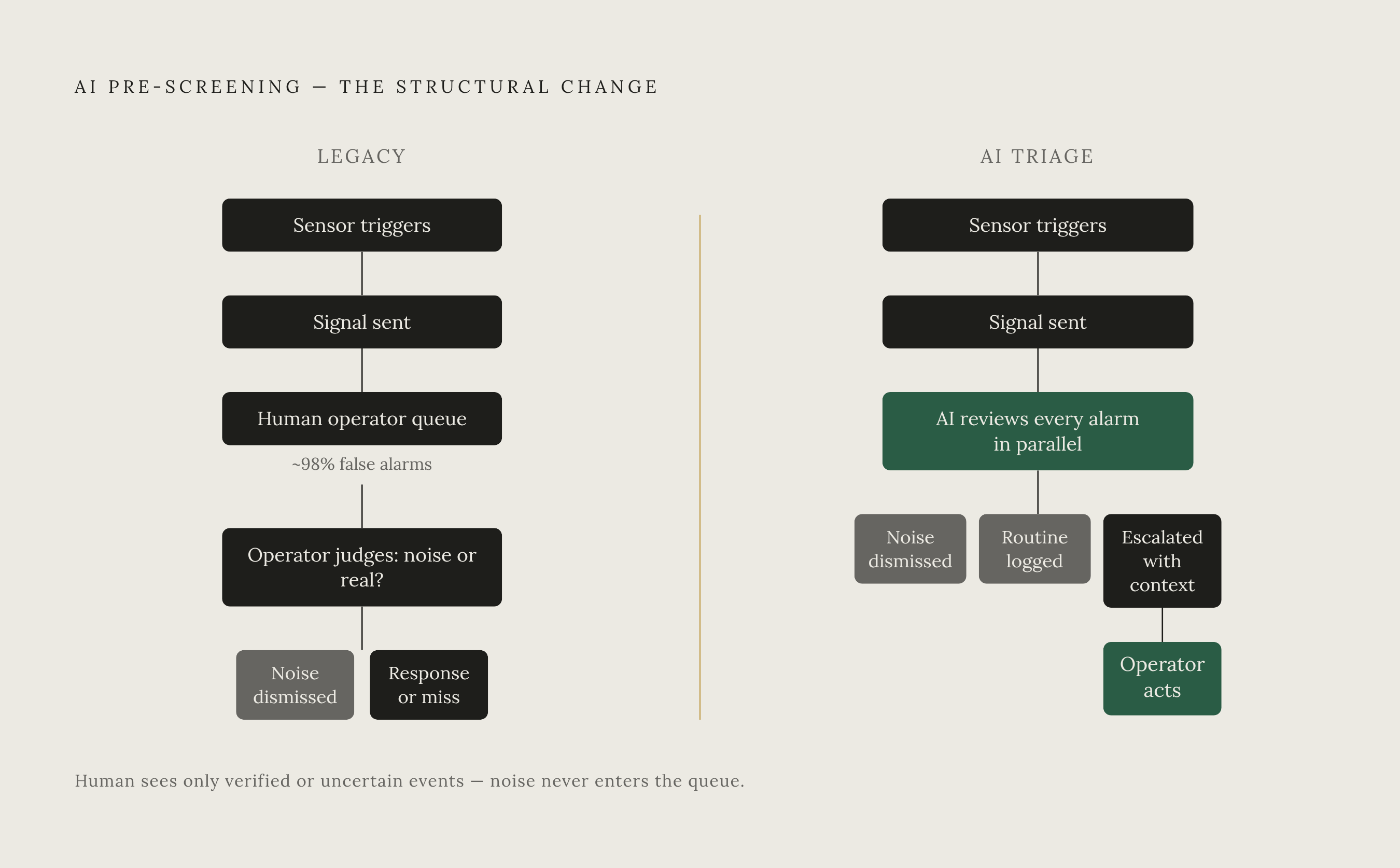
Adding operators can reduce queue depth, but it cannot change the ratio of genuine events to false alarms. An additional person entering a 98% false alarm environment inherits the same overwhelmingly unproductive workload. Staffing treats the congestion. It can provide capacity to process more alerts without improving the information contained in any of them. The architecture remains dependent on people repeatedly establishing that nothing requires action.
Human attention degrades under sustained, monotonous, high-volume alerting, even when the people doing the work are trained and conscientious. Hiring distributes that exposure across more people but does not make the pattern less corrosive to vigilance.
AI triage belongs before the human queue. AI should absorb the incoming volume, distinguish routine activity from potential threats, and surface events that are real or uncertain. Human operators then retain responsibility for judgment and action where their attention is needed. Events that remain uncertain must go through the escalation path and be kept out of automatic dismissal.
Verdun, an AI-powered remote video monitoring service, is one example of that approach, using AI agents to review every alarm from a site’s existing cameras in parallel. Its agents dismiss noise, log routine activity, and escalate anything real or uncertain to trained human operators with the context and time to act.
What naming the failure honestly changes for buyers and dealers
Asking how a provider will reduce false alarms leaves room for an answer about managing the existing queue more efficiently. Asking how an event is verified before it reaches a human tests the design itself. A second question follows directly from the limits of verification. What happens if the system misses a real event?
A verifiable false alarm rate and a human-escalation SLA provide more meaningful grounds for comparison than a general promise of attentive monitoring. They address different parts of the failure. The rate shows how much needless work enters the response process, while the SLA covers the human escalation that follows. Neither should disappear behind a claim that the system uses AI.
For dealers and integrators, that distinction offers a different way to earn recurring revenue. Monitoring with demonstrable quality gives customers a reason to retain the service beyond habit or contractual restraint. The legacy response to frustration relied on long contracts and locked panels while leaving service unimproved. AI-verified remote video monitoring offers a scalable alternative in which margin comes from service quality independently of the volume of events processed. The commercial incentive can then align with the purpose of monitoring.
The practical consequence for buyers is grounds to demand pilots and transitions on their terms. A pilot makes the proposed verification workflow, false alarm rate, and human-escalation commitment the subjects of evaluation before a longer commitment. Once the failure has been named, the purchasing process can test whether the replacement actually removes it.